A new self-paced online e-learning module will help to mainstream South-South and triangular cooperation in plans and work of the UN at the Country and Regional levels, strengthening inter-agency collaboration and accelerating results.
Why This Matters Now
The timing couldn’t be more critical. With 117 UN country teams already engaged in South-South and triangular cooperation initiatives this year, the need for standardized, accessible training has never been greater.
“Together with the Guidelines to integrate South-South and triangular cooperation in the work of the UN system at country and regional level, this E-module responds to the mandate given by Member States through the Second Committee resolutions over the last two years calling upon the UNDS to support in mainstreaming South-South cooperation in UN Sustainable Development Cooperation Frameworks and Regional Collaborative Frameworks,” said UNOSSC Director Dima Al-Khatib during the launch of the E-Module on 10 February.
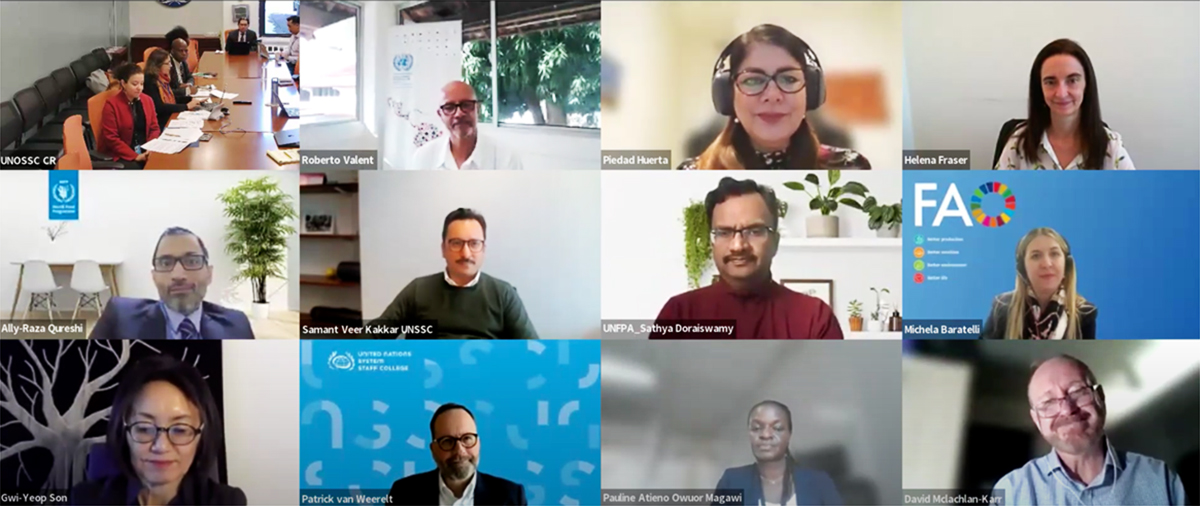
The E-Module was launched during a high-level event addressed by UN Development Coordination Office, UN Resident Coordinators, UN Country Teams, Regional Directors of UN Development Coordination Offices, UN Entities at the regional level, and Regional Commissions, E-Module UN collaborating partners, FAO, PAHO, UNFPA and WFP. It was attended by over 300 country- and regional-level UN personnel – from over 30 UN entities and 80 countries.
 A Collaborative Achievement
The e-learning module represents a unique partnership between multiple UN agencies. This new E-module was developed under the coordination of the United Nations Office for South-South Cooperation, with the guidance of the United Nations Development Coordination Office (UNDCO) and a UN task team drawn from the UN Inter-Agency Mechanism for South-South and triangular cooperation. It aims at empowering UN professionals to realize the full potential of the UN development system support to South-South and triangular cooperation.
The course – developed with the support of the UN System Staff College – received financial contributions from FAO, PAHO/WHO, UNFPA, and WFP, demonstrating the commitment of UN entities to the joint endeavor of capacity development for South-South and triangular cooperation at country and regional level.
“The practical applications to accelerate SDG progress and address national priorities are extensive,” said the UNOSSC Director. “South-South and triangular cooperation are important channels for support, partnerships, and financing as the UN system collaborates with national partners. We have integrated key resources including South-South Trust Funds, South-South Galaxy, Southern Development Banks and their financing tools, and platforms to strengthen networks between development agencies and support Voluntary National Reviews.”
A Collaborative Achievement
The e-learning module represents a unique partnership between multiple UN agencies. This new E-module was developed under the coordination of the United Nations Office for South-South Cooperation, with the guidance of the United Nations Development Coordination Office (UNDCO) and a UN task team drawn from the UN Inter-Agency Mechanism for South-South and triangular cooperation. It aims at empowering UN professionals to realize the full potential of the UN development system support to South-South and triangular cooperation.
The course – developed with the support of the UN System Staff College – received financial contributions from FAO, PAHO/WHO, UNFPA, and WFP, demonstrating the commitment of UN entities to the joint endeavor of capacity development for South-South and triangular cooperation at country and regional level.
“The practical applications to accelerate SDG progress and address national priorities are extensive,” said the UNOSSC Director. “South-South and triangular cooperation are important channels for support, partnerships, and financing as the UN system collaborates with national partners. We have integrated key resources including South-South Trust Funds, South-South Galaxy, Southern Development Banks and their financing tools, and platforms to strengthen networks between development agencies and support Voluntary National Reviews.”
A Collaborative Achievement
The e-learning module represents a unique partnership between multiple UN agencies. This new E-module was developed under the coordination of the United Nations Office for South-South Cooperation, with the guidance of the United Nations Development Coordination Office (UNDCO) and a UN task team drawn from the UN Inter-Agency Mechanism for South-South and triangular cooperation. It aims at empowering UN professionals to realize the full potential of the UN development system support to South-South and triangular cooperation.
The course – developed with the support of the UN System Staff College – received financial contributions from FAO, PAHO/WHO, UNFPA, and WFP, demonstrating the commitment of UN entities to the joint endeavor of capacity development for South-South and triangular cooperation at country and regional level.
“The practical applications to accelerate SDG progress and address national priorities are extensive,” said the UNOSSC Director. “South-South and triangular cooperation are important channels for support, partnerships, and financing as the UN system collaborates with national partners. We have integrated key resources including South-South Trust Funds, South-South Galaxy, Southern Development Banks and their financing tools, and platforms to strengthen networks between development agencies and support Voluntary National Reviews.”
UN Country Teams (UNCTs) across the globe have successfully integrated South-South and triangular cooperation into their UN Sustainable Development Cooperation Frameworks (UNSDCFs). Several countries showcase innovative approaches:
- India’s UNSDCF (2023-2027) leverages these partnerships to drive investment in research, technology, and innovation.
- China’s framework (2021-2025) places South-South and triangular cooperation at the core of its international development strategy.
- Kenya takes a quantitative approach in its 2022-2026 framework, tracking how development assistance and South-South cooperation benefit vulnerable populations through dedicated budget indicators.
- Rwanda’s UNSDCF (2018-2024) focuses on regional cooperation to foster peace and sustainable development.
- Saudi Arabia’s framework (2022-2026) emphasizes capacity-building in developing nations through various partnership models, including North-South and South-South cooperation.
- Egypt’s UNSDCF (2023-2027) takes a comprehensive approach, promoting regional integration, South-South trade relationships, and knowledge exchanges to enhance its business ecosystem and drive sustainable industrialization and job creation.
Objectives:
Upon successful completion of this module, the participants will:
A demo of the E-Module was provided by Samant Veer Kakkar, Instructor, UN System Staff College.
- Gain an understanding of the concept and principles of South-South and triangular cooperation and the knowledge and skills needed to effectively support national partners to leverage South-South and triangular cooperation to accelerate progress towards the SDGs and national priorities.
- Get familiarized with the practical application of the Guidelines for the Integration of South-South and triangular cooperation into the Country- and Regional-level Work of the United Nations Development System.
Watch the recording of the launch of the e-learning module:
Roll-out of the E-Module: Panel Discussion UN Collaborating partners A panel discussion among UN collaborating partners focused on plans for rolling out the E-Module at the regional and country level. “We recognize South-South cooperation as a strategic catalyst for advancing the food security and nutrition agenda,” said Ally-Raza Qureshi, Director, WFP Global Office in New York. “We have been engaged throughout this process so that we can ensure that our own staff understand how they can best leverage this to tailor our response at the country level… As we roll out this E-Module our focus is going to be on disseminating successful South-South corporation initiatives, and identifying scalable approaches to ensure that the most vulnerable populations benefit from these shared experiences and best practices.” “South-South cooperation and triangular cooperation is fundamental to expedite the exchange of experiences and best practices among countries, and the UN system plays a major role,” said Piedad Huerta, Head of Country and Subregional Coordination, PAHO/WHO, noting that an information bulletin about the E-Module has already been distributed to all staff requesting that training be included as part of their personal development plans. “For the Pan American Health Organization, South-South and triangular cooperation is critical to address common health challenges through effective sustainable and equitable solutions to promote collaboration among countries, and the exchange of knowledge and experiences to accelerate progress of the sustainable development goals as well as national development priorities, in particular in our case, health for all.” “At UNFPA we position South-South cooperation not only as a mode of engagement in how we work with partner countries, but also as an accelerator for results. As such South-South cooperation is mainstreamed in our planning processes, that is in our country program documents, as well as in program implementation, monitoring and evaluation,” said Dr. Sathyanarayan Doraiswamy, Chief, Quality Programming Branch, UNFPA. “This E-Module will become a crucial part of our set of interventions in raising UNFPA staff capacity in South-South cooperation. We will place this course on the learning management system where it can be accessed by all UNFPA personnel.” Country officers who are contributing the to the UNSDCF processes will also be encouraged to use this set of learning materials to prepare them on how to engage with governments and other national partners. “We need to create enabling environments for future South-South and triangular corporation partnerships,” said Michela Baratelli, Programme Officer/Communications Coordinator, South-South and Triangular Cooperation Division, FAO. “FAO plans to make effective use of this e-learning module in multiple ways. Firstly, we will encourage our South-South and triangular cooperation focal points in the regions – our key players in mainstreaming South-South and triangular cooperation – to really advocate for this important tool.” FAO will also launch its new revamped SSC Gateway platform, where the new E-Module will be utilized to further promote, scale-up and mainstream South-South development cooperation with partners and stakeholders.” Looking Forward: Interventions by DCO Regional Directors, RCs and Regional Commissions An open discussion on the roll-out of E-Module was moderated by Roberto Valent, Regional Director, Regional Office for Latin America and the Caribbean, UNDCO. Reflections from regions and the country level were welcomed. “South cooperation is more relevant than ever, with Member States increasingly relying on it to mobilize knowledge expertise and resource processes,” said Roberto Valent. “But also, South-South cooperation is a system that is embedded in common country assessments, common analytical frameworks, and planning UN Sustainable Development Cooperation Frameworks – making South-South cooperation a vital mechanism to advance Agenda 2030.” “South-South and triangular cooperation is no longer an option it’s actually a critical driver for development cooperation,” said David Mclachlan-Karr, Regional Director, Regional Office for Asia and the Pacific, UN Development Coordination Office. “Countries in our region, as they graduate from LDCs to middle income to higher income really are increasingly turning to South-South and triangular cooperation for technology transfer, knowledge sharing, innovative financing, and upstream policy advice – particularly in climate action, disaster resilience, digital transformation, public health, and food systems, among others.” The opportunities presented in the E-Module are key to strengthening institutional support for South-South cooperation at the country level, but also very importantly at the regional level, he said, noting that Resident Coordinators and UNCTs across the region don’t want to just receive development support, but they want to share their own successes and co-develop solutions with partners facing similar challenges. “This E-Module is particularly timely in our region, Europe and Central Asia, because we are rolling out 12 Cooperation Frameworks,” said Gwi-Yeop Son, Regional Director, Regional Office for Europe and Central Asia, UN Development Coordination Office. “It will definitely reinforce and strengthen mainstreaming South-South and triangular cooperation into the cooperation frameworks, and further highlight SDG17 on partnership which will have multiplier effects across all the SGS.” “In 2025 we have 10 countries that are designing cooperation frameworks, they are now at the strategic prioritization phase, and we also have an additional 13 country teams that will be designing their cooperation frameworks in 2026 – we see these as an entry point for collaboration,” said Pauline Magawi, Senior Regional Coordination Officer, Regional Office for Africa, UN Development Coordination Office. “In this regard, we are also seeing an increased number of agencies, funds and programs reporting the need to integrate South-South and triangular cooperation in their agency-specific programming instruments, which in most cases are derived from the cooperation framework.” “The timing of this E-Module is perfect for us because we are just finalizing our road map for what will become our new cooperation framework (2027 to 2031),” noted David Joy, on behalf of Mohamed El Zarkani, UN Resident Coordinator, Saudi Arabia. “We are very much looking forward to starting now, as early as possible, to building the principles and concepts of South-South and triangular cooperation into our processes from now.” He encouraged consideration of an annual joint UNOSSC UNDCO briefing, with all of the country teams who are starting their UNSDCF formulation process that year. “We at the UN in India have really embraced the South-South cooperation dimension as a core offer of our collective engagement with India,” said Shombi Sharp, UN Resident Coordinator, India. “India wants to strengthen its voice on behalf of the Global South, in part by sharing best practices of India’s SDG journey for others – and this is based on demonstrated solutions at enormous scale.” He noted that South-South cooperation is an explicit strategic priority in the cooperation framework (2023-2027). “In the roll out of this E-Module, we can strategically work together to maximize impact by targeting key decision makers who play a critical role in embedding South-South cooperation across the entities, aligning with regional priorities,” said Thilmeeza Hussain, Director, Regional Commissions New York Office, emphasizing that the success of the E-Module moving forward will depend on how well we embed it into our work, making it useful tool for Resident Coordinators, UNCTs and regional commissions. This dialogue underscored the evolving nature of South-South and triangular cooperation. From Latin America to Asia-Pacific, from Europe to Africa, regions have emphasized its growing significance in achieving the SDGs. With continued engagement from Resident Coordinators and Regional Offices, this tool promises to transform how countries share knowledge and build partnerships to tackle shared challenges.