LDCs Need Support From All Partners to Build an Inclusive and Sustainable Future
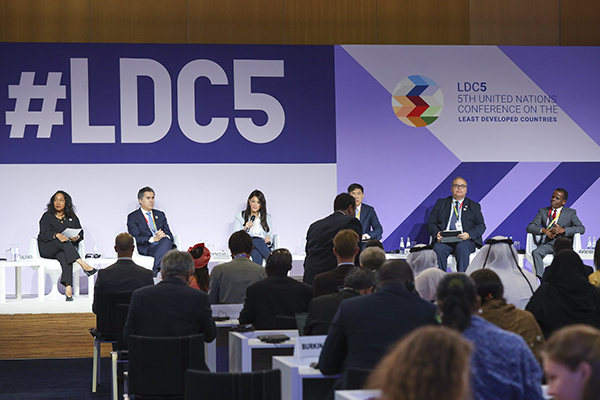
7 March, DOHA – A ministerial meeting on South-South cooperation was convened alongside the Fifth UN Conference on the Least Developed Countries (LDCs) to explore concrete, innovative and actionable solutions in support of the deliverables of the Doha Programme of Action for the Least Developed Countries (DPoA). The meeting focused on the theme ‘Renewed partnerships for actionable solutions in support of implementation of the DPoA’. It was organized by United Nations Office of the High Representative for LDCs, LLDCs and SIDS (OHRLLS), the State of Qatar (host country) and Malawi (Chair of LDCs), in collaboration with the United Nations Office for South-South Cooperation (UNOSSC).
Welcome remarks were provided by H.E. Ms. Rabab Fatima, Under Secretary-General and High Representative for LDCs, LLDCs and SIDS. “Implementation of the DPoA is a common endeavour,” she said, “The DPoA contains deliverables to narrow development gaps and to maximize potential.”
“Today we have a unique opportunity to prove our commitment towards cooperation and multilateral work supporting the LDCs,” H.E. Dr. Saleh Bin Mohammed Al Nabit, President of the Planning and Statistics Authority of the State of Qatar, said in a special address. He noted that Qatar is committed to enhancing cooperation among Southern countries to ensure support of joint interests, in line with the belief that challenges faced by these countries makes cooperation and collaboration and solidarity vital.
In his opening remarks H.E Mr. Rodrigo Malmierca Díaz, Minister of Foreign Trade and Foreign Investment of the Republic of Cuba (Chairman of the Group of 77 and China), said that “The Group is convinced that international cooperation among developing countries in addition to North-South cooperation is an effective instrument for optimizing our potential to promote development through sharing of knowledge, ideas, technical advances, skills and expertise across a broad range of sectors.” LDCs, he said, should be placed at the center of international cooperation toward fostering the prosperity and wellbeing of their populations.
“Together let’s bring the Doha Programme of Action to life, through new South-South solutions and triangular cooperation,” said H.E. Ms. Amina J. Mohammed, Deputy Secretary-General of the United Nations, in her message to the meeting. “Let’s deliver the greener, more productive, more inclusive, more resilient, and prosperous future that all people deserve everywhere.”
H.E. Santiago Andrés Cafiero, Minister of Foreign Affairs, International Trade and Worship of Argentina, (President of the High-level Committee on South-South Cooperation), in his message to the meeting noted that many developing countries play a fundamental role in supporting LDCs through South-South cooperation. It is encouraging, he said, to see how, “during trying times, we, Southern countries continue sharing best practices, supplies and humanitarian aid.”
A moderated fireside chat on how to reinvigorate South-South and triangular cooperation for actionable solutions in support of implementation of the DPoA followed the opening session.
H.E. Mr. Dee-Maxwell Saah Kemayah Sr., Minister of Foreign Affairs of Liberia, emphasized that the main challenge experienced is not having sufficient financing in order to fund the ambitious goals we have to expand South-South cooperation.
H.E. Dr. A.K. Abdul Momen, Hon. Foreign Minister of Bangladesh, said that “we should do a soul searching as to why under the present international financial mechanism and trade regime we are failing to achieve our goals.”
Her Excellency Ms. Tanja Fajon, Deputy Prime Minister and Foreign Minister of Slovenia, said that “all crisis affect us all”. “We all have something to bring to the table,” she said, noting that “South-South cooperation has a vital role in helping developing countries build collective self-resilience, and build more sustainable and equitable economic growth.”
The Rt. Hon. Patricia Scotland, Secretary-General of the Commonwealth, said that “we are facing a poly crisis, and this crisis is affecting LDCs and SIDS most exponentially.” She also highlighted the achievements of the India-UN Development Partnership Fund as an example success in the Commonwealth.
The Hon. Dr. Rajkumar Ranjan Singh, Minister of State of External Affairs and Education of India, said that we must mobilize international solidarity, a vibrant global partnership and innovative tools and instruments towards the high ambition of sustainable graduation of LDCs. “This will play a pivotal role in the achievement of the sustainable development goals,” he said. “We want to see developing and Least Developed Countries play a greater role in determining our shared future.”
Her Excellency Ms. Armida Salsiah Alisjahbana, Under Secretary-General, Executive Secretary of the Economic and Social Commission of Asia and the Pacific of the United Nations, said that the development landscapes have changed, many developing countries in the region have become active development partners – among them China, India, Turkey, Kazakhstan, Thailand and Indonesia. She highlighted the successful convening of the 2022 Global South-South Development Expo in the region, as well as the annual Asia-Pacific Directors General for Development Cooperation Forum.
Mr. Jin Liqun, President of the Asian Infrastructure Investment Bank, noted that the Bank has 106 members, where developing countries are the majority shareholders. All the efforts of the Bank are demand driven, he said.
The moderator, H.E. Dr Abdou Rabiou, Minister of Planning of the Republic of Niger, gave the floor to Ms. Dima AI-Khatib, Director, United Nations Office for South-South Cooperation. Ms. AI-Khatib emphasized that all partners have a stake and role to play in the successful implementation of South-South Cooperation. She noted that the UN Agencies continue to support Member States to implement South-South cooperation in line with the recommendations of the Buenos Aires Plan of Action for Technical Cooperation among Developing Countries and the subsequent conferences and summits.
Ms. Chee Yoke Ling, Executive Director, The Third World Network, said that the principle of solidarity underlies South-South cooperation. She recalled that all speakers at the meeting have emphasized the importance of finance.
Delegates of the Morocco; Republic of Sudan; Timor-Leste; Sierra Leone; Republic of Indonesia; the Organisation of African, Caribbean and Pacific States; OPEC Fund for International Development; Islamic Development Bank; and the World Bank Group also addressed the meeting.
Following the fireside chat, a panel discussion took place, moderated by H.E. Dr. Rania Al-Mashat, Minister of International Cooperation of the Arab Republic of Egypt. The panel focused on accelerating South-South and triangular cooperation to recover from the impacts of the ongoing crises, building resilience and accelerating the implementation of the DPoA.
Ms. Pamela Coke-Hamilton, Executive Director of International Trade Centre, said that fresh thinking is needed. She emphasized the need for private sector-led South-South investment that follows government enabled policies.
H.E. Mr. Aurélien Agbenonci, Minister of Foreign Affairs and Cooperation of Bénin, said that unfortunately funds are often given for short-terms, when in fact what is needed is long-term transformative financing.
H.E. Mr. Francisco André, Secretary of State for Foreign Affairs and Cooperation of Portugal, emphasized that “we are living in turbulent times with interlinked crises that transcend all our borders, and these require us to think and act in different new modern approaches.” South-South and triangular cooperation deliver high-impact results in supporting the delivery of the SDGs, he said, through forging of strategic and inclusive partnerships that are demand-driven and context specific.
Mr. Haoliang Xu, Assistant Administrator and Director of the Bureau for Policy and Programme Support of United Nations Development Programme, said that “for development, we must come together, we must commit to this new era of multilateralism”. He encouraged Member States to make best use of UN capacities on the ground, noting the important role of UNOSSC as an available resource in this regard.
Mr. Máximo Torero, Chief Economist of FAO, said that international financial institutions should have dedicated offices focusing on South-South cooperation, so that we can learn from successes in a “lab of best practice”. The logic is not just financing, he explained, it also involves human capital, technology and knowledge. “Every agent has to play a role,” he emphasized.
Mr. Antonio Pedro, Acting Executive Secretary, Economic Commission for Africa of the United Nations, said that structural transformation is key for African LDCs. He noted opportunities for South-South cooperation to contribute to sharing of human capital, to building carbon credit markets, and optimizing the African Continental Free Trade Area.
Delegates of Burundi, Burkina Faso, Lesotho, Ghana, African Union Commission, Technology Bank for the Least Developed Economies, Togo, Madagascar, OECD Development Centre, Singapore, Lao People’s Democratic Republic, International Telecommunication Union, Côte d’Ivoire, Paraguay, Nepal, The Philippines, Tunisia, Thailand, and Ukraine also addressed the panel.
The Hon. Sosten Gwengwe, M.P., Minister of Finance and Economic Affairs of Malawi (current Chair of the LDC Group); and Ms. Dima AI-Khatib, Director, United Nations Office for South-South Cooperation closed the meeting. Click here to read the UNOHRLLS page covering South-South cooperation at LDC5.
Read more: