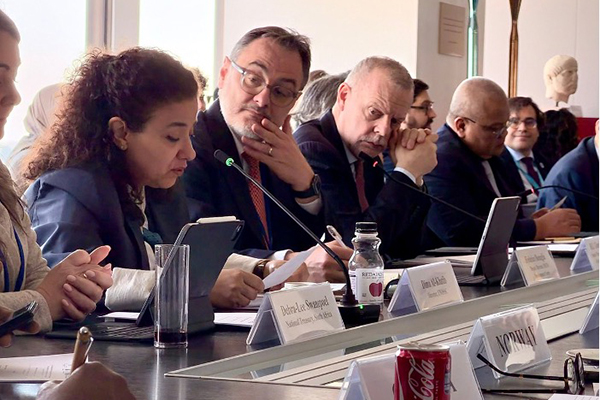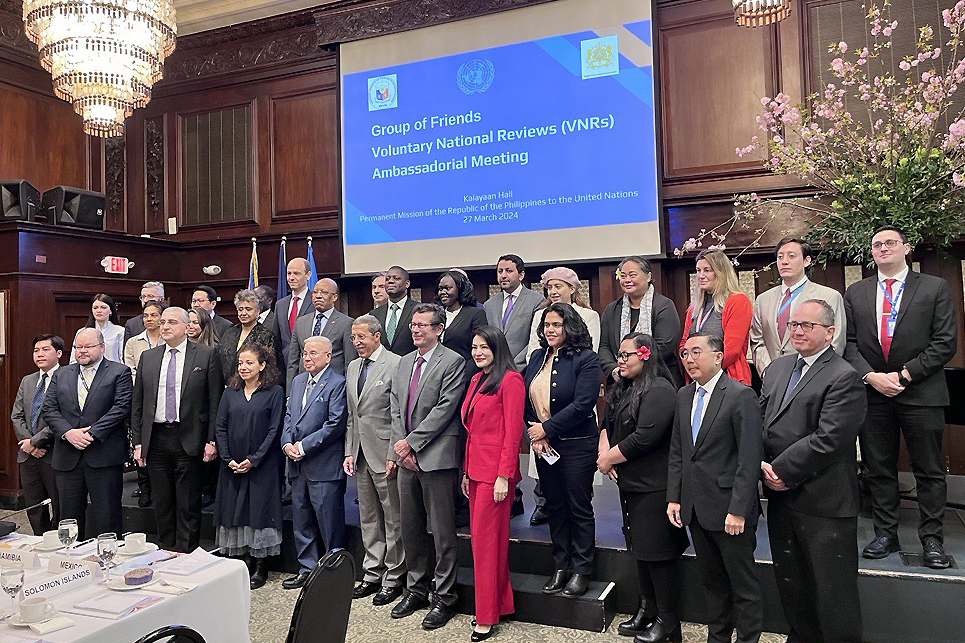
A meeting of the Group of Friends of Voluntary National Reviews (VNRs) of SDG Progress was convened at the Mission of the Philippines to the UN on 27 March.
The meeting was co-organized by the Co-Chairs of Group of Friends of the VNRs – the Permanent Mission of Philippines to the UN and Permanent Mission of Morocco to the UN – to assist 38 Member States in integrating South-South and triangular cooperation in the preparation of their VNRs for presentation during the ECOSOC High Level Political Forum of 2024.
“At this mid-point in our work toward the goals of the 2030 Agenda for Sustainable Development, it has become clear that we will need urgent and additional efforts to accelerate progress,” said UNOSSC Director Dima Al-Khatib. “As evident during COVID-19 response and recovery, South-South cooperation can make a meaningful difference in building back better. Solutions and innovative strategies originating in the South are delivering lasting results around the world… South-South and triangular cooperation – among countries facing similar challenges – can be a valuable catalyst in igniting political will and enhancing know-how to implement much needed economic and social reforms needed to rescue the SDGs.”
Member States, in the BAPA+40 Outcome Document of the Second High-level United Nations Conference on South-South Cooperation, amongst others, have recognized the importance of leveraging South-South and triangular cooperation in the implementation the 2030 Agenda for Sustainable Development, and toward achieving the overarching goal of eradication of poverty in all its forms and dimensions.
The Permanent Representatives of the Philippines and Morocco, the Permanent Representative of Croatia to the UN and ECOSOC Vice-President, and the Acting Director for the Office of Intergovernmental Support and Coordination for Sustainable Development at UN DESA, also addressed the meeting.
We have seen that countries are increasingly integrated South-South and triangular cooperation during the preparation and presentation of their Voluntary National Reviews of SDG progress, said UNOSSC Director Dima Al-Khatib, including through twining to facilitate the sharing of experiences, best practices, lessons learned; and the mobilization of multi-stakeholder support and partnerships with the view to accelerate development impacts.
For example, South-South and triangular cooperation has been incorporated into the National Development Plan of Colombia. The Colombian Government’s roadmap has provided spaces and mechanisms that facilitate the interaction and articulation of actors for the fulfillment of the SDGs. One of these mechanisms is the SDG Corporate Tracker, an initiative that seeks to measure the progress of the private sector towards the SDGs, and which to date has 12 implementing partners and more than 600 reporting companies.
Within its 2020 VNR, Uganda highlighted data on South-South and triangular cooperation support from different partner countries including China, Republic of Korea, Saudi Arabia and Kuwait.
Taking a peer-to-peer learning approach, experts from the Austrian Parliamentary Administration teamed up with their Zambian National Assembly counterparts focusing on strengthening democratic institutions, including programmes tailored specifically for school children.
In Mongolia, Tajikistan, and Uzbekistan, ESCAP began its first triangular cooperation initiative in 2022 in relation to voluntary national reviews. Building on lessons from previous twinning arrangements, ESCAP proactively sought to convene twinning around key reforms and good practices that the countries identified that they would like to share and learn about. Government officials and key stakeholders from the three countries were able to exchange good practices in relation to social policy reforms, data analysis, and stakeholder engagement in addition to sharing lessons from the review process. Stakeholders included civil society, private sector, and parliamentarians.
Collaboration between Georgia and Uzbekistan through twinning has helped both countries to exchange and learn from each other’s institutional structures and reform agendas. Through two study tours to both countries, country representatives explored each other’s institutional structures and reform agendas. Since the Government of Georgia was conducting its review for the second time, it was able to share with Uzbekistan its experience of utilizing the VNR to advance social policy reforms. By including civil society, the media, and oversight institutions such as parliaments in the review and twinning process, Georgia was able to highlight to Uzbekistan these stakeholders’ important role in monitoring the goals.
Similarly, Denmark is involved in peer review collaboration on VNR with Norway and Kenya, which involves exchanging knowledge and reviewing draft VNR reports.
The meeting provided an important opportunity for the 2024 VNR presenting countries to receive guidance on key elements to be considered; on how they may partner with other countries for peer review/collaboration; and on what support is available from the UN system for the preparation and presentation of their VNRs.
It was also noted that as a concrete follow-up to requests of Member States in the 2022 High-level Political Forum on Sustainable Development Ministerial Declaration and the latest UNGA Resolution on South-South Cooperation; UNOSSC in collaboration with the Co-chairs of Group of Friends of VNRs, Member States and other stakeholders has prepared a handbook to support the Member States and partners in integrating South-South and triangular cooperation in VNRs. This handbook complements the existing UN DESA VNR Handbook and other VNR Resource Packages, providing step-by-step guidance.