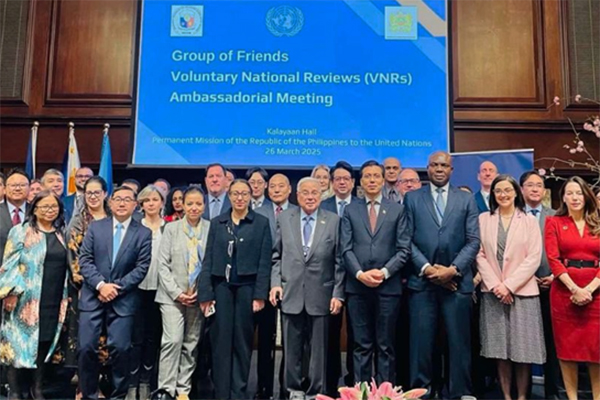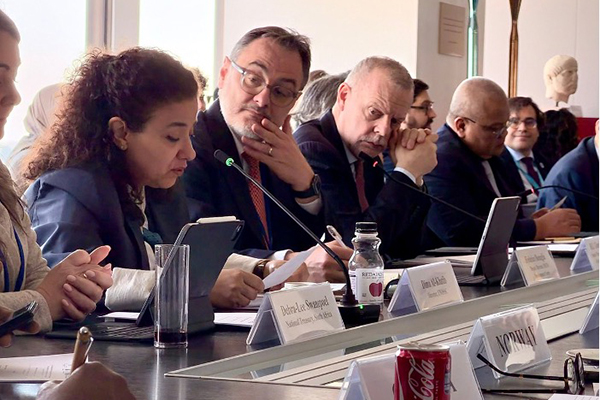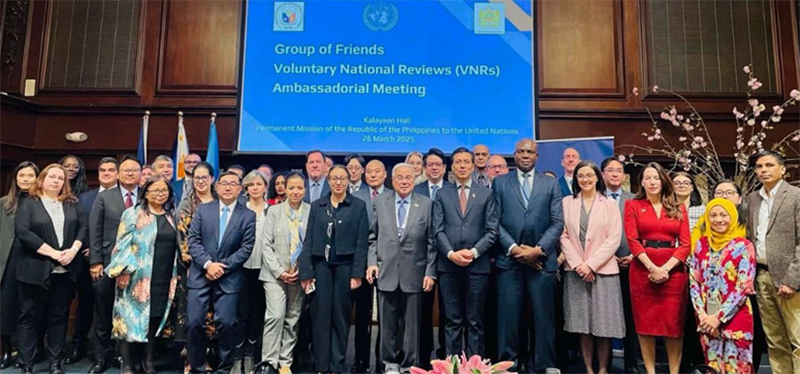
An ambassadorial meeting of the Group of Friends of Voluntary National Reviews (VNRs) of SDG Progress was convened at the Mission of the Philippines to the UN on 26 March.
The meeting was co-organized by the Co-Chairs of Group of Friends of the VNRs – the Permanent Mission of Philippines to the UN and Permanent Mission of Morocco to the UN – to assist Member States in integrating South-South and triangular cooperation in the preparation of their VNRs for presentation during the ECOSOC High Level Political Forum of 2025.
“VNRs are not only reports. They need to be appreciated as extremely rich sources of experiences and learnings for all countries in their journey to sustainable development, pursuant to their national needs and priorities,” said Ambassador Antonio M. Lagdameo, Permanent Representative of Philippines to United Nations.
“At the halfway point in our journey toward achieving the goals of the 2030 Agenda for Sustainable Development, it is evident that urgent and intensified efforts are needed to speed up progress,” said UNOSSC Director Dima Al-Khatib. “Current progress falls far short of what is required to meet the Sustainable Development Goals (SDGs) – only 17 per cent of the SDG targets are currently on track, with nearly half showing minimal or moderate progress, and over one-third stalled or regressing.”
The Permanent Representative of Nepal to United Nations, ECOSOC Vice-President; the Deputy Permanent Representative of Morocco to United Nations; and DESA Director of Office for Intergovernmental Support and Coordination also addressed the meeting.
Solutions and innovative strategies developed in the Global South are producing lasting and impactful results worldwide.
Member States, in the BAPA+40 Outcome Document of the Second High-level United Nations Conference on South-South Cooperation, amongst others, have recognized the importance of leveraging South-South and triangular cooperation in the implementation the 2030 Agenda for Sustainable Development, and toward achieving the overarching goal of eradication of poverty in all its forms and dimensions.
“Countries are increasingly integrating South-South and triangular cooperation into the preparation and presentation of their Voluntary National Reviews (VNRs) on SDG progress,” said UNOSSC Director Dima Al-Khatib, “This includes initiatives such as twinning arrangements to facilitate the exchange of experiences, good practices, and lessons learned, as well as mobilizing multi-stakeholder support and partnerships to accelerate development impacts.”
For example, Colombia has incorporated South-South and triangular cooperation into its National Development Plan. The government’s roadmap has established spaces and mechanisms to foster collaboration among various actors to advance the SDGs. One such mechanism is the SDG Corporate Tracker, an initiative designed to measure the private sector’s progress toward the SDGs.
A peer-to-peer learning approach was adopted when experts from the Austrian Parliamentary Administration partnered with their counterparts from Zambia’s National Assembly. Their collaboration focused on strengthening democratic institutions, including the development of tailored programs for school children.
Economic Commission for Asia and Pacific (ESCAP) launched its first triangular cooperation initiative in 2022, involving Mongolia, Tajikistan, and Uzbekistan in facilitating the exchanges among these countries to develop the VNRs. Building on lessons from previous twinning arrangements, ESCAP facilitated discussions around key reforms and best practices the countries identified for sharing. Government officials and key stakeholders from the three countries exchanged experiences on social policy reforms, data analysis, and stakeholder engagement, with participants including civil society, the private sector, and parliamentarians.
Similarly, Denmark has engaged in a peer review collaboration on VNRs with Kenya and Norway, facilitating knowledge exchange and the review of draft VNR reports.
Another example is Azerbaijan’s 2024 VNR report, which highlights its South-South exchange of VNR experiences with Lao P.D.R., as part of a twinning initiative facilitated by UNESCAP.
When it comes to monitoring and reporting of SDG indicator 17.3.1 – on South South cooperation, in 2024, Brazil emphasized the importance of this indicator by highlighting their South-South Cooperation Management Manual developed by the Brazilian Cooperation Agency, which became a standard for their collaboration since 2017.
That same year, Mauritius reported on its South-South and triangular cooperation in infrastructure development, undertaken in collaboration with various countries, including the Republic of Korea, France, Luxembourg, Switzerland, Singapore, China, Türkiye, and South Africa.
In its 2023 VNR, the Central African Republic documented the South-South cooperation support it received from both African and non-African countries, including China, India, Libya, Morocco, Rwanda, and South Africa.
Also in 2023, Fiji included a dedicated sub-chapter on its work in South-South and triangular cooperation, highlighting the support received from the India-UN Partnership Development Fund, managed by UNOSSC.
The meeting provided an important opportunity for the 2025 VNR presenting countries to receive guidance on key elements to be considered; on how they may partner with other countries for peer review/collaboration; and on what support is available from the UN system for the preparation and presentation of their VNRs.
It was also noted that as a concrete follow-up to requests of Member States in the 2022 High-level Political Forum on Sustainable Development Ministerial Declaration and the latest UNGA Resolution on South-South Cooperation; UNOSSC in collaboration with the Co-chairs of Group of Friends of VNRs, Member States and other stakeholders has prepared a
Handbook on Integrating South-South and Triangular Cooperation in the Voluntary National Reviews to support the Member States and partners in integrating South-South and triangular cooperation in VNRs. This handbook complements the existing UN DESA VNR Handbook and other VNR Resource Packages, providing step-by-step guidance.
Expected outcomes from using the Handbook on Integrating South-South and Triangular Cooperation in the Voluntary National Reviews include:
- More VNRs presented to the HLPF integrate South-South and triangular cooperation
- More Members States receive capacity development and technical advisory support from the UN System to integrate South-South and triangular cooperation perspectives in VNRs.
- Tracking progress in implementing the 2030 Agenda including the SDGs and targets becomes more comprehensive and inclusive; and generates evidence of South-South and triangular cooperation’s contributions to achieving SDGs.
- More Member States and development partners consider integrating South-South and triangular cooperation as a modality, where appropriate, to accelerate progress towards the SDGs.
The Handbook suggests two specific ways to integrate South-South and triangular Cooperation in the VNRs:
- In the VNR Process: By applying South-South and triangular cooperation activities/approaches as a part of the VNR preparations.
- In VNR Contents: Reporting on South-South and triangular cooperation efforts and achievements in the VNR report.
In addition, UNOSSC, in collaboration with its partners, has developed
Guidelines for UN Country Teams and regional UN Development System partners to help operationalize and mainstream South-South and triangular cooperation in their programming. UNOSSC has also prepared – with the guidance of the United Nations Development Coordination Office (UNDCO) and a UN task team – a self-paced
E-Learning Module is designed to provide UN personnel, particular at regional and country level, with the knowledge and tools to operationalize United Nations support for the South-South and triangular cooperation modalities.
VNR country-presenters for 2025 include: Angola, Bahamas, Bangladesh, Belarus, Bhutan, Bulgaria, Czech Republic, Dominican Republic, El Salvador, Eswatini, Ethiopia, Finland, Gambia (Republic of the), Germany, Ghana, Guatemala, India, Indonesia, Iraq, Israel, Japan, Jordan, Kazakhstan, Kyrgyz Republic, Lesotho, Malaysia, Malta, Micronesia (Federated States of), Nigeria, Papua New Guinea, Qatar, Saint Lucia, Seychelles, South Africa, State of Palestine, Sudan, Suriname, and Thailand.