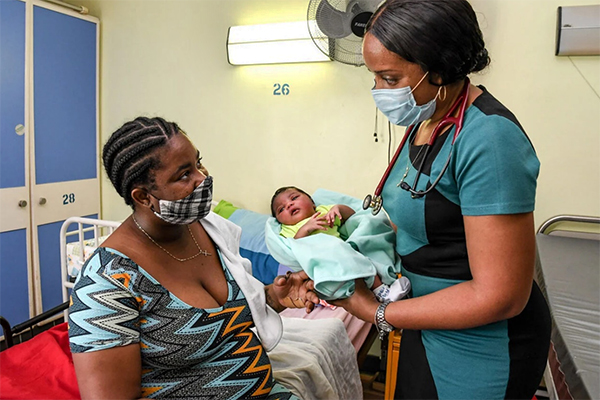
Toward combatting mother-to-child transmission of diseases like HIV, Syphilis, Hepatitis B, and Chagas, 16 Caribbean nations are coming together under a project proposal to be funded by the India-UN Development Partnership Fund, and to be implemented by the Pan American Health Organization (PAHO). This initiative, ‘Strengthening the EMTCT plus strategy within maternal and child health services’ aims to eliminate mother-to-child transmission of infectious diseases.
“Together, as Caribbean nations we acquire knowledge, share experiences and enhance the competencies of health care providers for an efficient and sustainable EMTCT Plus program,” says Dr. Julio Sabido, CEO Ministry of Health and Wellness, Belize. “This approach accelerates the adoption of effective health strategies across the region, and also fosters a sense of solidarity and collective responsibility. Infectious diseases do not know national boundaries, so only collective action would be truly effective.”
Dr. Julio Sabido, CEO Ministry of Health and Wellness, Belize, states that the project will enhance efforts among 16 Caribbean countries, ensuring the right of every child to be born and remain free of HIV and syphilis and other perinatal transmitted infections.
The World Health Organization (WHO) highlights that despite significant progress in eliminating the mother-to-child transmission of HIV and syphilis, challenges remain. For HIV, the goal has been set to reduce the mother-to-child transmission rate to 2% or less. However, in some regions, these rates continue to rise, indicating a pressing need for intensified efforts.
In the Caribbean, strides towards eliminating congenital syphilis are evident, yet some areas report rates as high as 1.8 cases per 1,000 live births, significantly above the WHO’s elimination target of 0.5 cases per 1,000 live births.
At the heart of the project’s strategy is a commitment to enhancing maternal and child health (MCH) services.
By focusing on strengthening leadership within these services, improving diagnostic capabilities, and upgrading surveillance systems, the initiative aims to address the gaps that have hindered progress toward eliminating these diseases.
Anchored in South-South cooperation approaches, knowledge sharing stands out as a key component, creating a comprehensive community-of-practice for Caribbean countries to exchange successful practices, challenges, and innovations through peer-to-peer country support.
This approach accelerates the adoption of effective health strategies across the region, and also fosters a sense of solidarity and collective responsibility.
Infectious diseases do not know national boundaries, so only collective action would be truly effective.
The project also places a strong emphasis on technical systems, particularly in enhancing laboratory services and data collection systems. Reliable diagnostics and effective surveillance are foundational to achievement of the project objectives.
The project is expected to reduce the mother-to-child transmission rate of HIV to achieve a goal of less than 0.03% per 1,000 live births. By eliminating mother-to-child transmission of these diseases, the region moves closer to a world where every child has the opportunity to lead a healthy, prosperous life, free from the burden of preventable illnesses.