The development of new plant varieties, that are adapted to the effects of climate change, and their rapid introduction to the farmers is a vital necessity to ensure food security and livelihoods for communities.
A Pérez-Guerrero Trust Fund for South-South Cooperation (PGTF)-supported project brought together researchers, academia, and farmers from Cuba, Panama and Paraguay, to develop new soyabean, rice, and tomato varieties that are adapted to the effects of climate change.
The institutions involved in the project are: the National Institute of Agricultural Sciences (INCA) of Cuba; the Multidisciplinary Center for Technological Research (CEMIT) of the National University of Asunción, Paraguay; and the Agricultural Research Institute of Panama (IDIAP).
The partners selected varieties of soyabean, rice, and tomato; as well as identified strains of nitrogen-fixing bacteria that would reduce the use of chemical fertilizers, resulting in the highest possible yield under local environmental conditions.
The project facilitated a participatory method for the selection of the optimal plant variety among the those tested in the breeding program. In addition, the project supported the evaluation and selection of the best biofertilizers. These elements are contributing to higher production, increased food security, and reduced land pollution from fertilizers.
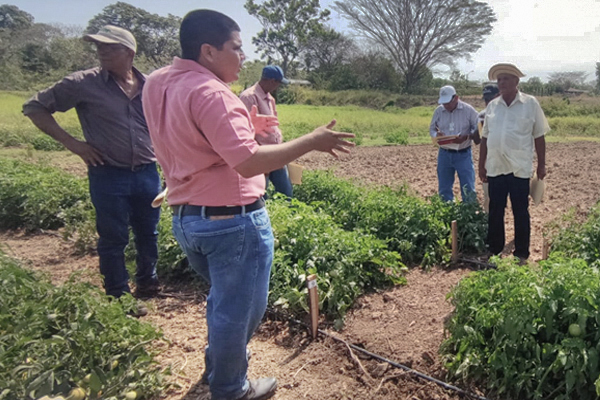
Over 140 farmers participated in the field days for the selection of the soyabean, rice, and tomato varieties suitable for the soils of specific farms in the participating countries.
The project disseminated its results through national and international activities, such as practical exchanges on biofertilizers and their application, and courses on participatory methods for plant genetic improvement and quality analysis. These have been attended by over 70 farmers thus far.
For further information on this project, please contact: Dr. María Caridad González, mcaridad9450@gmail.com