The Fourth International High-Level Conference on Financing for Development (FfD4) will be convened in Seville, Spain in June 2025. It will review the implementation of the Monterrey Consensus of the International Conference on Financing for Development, the Doha Declaration on Financing for Development and the Addis Ababa Action Agenda as well as examine challenges alongside emerging issues that hamper progress. As part of the preparations for the Conference, Regional Commissions have been requested (through General Assembly Resolution 78/271) to hold consultations with stakeholders and to provide the Conference Chair the views and perspectives from the region to help inform FfD4 proceedings.
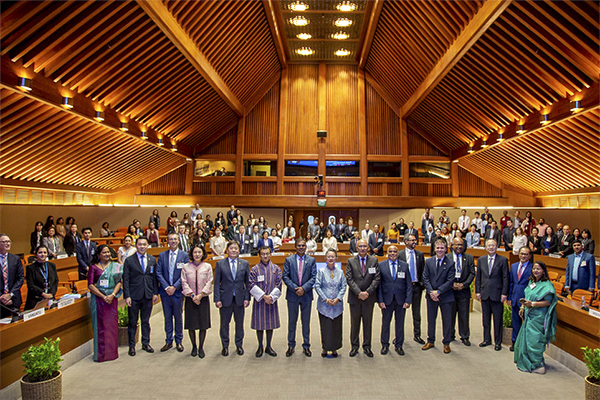
The UN Economic and Social Commission for Asia and the Pacific (UNESCAP) held the High-Level Regional Consultation on Financing for Development in Asia and the Pacific on 17-18 December with a focus on the themes of: 1) strengthening domestic public resources; 2) accelerating the mobilization of domestic and international private finance and investment towards the SDGs; 3) tackling concerns around public debt sustainability; and 4) addressing new and emerging issues. The consultations included a specific focus on South-South and triangular cooperation, raising the call made in the Elements Paper for FfD4 to leverage it more effectively to help address setbacks and evolving challenges.
South-South and triangular cooperation has long channeled development support to developing countries in a manner that poses no burden, ensures mutual benefits, assures ownership, and builds self-reliance. It has therefore been viewed as valuable complement to traditional North-South development assistance with immense potential to fill gaps and help deliver on internationally agreed development goals.
As the global community heads to FfD4, South-South and triangular cooperation is achieving greater resonance, given the interlocking crises that countries face, the fast approaching 2030 mark for achieving the Sustainable Development Goals (SDGs) of which only 17% are on track, and the constricted financing pipelines as official development assistance (ODA) declines (the SDG financing gap is estimated in the $2.5-$4 trillion range).
In the Asia Pacific region, this resonance is particularly distinct. As the region where South-South cooperation took shape, Asia Pacific attaches importance to this cooperation modality for the highly contextual technical support it channels and for the solidarity it nurtures through strategic partnerships. Given the various priorities requiring transborder collaboration (such as combatting illicit financial flows, boosting trade and deepening regional integration, etc.), regional South-South and triangular cooperation will be crucial in mobilizing, facilitating, and ensuring coherence in policy and programmatic responses to accelerate progress on the SDGs.
 The United Nations Office for South-South Cooperation (UNOSSC) joined around 200 representatives of governments, private sector and civil society from across the Asia-Pacific region for the regional consultations on FfD4 (30 Member States and 32 entities/organizations). UNOSSC was represented by its Regional Policy Specialist, Minerva Novero-Belec. To more fully leverage South-South and triangular cooperation for financing for development, Minerva Novero-Belec shared the following key points for reflection by stakeholders during the High-Level Regional Consultation and the workshop/expert group meeting preceding the Consultation:
South-South and triangular cooperation in the Elements Paper or FfD4
South-South cooperation is expanding in scope, volume, and reach, evolving to include a diverse range of actors and developing countries. It is a complement to, not substitute for, North-South cooperation. Triangular cooperation is also growing, though coordination challenges should be addressed to fully exploit its potential.- Increase the quantity and quality of South-South cooperation and encourage multi-actor partnerships for funding.
- Building on the existing UN Conceptual Framework to measure South-South Cooperation, and the results of the pilot project, encourage broader reporting by South-South providers to facilitate a better understanding of the impact of South-South cooperation on sustainable development.
- Consider establishing a triangular cooperation marker in reporting.
The United Nations Office for South-South Cooperation (UNOSSC) joined around 200 representatives of governments, private sector and civil society from across the Asia-Pacific region for the regional consultations on FfD4 (30 Member States and 32 entities/organizations). UNOSSC was represented by its Regional Policy Specialist, Minerva Novero-Belec. To more fully leverage South-South and triangular cooperation for financing for development, Minerva Novero-Belec shared the following key points for reflection by stakeholders during the High-Level Regional Consultation and the workshop/expert group meeting preceding the Consultation:
- South-South and triangular cooperation can help mobilize and channel various types of development support from across sectors, in both the Global North and Global South, as a complement to, not substitute for, traditional North-South development cooperation. For developing countries navigating financial pressures, in debt crises, facing declining official development assistance (ODA), and/or making difficult decisions over trade-offs in the midst of competing development priorities, South-South and triangular cooperation offers a win-win collaborative arrangement, enabling assistance that poses no burdens and ensures mutual benefit.
- Beyond the potential to increase the financial pool that stakeholders expect of development assistance in general, South-South and triangular cooperation can channel capacity building support that is specific to context, offering approaches that have been tested by peers. The Elements Paper for FfD4 details numerous capacities in so many areas that need to be built in order to transform the national financial landscape and the global financial architecture – from strengthening fiscal and tax systems to building digital financial system infrastructure and accountability mechanisms, developing regulatory frameworks, establishing institutions such as national development banks, building domestic financial markets, facilitating diaspora investment, building SMEs, building pipelines of projects for investments, etc. South-South and triangular cooperation is helping Global South countries access knowledge and technical expertise on a range of areas without incurring financial burdens.
- South-South and triangular cooperation is demand-driven and country-led; it can be leveraged therefore for wherever countries need it most, integrating contributions from stakeholders across sectors. Asia Pacific has the largest population in the world and is home to some of the world’s fastest growing economies (in 2023, it contributed to two-thirds of the global economic growth). It is understood to have sufficient financial capital in the region to meet the SDG financing gap, as well as numerous innovative financing approaches and initiatives developed with cross-sector engagement that can be leveraged for collective progress. South-South and triangular cooperation provides developing countries the platform for knowledge and technical exchange, focused on cross-sectoral cooperation for addressing priorities defined by the countries themselves (see examples here).
- Regional cooperation is essential particularly for addressing issues and priorities that transcend borders. Due to their proximity in geography, common experiences, complementarity in economic conditions, as well as in history, language, culture and ethnicity, South-South and triangular cooperation is significant for countries at the regional level. With issues and development challenges transcending or spilling over neighboring borders, and the knock-on impact of crises cascading through immediate geographic areas, developing countries within regions find many complementary or overlapping priorities for mutually beneficial collaboration. Regional South-South and triangular cooperation will be particularly helpful in establishing the transborder arrangements and agreements critical to advancing FfD priorities (such as combatting illicit financial flows, deepening regional integration, enhancing trade for development, etc.)
- Development support to address financing gaps needs to be tightly coordinated and integrated to be of impact. Regional South-South and triangular cooperation is even more crucial in this regard. Member States have elevated this cooperation modality for the new multilateralism it promotes and for its principles (critical for building trust and the cross-border solidarity) and have established UNOSSC with a mandate to advocate for and facilitate South-South and triangular cooperation within the UN and beyond. UNOSSC advances coherence primarily through the UN Interagency Mechanism for South-South Cooperation, which is composed of about 40 UN entities including the Regional Commissions, and UNOSSC serves as its Secretariat. The Mechanism shepherds the integration of South-South and triangular cooperation in the programs of individual entities, and the Regional Commissions like ESCAP have a particular important role to play given its mandate and role in the region. Through its various mechanisms like the Regional Cooperative Platform, it can see what is on the horizon in terms of country needs and priorities and how UNCTs can provide coherent, integrated support.