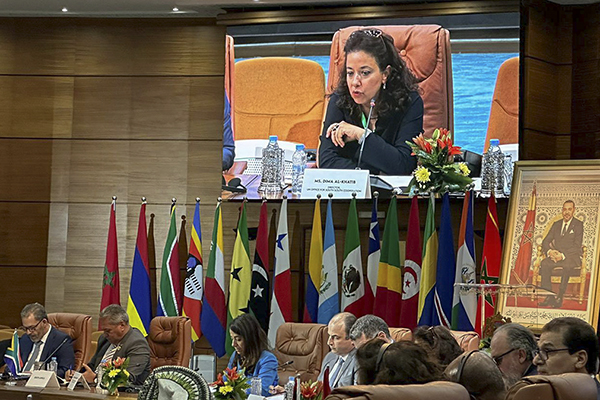
The Ministry of Foreign Affairs, African Cooperation and Moroccan Expatriates of the Kingdom of Morocco, the UNDP Country Office in Morocco and the United Nations Economic Commission for Africa joined forces in November 2023 to organize a High-Level Ministerial Conference on Middle-Income Countries (MICs) on “Solutions to Address Development Challenges of Middle-Income Countries in a Changing World” on 5-6 February 2024 in Rabat, Morocco.
Following the interactive dialogue with ministers, the outcome document of the Conference, the Rabat Declaration (Ministerial), was adopted. It contains a set of action-oriented and innovative solutions to address key development challenges of MICs, which consolidate the position of the Like-Minded Group for MICs for the 2024 Summit of the Future and for the 4th International Conference on Financing for Development to be held in 2025.
The Ministerial Declaration stresses the “importance of the role of South-South cooperation and triangular cooperation in addressing the development needs of middle- income countries, including through capacity-building and fostering peer- learning and sharing of best practices among Middle-Income Countries across regions”.
The Conference brought together 36 MICs (from the Likeminded group and beyond, from the 5 regions: Angola, Armenia, Benin, Cabo Verde, Cameroun, Chili, Colombia, Comoros, Congo, Costa Rica, Côte d’Ivoire, Djibouti, Dominican Republic, Egypt, El Salvador, Equatorial Guinea, Eswatini, Gabon, Ghana, Guatemala, Lebanon, Libya, Mauritania, Mexico, Morocco, Nigeria, Panama, Peru, Philippes, Sao Tome and Principe, Senegal, South Africa, Tunisia, Zimbabwe), the UN System (the DSG, UNDP, UNOSSC, ECA, ESCWA, OSAA, UNIDO, UNCTAD, as well as locally the RC, ILO, UNICEF, UNHCR, UN-Women, UNAIDS, etc.), International and Regional Financial Institutions (IsDB, BOA, WB) and other development partners (academia, think tanks, etc.).
The goal was to highlight MICs’ potential and discuss challenges, including financing gaps, that MICs face in implementing the Agenda 2030. It also presented a great opportunity for an exchange of experiences and peer-learning among MICs, Regional Economic Commissions, UN entities and international organizations.
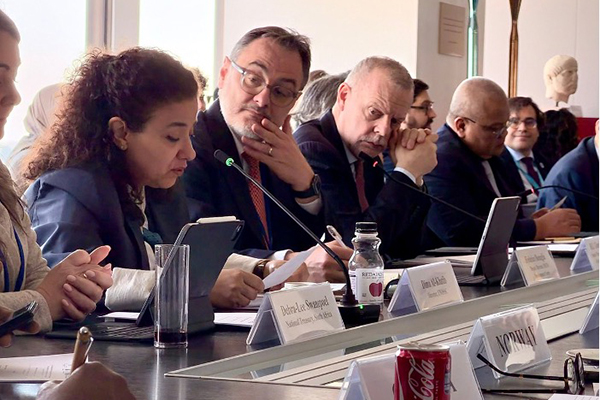
UNOSSC Director Dima Al-Khatib had a prominent role in Panel 5 on Transformative partnerships within and with MICs: Focus on South-South and Triangular Cooperation. The panel was moderated by Mr. Karim El Aynaoui, Executive President, Policy Center for the New South (Morocco).
Key issues discussed included: access by MICs, structural issues related to debt and lack of access to finance; the many opportunities offered by SSC (BRICS; role of Morocco on renewable energies, in the education sector, in support South-South collaboration; UNDP’s integrator role, UNOSSC service lines – Trust Funds, Galaxy; need to strengthen role of decentralized cooperation in SSC; the role of the IsDB including on support to small farmers, support to professional education, mobile banking; participation of African Union in G20).
The United Nations Deputy Secretary-General, Amina J. Mohammed, referred to persistent obstacles that MICs face and the opportunities lost for growth, stability, and sustainable development. She added that in an uncertain world with multiple and cascading global crises, flexibility, innovation, creativity, and global solidarity are needed to secure a sustainable future, not just for the few, but for the global community as a whole, especially for women and children. She welcomed the proposal for MICs to develop a Strategic Plan of Action for 2025- 2030, and highlighted three areas to unleash the potential of MICs, support and solidarity from the international community:
- Scaling up of development finance: MICs require a step-change in levels of investment to meet their development needs including trade.
- Reform of the international financial architecture: MICs are currently short- changed. They are denied resources and voice. Global initiatives to assist countries in need often exclude MICs by design.
- Incorporating measures of progress on sustainable development that go beyond GDP and support MICs based on their specific challenges and diverse needs.