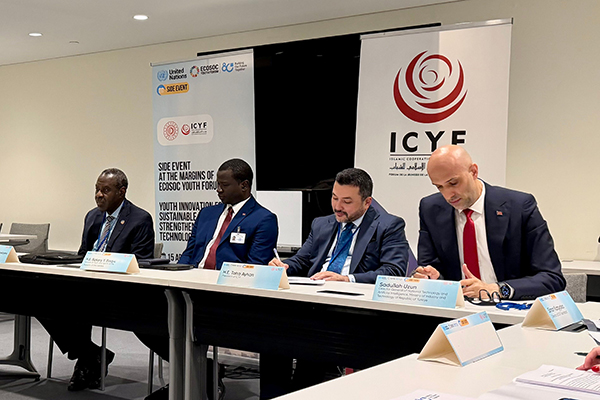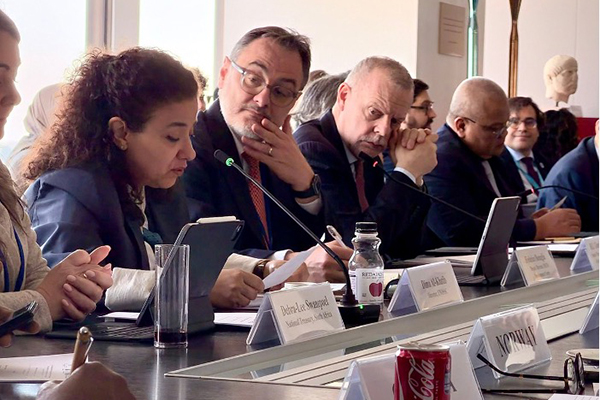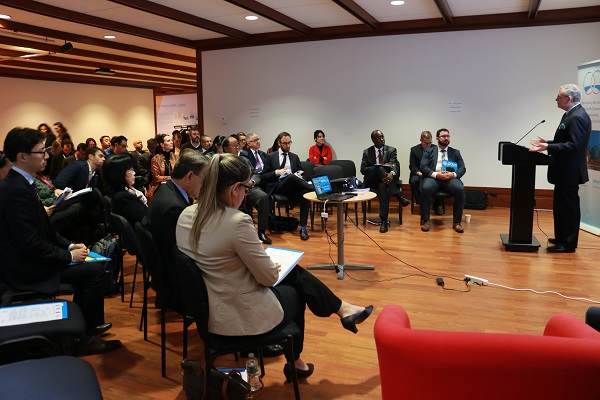
On 27 November 2018, UNICEF and the UN Office for South-South Cooperation (UNOSSC), in collaboration with the Governments of Argentina, the Kindom of Thailand and the Government of Uganda and the Islamic Development Bank (IsDB), co-organized a roundtable on maximizing the role of South-South Cooperation (SSC) in delivering the Sustainable Development Goals (SDGs) that impact children. This was a side event of the annual South-South Development Expo which took place in New York on 28-30 November 2018.
His Excellency Mr. Vitavas Srivihok, Thailand Permanent Representative, indicated that SSC is important to fulfil the rights of children and encouraged inspired thinking on how SSC can adopt more cost-effective responses that will contribute to the upcoming High-level Conference on South-South Cooperation (BAPA+40) and the 2030 Agenda to realize the goal of leaving no one behind.
His Excellency Mr. Philip Ochen Andrew Odida, Uganda Deputy Permanent Representative, said that SSC provides an immense opportunity to bring the global South together in delivering the SDGs and to bring positive impact for children, since 10 out of 17 SDGs have a direct link to children.
Mr. Jorge Chediek, Director and Envoy of the Secretary-General on South-South Cooperation, encouraged all participants to validate SSC as a tool and key instrument to support the 2030 agenda, and conveyed the message that more financial and institutional resources are required to overcome the obstacles, and to ensure engagement of additional partners to showcase the usefulness of SSC in achieving the SDGs.
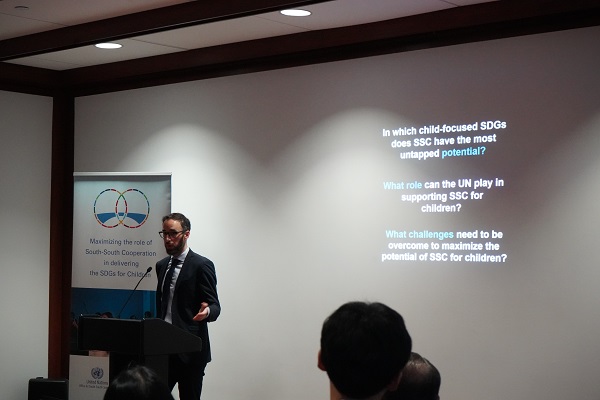 During the roundtable discussions, Mr. Laurence Chandy, Director of UNICEF Division of Data, Research and Policy, outlined the challenges to achieve the SDGs for children and the untapped potential of SSC to address these. He made a case for the critical role of SSC in delivering results for children and that children should be a strong focus of SSC, in addition to the more traditional focus areas of SSC.
Dr. Néstor Marimón Torres and Dr. Amporn Benjaponpitak, Representatives of Health Ministries of Cuba and Thailand, showcased their experiences in successfully eliminating the mother-to-child transmission (EMTCT) of HIV and syphilis. Ms. Kelly Ann Naylor from UNICEF shared WASH approaches and experience in leveraging SSC to deliver SDG 6 and UNICEF’s plan to end open defecation by 2030. Representing the International Organization for Migration (IOM), Mr. Kieran Gorman-Best shared the key issues related to South-to-South migration and its impact on youth.
Mr. Evan Wheeler, also from UNICEF, presented on experiences in Information and Communication Technologies and Development (ICTD), introducing the mobile health monitoring tool RapidPro that supports collection of real-time information on health, education and child protection. RapidPro was developed in the South, expanded by countries in in the South and is now also being adopted in the North.
In the last presentation, Mr. Ahmed Faruk Diken from IsDB shared the organization’s experience as a connector and catalyst in providing support and building capacity in priority areas using the Reverse Linkage conceptual framework, and presented some ideas for using Reverse Linkage for children and young people.
The two substantives sessions were moderated by Ms. Carla Mardini, Director Public Partnerships Division, UNICEF and Ms. Vidhya Ganesh, Deputy Director Programme Division, UNICEF. The Q&A session was moderated by Ms. Xiaojun Grace Wang, Deputy Director, UNOSSC.
His Excellency Mr. Martín García Moritán, Argentina Permanent Representative, closed the roundtable, reiterating that SSC is a valuable tool to achieve the SDGs and to fulfil people’s potential, especially for children. He called for leadership commitment and support from all global development partners to fully utilize the potential of SSC. He delivered the Summary Note from the Roundtable Discussion highlighting key recommendations.
The key recommendations from the roundtable called for:
During the roundtable discussions, Mr. Laurence Chandy, Director of UNICEF Division of Data, Research and Policy, outlined the challenges to achieve the SDGs for children and the untapped potential of SSC to address these. He made a case for the critical role of SSC in delivering results for children and that children should be a strong focus of SSC, in addition to the more traditional focus areas of SSC.
Dr. Néstor Marimón Torres and Dr. Amporn Benjaponpitak, Representatives of Health Ministries of Cuba and Thailand, showcased their experiences in successfully eliminating the mother-to-child transmission (EMTCT) of HIV and syphilis. Ms. Kelly Ann Naylor from UNICEF shared WASH approaches and experience in leveraging SSC to deliver SDG 6 and UNICEF’s plan to end open defecation by 2030. Representing the International Organization for Migration (IOM), Mr. Kieran Gorman-Best shared the key issues related to South-to-South migration and its impact on youth.
Mr. Evan Wheeler, also from UNICEF, presented on experiences in Information and Communication Technologies and Development (ICTD), introducing the mobile health monitoring tool RapidPro that supports collection of real-time information on health, education and child protection. RapidPro was developed in the South, expanded by countries in in the South and is now also being adopted in the North.
In the last presentation, Mr. Ahmed Faruk Diken from IsDB shared the organization’s experience as a connector and catalyst in providing support and building capacity in priority areas using the Reverse Linkage conceptual framework, and presented some ideas for using Reverse Linkage for children and young people.
The two substantives sessions were moderated by Ms. Carla Mardini, Director Public Partnerships Division, UNICEF and Ms. Vidhya Ganesh, Deputy Director Programme Division, UNICEF. The Q&A session was moderated by Ms. Xiaojun Grace Wang, Deputy Director, UNOSSC.
His Excellency Mr. Martín García Moritán, Argentina Permanent Representative, closed the roundtable, reiterating that SSC is a valuable tool to achieve the SDGs and to fulfil people’s potential, especially for children. He called for leadership commitment and support from all global development partners to fully utilize the potential of SSC. He delivered the Summary Note from the Roundtable Discussion highlighting key recommendations.
The key recommendations from the roundtable called for:
During the roundtable discussions, Mr. Laurence Chandy, Director of UNICEF Division of Data, Research and Policy, outlined the challenges to achieve the SDGs for children and the untapped potential of SSC to address these. He made a case for the critical role of SSC in delivering results for children and that children should be a strong focus of SSC, in addition to the more traditional focus areas of SSC.
Dr. Néstor Marimón Torres and Dr. Amporn Benjaponpitak, Representatives of Health Ministries of Cuba and Thailand, showcased their experiences in successfully eliminating the mother-to-child transmission (EMTCT) of HIV and syphilis. Ms. Kelly Ann Naylor from UNICEF shared WASH approaches and experience in leveraging SSC to deliver SDG 6 and UNICEF’s plan to end open defecation by 2030. Representing the International Organization for Migration (IOM), Mr. Kieran Gorman-Best shared the key issues related to South-to-South migration and its impact on youth.
Mr. Evan Wheeler, also from UNICEF, presented on experiences in Information and Communication Technologies and Development (ICTD), introducing the mobile health monitoring tool RapidPro that supports collection of real-time information on health, education and child protection. RapidPro was developed in the South, expanded by countries in in the South and is now also being adopted in the North.
In the last presentation, Mr. Ahmed Faruk Diken from IsDB shared the organization’s experience as a connector and catalyst in providing support and building capacity in priority areas using the Reverse Linkage conceptual framework, and presented some ideas for using Reverse Linkage for children and young people.
The two substantives sessions were moderated by Ms. Carla Mardini, Director Public Partnerships Division, UNICEF and Ms. Vidhya Ganesh, Deputy Director Programme Division, UNICEF. The Q&A session was moderated by Ms. Xiaojun Grace Wang, Deputy Director, UNOSSC.
His Excellency Mr. Martín García Moritán, Argentina Permanent Representative, closed the roundtable, reiterating that SSC is a valuable tool to achieve the SDGs and to fulfil people’s potential, especially for children. He called for leadership commitment and support from all global development partners to fully utilize the potential of SSC. He delivered the Summary Note from the Roundtable Discussion highlighting key recommendations.
The key recommendations from the roundtable called for:
- Making a more concerted global effort to create an environment for promoting and using South-South Cooperation to achieve results for children and young people
- Formalizing new and inclusive partnerships for SSC for children
- Identifying, documenting and brokering high impact development solutions for children from the South
- Increasing access to state of the art SSC tools, platforms and support services
- Making children and young people more visible in national and global SSC agenda