Smart Technology, Stronger Communities: Thailand’s Bung Khla Sets Model for Smart Water Management
In a quiet district along the Thai-Lao border, a new kind of digital transformation is taking shape – one powered by solar panels, smart sensors, digital tools, and most importantly, by the people who use them.
Bung Khla Sub-district, home to Moo 1, 2, and 3 (Moo means villages in Thai) in Bueng Kan Province, has recently emerged as a pioneering innovation site for a smart, community-led water management solution under the P-LINK Project – People’s Livelihoods Initiative through water-energy-food Nexus in the Mekong Region. Rooted in South-South and triangular cooperation, the community is stepping into the future with smart water technology, designed not just to function, but to last.
Also known as the ROK-UNOSSC Facility (Phase 3), this initiative brings together the United Nations Office for South-South Cooperation (UNOSSC), the Republic of Korea’s Ministry of Science and ICT (MSIT), the Mekong River Commission, Thailand’s Office of the National Water Resources (ONWR)/Thailand National Mekong Committee Secretariat (TNMCS), the Mekong Institute (MI), ROK Science and Technology Policy Institute (STEPI) and Korean startup WI.Plat, all working closely with local government and communities to deliver results.
Digital Innovation with a Local Pulse
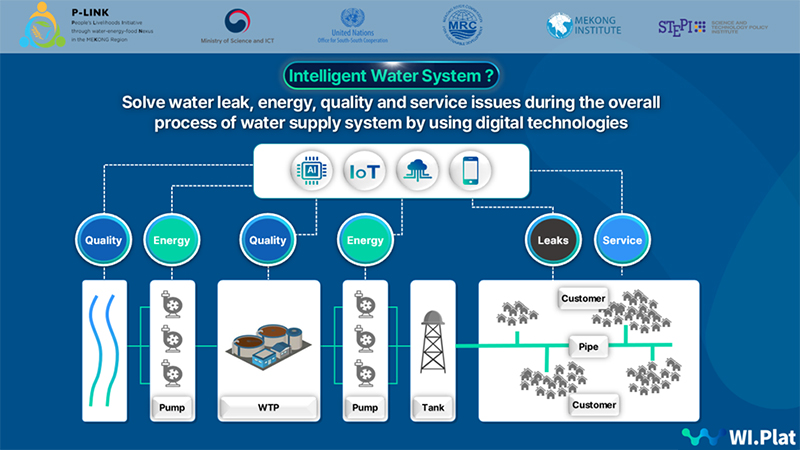
At the core of the project is a smart water system—a major upgrade to the community’s existing infrastructure. Installed across three villages, the system includes:
AI-powered leak detection and water pressure sensors
Automated chemical dosing systems to improve treatment consistency
Solar-powered energy units for sustainability
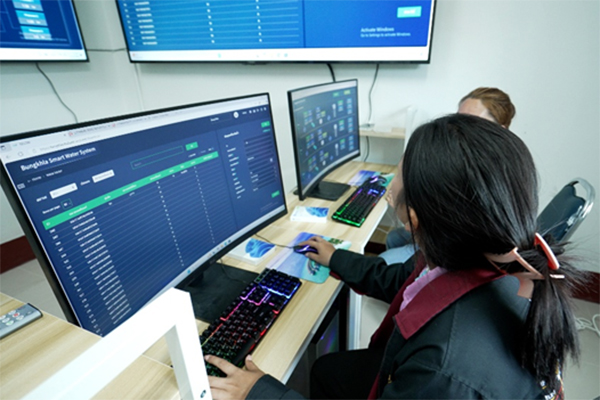
A centralized real-time monitoring room outfitted with digital dashboards
System overview.
These tools allow local operators to monitor water quality, track system performance, and detect problems quickly – something that was not possible before.
“Before this project, we relied mostly on manual checks and didn’t have tools to detect leaks or monitor water quality in real time,” said Mr. Piya Panumas, Director of Public Works at Bung Khla SAO. “Now, we can see what’s happening in the system right away and respond faster. Since installation, the water looks clearer and more consistent. I really hope everyone in the village will take care of it together.”
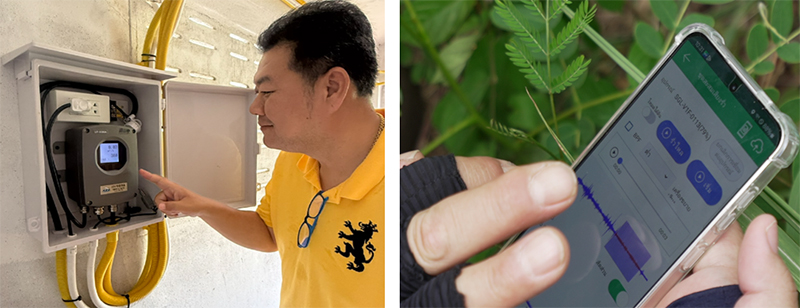
Installed digital water meter and mobile app for real-time leak detection via IoT.Empowering People for Long-Term Sustainability
Smart systems only reach their full potential when people are equipped to use them. This is why the project placed strong emphasis on training, local capacity, and ownership.
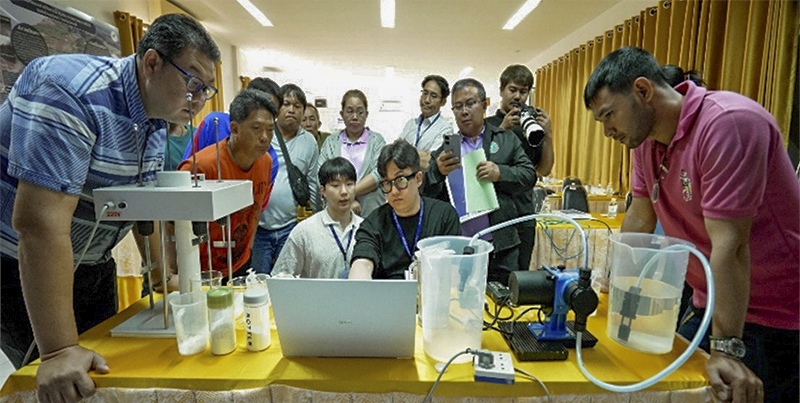
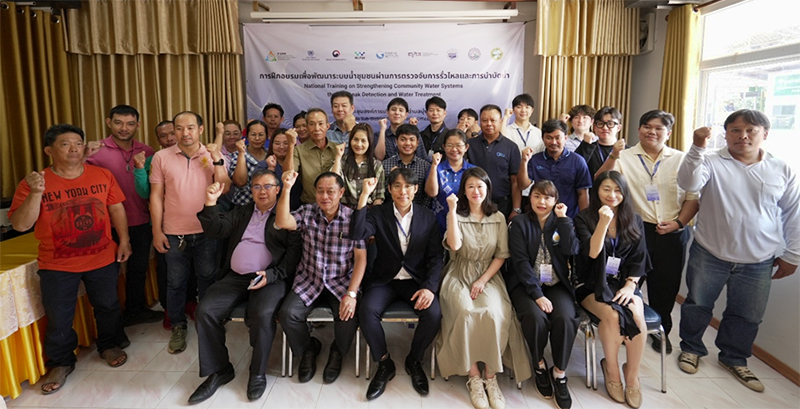
Over a three-day national training course, more than 30 community members – including treatment operators, billing staff, maintenance technicians, and local leaders – gained hands-on experience with the new systems. Co-led by WI.Plat and the Mekong Institute, the training was designed to be practical, accessible, and tailored to the real-world needs of Bung Khla’s pilot sites.
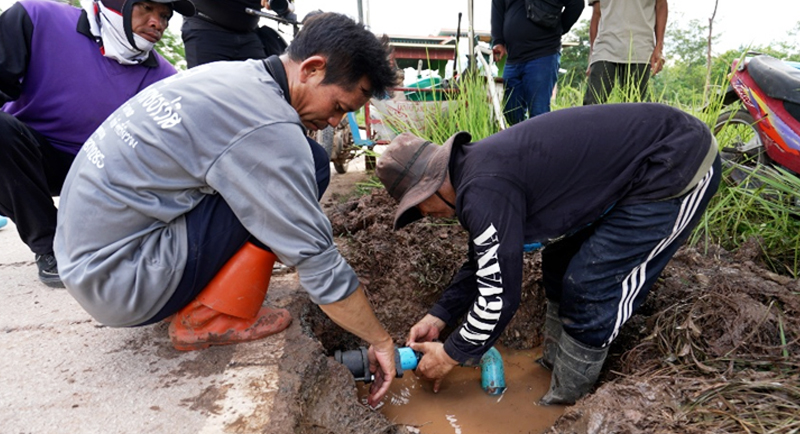
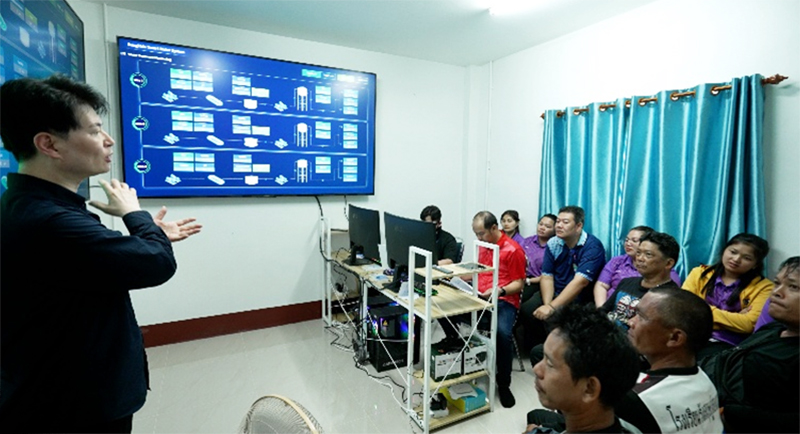
Training on water quality monitoring through jar test. Identifying and repairing a leak through acoustic water leak detection. Learning how the digital system operates at the newly established centralized real-time monitoring room.
For example, billing staff used to visit each home with pen and paper to record water usage, manually entering data into Excel and handwriting individual receipts. Now, they can input meter readings directly into a mobile app, which automatically generates billing templates – saving time and reducing errors.
“The old way took so long,” shared one billing officer. “We had to check each house, write down the readings, and then handwrite each receipt. Now, we just input the data, and the system creates the bills for us. It’s much easier.”
While full automation remains limited by cost and uneven internet access, this semi-digital approach already marks a significant step forward in efficiency and service delivery.
Community First, Technology Second
“More important than having advanced technology is community participation – the commitment to maintain and manage the system sustainably,” said Mr. Naris Arthan, Chief Executive of the Bung Khla Sub-district Administrative Organization.
That message was echoed throughout the training. Beyond just using the tools, community members were encouraged to take full ownership of the system and view it as a shared asset. UNOSSC also emphasized how the project fits within a broader vision of South-South and triangular cooperation, highlighting the importance of local solutions and regional learning among Mekong countries.
MI underscored how the Bung Khla pilot could become a demonstration site for other villages in Cambodia, Lao PDR, and Viet Nam, showing how tailored technology and empowered communities can go hand-in-hand.
A Model for the Mekong Region
The smart water system has already begun to reduce water loss, improve supply quality, and support clean energy use. As ONWR/TNMCS’s Director of Foreign Affairs Division, Dr. Winai Wangpimool noted, “There are real production costs to ensure water is clean and safe. It is crucial that water reaches households as efficiently as possible.”
As results are tracked over the coming months, stakeholders are already looking at scaling the model across Thailand and the wider Mekong region.
The Bung Khla pilot is more than a technical upgrade – it is a human story about what happens when innovation is grounded in cooperation and driven by community. For Moo 1, 2, and 3, it is not just about water flowing downstream. It is about progress flowing forward.

 A Model for the Mekong Region
The smart water system has already begun to reduce water loss, improve supply quality, and support clean energy use. As ONWR/TNMCS’s Director of Foreign Affairs Division, Dr. Winai Wangpimool noted, “There are real production costs to ensure water is clean and safe. It is crucial that water reaches households as efficiently as possible.”
As results are tracked over the coming months, stakeholders are already looking at scaling the model across Thailand and the wider Mekong region.
The Bung Khla pilot is more than a technical upgrade – it is a human story about what happens when innovation is grounded in cooperation and driven by community. For Moo 1, 2, and 3, it is not just about water flowing downstream. It is about progress flowing forward.
A Model for the Mekong Region
The smart water system has already begun to reduce water loss, improve supply quality, and support clean energy use. As ONWR/TNMCS’s Director of Foreign Affairs Division, Dr. Winai Wangpimool noted, “There are real production costs to ensure water is clean and safe. It is crucial that water reaches households as efficiently as possible.”
As results are tracked over the coming months, stakeholders are already looking at scaling the model across Thailand and the wider Mekong region.
The Bung Khla pilot is more than a technical upgrade – it is a human story about what happens when innovation is grounded in cooperation and driven by community. For Moo 1, 2, and 3, it is not just about water flowing downstream. It is about progress flowing forward.