Regional integration and cooperation have been vital to the growth and development of countries and regions. At a time of global uncertainties and economic fragmentation, they are even more crucial for mobilizing collective action to accelerate progress on the Sustainable Development Goals (SDGs).
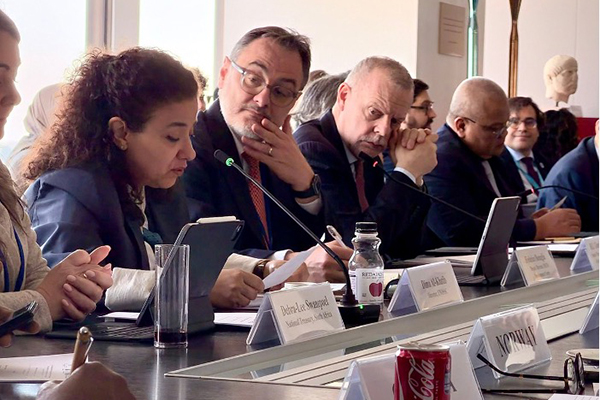
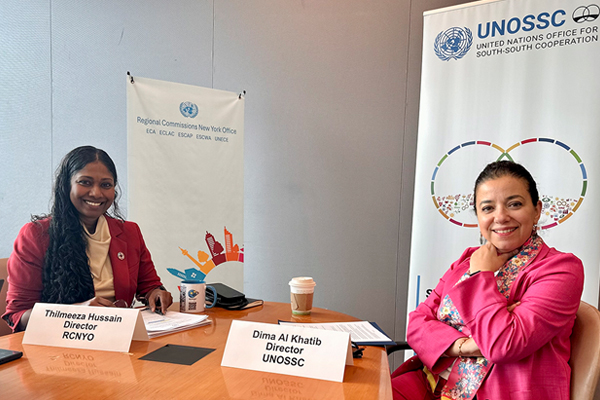
“We gather today at a pivotal moment,” UNOSSC Director Dima Al Khatib pointed out at the cross-regional dialogue co-hosted by UNOSSC with UN Regional Commissions New York Office (RCNYO) and the Emerging Development Partners (EDP) Network to celebrate the 80th year of the United Nations and mark the 70th anniversary of the Bandung conference.
“Just five years from when we intend to achieve the SDGs, our ambition for a more prosperous, more inclusive, more peaceful and sustainable world is becoming harder to reach – only 35% of our SDGs are on track for achievement by 2030, and the financial muscle we need for breakthrough solutions is weakening as traditional development support wanes. We need greater cooperation at all levels,” the UNOSSC Director underlined, “and South-South and triangular cooperation at the regional level, anchored in solidarity, can bolster efforts to take forward the aspirations in the UN Charter.”
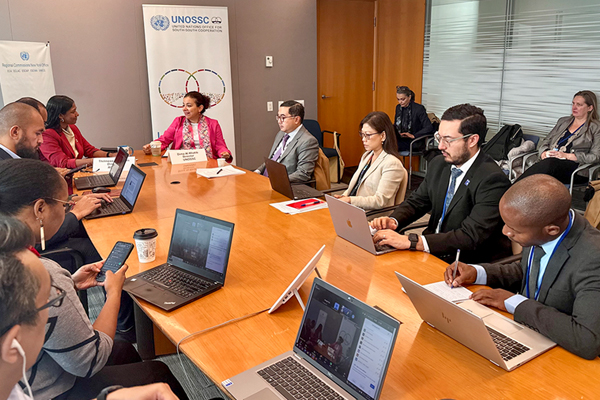 This cross-regional dialogue came at a critical juncture, providing the space for Regional Commissions and South-South champions to jointly reflect on regional integration and cooperation trends and to identify practical pathways for accelerating SDG progress.
RCNYO Director Thilmeeza Hussain underlined that the Regional Commissions are strategically placed, and have the mandate, to advance regional integration and cooperation in support of Member States. She noted that South-South and triangular cooperation are in their DNA, but more can be done to systematically leverage these cooperation modalities to respond to evolving challenges and support efforts within and between regions.
The need to deepen regional integration and cooperation
The path forward is uneven: global growth is forecast at just 2.8% in 2025, while rising fragmentation could shrink global GDP by up to 7%. Trade and investment trends, on an upward trajectory since the end of the COVID-19 pandemic, are expected to reverse in light of trade policy shocks (such as uptick of tariffs) and increasing trade tensions.
The Sustainable Development Goals (SDGs), with just 35 percent of its targets on track for achievement by 2030 and 18 percent regressing, are at further risk.
Persistent development challenges, combined with geopolitical and economic fragmentation, financial distress, and instability, are hitting regions in distinct ways – shaping national SDG progress and regional prospects alike. In this context, regional integration and cooperation are vital, not only for the growth of countries and regions, but also for addressing cross-border challenges and securing a peaceful, sustainable global future.
Consolidating action through South-South & triangular cooperation at the regional level
The UNCTAD Trade and Development Foresight Report 2025 calls for leveraging multilateral frameworks and regional arrangements as well as South-South economic integration to navigate uncertainties and propel growth. The future of regional integration however lies in ensuring its benefits are equitably distributed. When rooted in the principles of South-South and triangular cooperation, integration delivers tangible impact.
South-South and triangular cooperation, long viewed as a complement to traditional North-South development cooperation, are increasingly seen as a crucial pillar in the kind of action (and support) countries of the Global South require to grow, build resilience, and achieve development priorities. These cooperation modalities channel development solutions anchored in the experience of the Global South; enable collaborations where partners accompany each one’s development journey; and deliver support that ensures context specificities and mutual benefit with no burden.
Objectives and expected outcomes
This dialogue takes place at a pivotal moment, offering a dedicated platform for regional commissions and South-South actors to come together, better understand anticipate emerging integration trends, and chart innovative pathways to accelerate sustainable development – advancing the SDGs and shaping a more resilient, inclusive future overall.
This cross-regional dialogue was designed to:
This cross-regional dialogue came at a critical juncture, providing the space for Regional Commissions and South-South champions to jointly reflect on regional integration and cooperation trends and to identify practical pathways for accelerating SDG progress.
RCNYO Director Thilmeeza Hussain underlined that the Regional Commissions are strategically placed, and have the mandate, to advance regional integration and cooperation in support of Member States. She noted that South-South and triangular cooperation are in their DNA, but more can be done to systematically leverage these cooperation modalities to respond to evolving challenges and support efforts within and between regions.
The need to deepen regional integration and cooperation
The path forward is uneven: global growth is forecast at just 2.8% in 2025, while rising fragmentation could shrink global GDP by up to 7%. Trade and investment trends, on an upward trajectory since the end of the COVID-19 pandemic, are expected to reverse in light of trade policy shocks (such as uptick of tariffs) and increasing trade tensions.
The Sustainable Development Goals (SDGs), with just 35 percent of its targets on track for achievement by 2030 and 18 percent regressing, are at further risk.
Persistent development challenges, combined with geopolitical and economic fragmentation, financial distress, and instability, are hitting regions in distinct ways – shaping national SDG progress and regional prospects alike. In this context, regional integration and cooperation are vital, not only for the growth of countries and regions, but also for addressing cross-border challenges and securing a peaceful, sustainable global future.
Consolidating action through South-South & triangular cooperation at the regional level
The UNCTAD Trade and Development Foresight Report 2025 calls for leveraging multilateral frameworks and regional arrangements as well as South-South economic integration to navigate uncertainties and propel growth. The future of regional integration however lies in ensuring its benefits are equitably distributed. When rooted in the principles of South-South and triangular cooperation, integration delivers tangible impact.
South-South and triangular cooperation, long viewed as a complement to traditional North-South development cooperation, are increasingly seen as a crucial pillar in the kind of action (and support) countries of the Global South require to grow, build resilience, and achieve development priorities. These cooperation modalities channel development solutions anchored in the experience of the Global South; enable collaborations where partners accompany each one’s development journey; and deliver support that ensures context specificities and mutual benefit with no burden.
Objectives and expected outcomes
This dialogue takes place at a pivotal moment, offering a dedicated platform for regional commissions and South-South actors to come together, better understand anticipate emerging integration trends, and chart innovative pathways to accelerate sustainable development – advancing the SDGs and shaping a more resilient, inclusive future overall.
This cross-regional dialogue was designed to:
This cross-regional dialogue came at a critical juncture, providing the space for Regional Commissions and South-South champions to jointly reflect on regional integration and cooperation trends and to identify practical pathways for accelerating SDG progress.
RCNYO Director Thilmeeza Hussain underlined that the Regional Commissions are strategically placed, and have the mandate, to advance regional integration and cooperation in support of Member States. She noted that South-South and triangular cooperation are in their DNA, but more can be done to systematically leverage these cooperation modalities to respond to evolving challenges and support efforts within and between regions.
The need to deepen regional integration and cooperation
The path forward is uneven: global growth is forecast at just 2.8% in 2025, while rising fragmentation could shrink global GDP by up to 7%. Trade and investment trends, on an upward trajectory since the end of the COVID-19 pandemic, are expected to reverse in light of trade policy shocks (such as uptick of tariffs) and increasing trade tensions.
The Sustainable Development Goals (SDGs), with just 35 percent of its targets on track for achievement by 2030 and 18 percent regressing, are at further risk.
Persistent development challenges, combined with geopolitical and economic fragmentation, financial distress, and instability, are hitting regions in distinct ways – shaping national SDG progress and regional prospects alike. In this context, regional integration and cooperation are vital, not only for the growth of countries and regions, but also for addressing cross-border challenges and securing a peaceful, sustainable global future.
Consolidating action through South-South & triangular cooperation at the regional level
The UNCTAD Trade and Development Foresight Report 2025 calls for leveraging multilateral frameworks and regional arrangements as well as South-South economic integration to navigate uncertainties and propel growth. The future of regional integration however lies in ensuring its benefits are equitably distributed. When rooted in the principles of South-South and triangular cooperation, integration delivers tangible impact.
South-South and triangular cooperation, long viewed as a complement to traditional North-South development cooperation, are increasingly seen as a crucial pillar in the kind of action (and support) countries of the Global South require to grow, build resilience, and achieve development priorities. These cooperation modalities channel development solutions anchored in the experience of the Global South; enable collaborations where partners accompany each one’s development journey; and deliver support that ensures context specificities and mutual benefit with no burden.
Objectives and expected outcomes
This dialogue takes place at a pivotal moment, offering a dedicated platform for regional commissions and South-South actors to come together, better understand anticipate emerging integration trends, and chart innovative pathways to accelerate sustainable development – advancing the SDGs and shaping a more resilient, inclusive future overall.
This cross-regional dialogue was designed to:
- Facilitate cross-regional exchanges on emerging trends and regional responses to evolving pressures and uncertainties
- Highlight effective practices and approaches enabled by or through South-South and triangular cooperation that would be potentially replicable in other regions
- Explore pathways to broaden partnerships (particularly with and among entities with regional focus) to enhance support for SDG acceleration over the next five years
- Identify potential areas of joint action planned by UNOSSC and RCNYO to support SDG acceleration across regions
- Provide opportunities for Member States to gain insights into regional opportunities and challenges, learn about replicable practices, and explore partnerships that can directly support their national SDG implementation
Opportunities for leveraging regional South-South and triangular cooperation
Amidst the landscape of turbulence, certain trends offer opportunities for the Global South that, when leveraged strategically, can both cushion shocks and drive progress.
About the UN Office for South-South Cooperation (UNOSSC)
The United Nations Office for South-South Cooperation (UNOSSC) was established by the UN General Assembly with a mandate to promote, facilitate and support South-South and triangular cooperation globally and within the United Nations system. UNOSSC, hosted by UNDP since 1974, receives policy directives and guidance from the General Assembly and through its subsidiary body, the High-level Committee on South-South Cooperation.
About the UN Regional Commission NY Office (UNRCNYO)
The Regional Commissions New York Office (RCNYO) is a joint office for coordination, representation, and policy advice at the global level for the five United Nations Regional Commissions, namely the Economic Commission for Africa, the Economic and Social Commission for Asia and the Pacific, the Economic Commission for Latin America and the Caribbean, the Economic Commission for Europe and the Economic and Social Commission for Western Asia.
About the Emerging Development Partners (EDP) Network
The EDP Network is a group of countries that have made important economic, social, and environmental advances and are taking on new roles at regional and global levels to help address development challenges. Once viewed as developing countries, they have become some of the world’s most dynamic economies today and represent increasing share of global GDP. Inspired by the spirit of solidarity, they seek to strengthen South-South and triangular partnerships and collaborations in support of developing countries, leveraging their own experience for context-adapted solutions. The Network includes Azerbaijan, Colombia, Indonesia, Kazakhstan, Philippines, Thailand and Turkiye.
Click here to view the invitation
Click here for the concept note
Click here for bios of speakers
Read more from the Agencia Uruguaya de Cooperación Internacional
- South-South economic cooperation and integration are shifting the socio-economic profiles of countries and whole regions. South-South trade (trade among developing countries) has been “expanding at a faster pace” than other trade flows, surpassing North-South trade in 2023 (accounting for about one third of global trade) and contributing up to 42% of global GDP.
- The landscape of the Global South continues to shift dramatically. Among the countries viewed traditionally as the global South are some of the world’s most dynamic economies today. Once known as “aid recipients,” these countries have gained new capacities and are taking on greater roles at the regional and global level befitting their new aspirations and self-defined growth trajectories.
- Relations among the global South countries have been transforming in significant ways, with implications for development cooperation itself. The increased trade relations among the global South not only broadened developing countries’ access to each other’s markets, but also embedded or deepened development cooperation based on the principles of solidarity and mutual benefit.
- Africa: Regional integration in Africa is advancing, with the African Continental Free Trade Area (AfCFTA) representing a major milestone in Africa’s regional integration journey towards establishing the African Economic Community. Full implementation of the AfCFTA is expected to increase the value of intra-Africa trade by an estimated 33.5% ($196.4 billion) by 2045. The Africa Regional Integration Index shows an upward trend; however, regional trade integration has lagged with only 14% of Africa’s exports and imports taking place within the continent in 20
- Arab Region: The 2024 Arab Sustainable Development Report notes that “regional economic integration remerged as critical in the context of trade, digital connectivity, health services, and food security among others”, but broader regional integration remains weak with great impact on trade (intraregional trade represents around 13% of total trade), conflict management and state of the economy. The Pan-Arab Free Trade Area agreement is one of the efforts towards market integration in the region.
- Asia-Pacific: The region has made significant strides in regional integration over the past two decades, especially in investment, movement of people and trade, with intraregional trade accounting for over 56% the region’s total imports and 53% of its total exports in 2024. The number of intra-Asian Preferential Trade Agreements (PTAs) surged from 4 in 1990 to 77 by 2023, now making up 45% of all global PTAs. However, overlapping trade agreements create complexity and compliance costs, especially for SMEs, and utilization rates are low due to complex rules of origin and administrative burdens. Regional integration has driven progress in poverty reduction, health, and infrastructure (Goals 1, 3, 9), but has yet to translate into gains in decent work, climate action, or reduced inequalities.
- Latin America and the Caribbean: Regional integration is recognized in this region as vital for accelerating SDG progress, but only 16% of Latin American trade currently is intraregional. Regional integration is uneven, with significant subregional differences requiring differentiated strategies and cooperation mechanisms. The region faces three persistent “development traps”: low growth capacity, high inequality, and weak institutional/governance capacity.
- Pan-European (Europe and Central Asia) and Mediterranean Regions: Regional integration trends are multifaceted in these regions, with Western Europe’s integration (via the EU) being among the deepest in the world while Central Asia remains among the least connected regions globally. The Mediterranean, a long-standing channel and hub for trade as well as cultural exchanges, has maintained relevance in intra-regional and global markets but trade has been largely in its Northern shores. About 70% of cargo trade in the Mediterranean is between European ports, with only 15% between Europe and North Africa and 5% between countries in Middle East and North Africa.