Op-Ed: South-South Cooperation – Advancing Rights, Equality, and Empowerment for ALL Women and Girls
By Dima Al-Khatib, Director of the United Nations Office for South-South Cooperation
Today we commemorate International Women’s Day 2025, under the theme For ALL Women and Girls: Rights. Equality. Empowerment.
This day is not just a celebration of the achievements of women and girls, but also a call to action to address the persistent barriers that hinder their full participation in society, economy, and governance.
Three decades after the agreement of the Beijing Platform for Action, progress toward gender equality remains significantly off track. Despite the world’s vast wealth, it will take an estimated 137 years to end extreme poverty for women and 257 years to close the pay gap between women and men . These projections are not inevitable – they result from choices made today – and emphasize the urgent need to accelerate progress toward a more inclusive and equitable world.
Within the context of South-South cooperation – a framework where developing countries share knowledge, skills, and resources in solidarity – remarkable strides have been made in advancing gender equality, and these must be scaled up if we are to reach ALL women and girls.
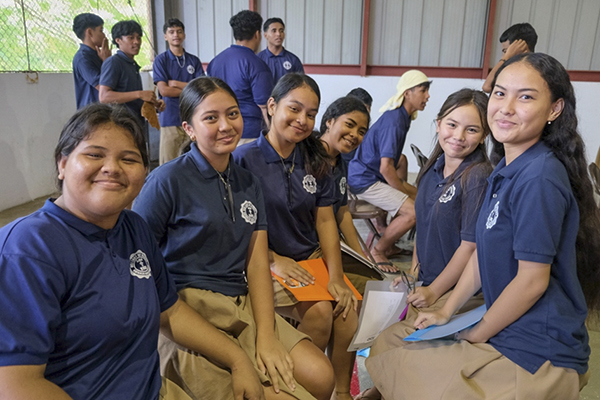
Supported by the India-UN Development Partnership Fund, UNDP’s Gender Machinery Project in the Federated States of Micronesia is enhancing leadership capabilities, promoting gender equality and strengthening communities. Photo: UNDP Pacific Office
Countries of the Global South have shared innovative solutions, best practices, and resources to address common challenges such as access to education, healthcare, economic opportunities, and political participation. From digital literacy programs for rural women to initiatives promoting female entrepreneurship, these collaborations have demonstrated that solidarity and shared knowledge can drive meaningful change.
The Buenos Aires Plan of Action (BAPA+40) recognizes “the contributions of South-South and triangular cooperation in promoting gender equality and the empowerment of women and girls in sustainable development” and calls for, among others, bolstering regional and interregional efforts to advance priorities (paras 19 and 24). It also calls for “more regional mechanisms” and “interregional coordination and collaboration”, specifically to build the capacities and increase the representation of women and girls in Science, Technology and Innovation (para 28c).
The Beijing Platform for Action also recognizes the role of South-South cooperation in advancing the 12 critical areas of concern that it highlights, calling on the UN system, regional organizations and other development partners to “develop a South-South cooperation programme” to build national capacities on those areas (para 93b).
To bridge these gaps, we must harness innovative and collaborative approaches. South-South cooperation has been recognized as a key strategy in this endeavor, in pivotal areas.
Promoting Equal Opportunities in Education and Employment
Education is the cornerstone of empowerment.
Through South-South cooperation, countries are sharing best practices in girls’ education, particularly in STEM fields, to equip them with the skills needed for the jobs of the future. Initiative such as Malala Fund for Girls’ Right to Education has helped expand girls’ access to quality education, especially in countries affected by conflict and disaster. It involves countries such as Cambodia, Egypt, Mauritania, Mozambique, Nepal, Nigeria, Pakistan, the United Republic of Tanzania, and Viet Nam.
UNESCO Community Learning Centres for Women’s Literacy and Empowerment in Egypt are enhancing the literacy skills of women and girls and building their life skills for health, livelihoods, and citizenship engagement. Such initiatives are part of broader efforts to promote gender equality through education.
India, Brazil and South Africa Facility for Poverty and Hunger Alleviation (IBSA Fund) projects in Guinea-Bissau, The Gambia and Uganda, among others, are advancing women’s livelihoods – enhancing literacy, introducing solar energy, and training rural women and youth in agribusiness, entrepreneurship, and cooperative formation.
The IBSA Fund Karamoja Greenbelts Project – a partnership between UNDP, the Government of South Africa, and Government of Uganda – is transforming lives of women and youth in Uganda’s Karamoja sub-region through commercial agriculture.
In Asia and Latin America, nations have shared policies on gender-responsive curricula, ensuring that educational content promotes equality and challenges stereotypes. For instance, in Nicaragua, an initiative under the India-UN Development Partnership Fund applies the ‘Universal Design for Learning’ framework to develop digital second-grade science materials, including videos, illustrations, animations, and interactive storyboards.
Protecting and Upholding Women’s Rights
Legal and policy frameworks must be strengthened to protect women’s rights, including their right to live free from violence, discrimination, and harmful practices. South-South cooperation can facilitate the exchange of successful legislative models and judicial reforms, while triangular cooperation can support the implementation of these frameworks through capacity-building and technical assistance.
UNESCO’s Our Rights, Our Lives, Our Future (O3) Programme is providing comprehensive sexuality education to young girls, empowering them with knowledge about their health and rights, and addressing gender-based violence and child marriage. It fosters safe environments through community engagement, while promoting open dialogue between parents and adolescents to support women’s well-being.
With the right decisions and investments, the world has the solutions and the resources to accelerate progress. South-South cooperation can promote the sharing of experiences and strategies to increase women’s political participation, while triangular cooperation can support leadership training programs and mentorship initiatives for aspiring female leaders.
Enhancing Health and Social Protection
Countries in the Caribbean and Pacific regions are exchanging knowledge on maternal health programs, leading to reduced maternal mortality rates. The India-UN Development Partnership Fund is helping 16 Caribbean countries coordinate to jointly eradicate mother-to-child transmission of infections diseases.
Similarly, in the Kyrgyz Republic, an India-UN Development Partnership Fund project is enhancing maternal and neonatal health in remote mountainous areas by equipping five rural maternity hospitals with telemedicine technology and training – improving access to quality reproductive healthcare for rural women.
A Call to Collective ActionRights, Equality and Empowerment serve as a foundation of a just and prosperous world. Let us make them a reality for all, through the power of solidarity, collaboration, and shared purpose.
Women can’t wait, the global economy can’t wait, and humanity can’t wait.
The United Nations Office for South-South Cooperation remains committed to advancing gender equality through South-South and triangular cooperation. We will continue to support initiatives that promote women’s economic empowerment, enhance their access to technology, and strengthen their leadership roles.
Beyond the 3 projects that are exclusively focus on gender empowerment, UNOSSC-managed South-South Trust Funds mainstream gender considerations into initiatives across the full range of the Sustainable Development Goals, and consistently advance women’s livelihoods, education and health.
Together, we can create a world where every woman and girl can thrive, unburdened by inequality and injustice.
On this International Women’s Day, let us reaffirm our commitment to the principles of rights, equality and empowerment. Let us celebrate the resilience, strength, and contributions of women and girls worldwide. And let us work tirelessly to ensure that the future we build is one where no one is left behind.
I encourage all partners to join us on our South-South Galaxy platform featuring over 960 successful projects led by developing countries – all which contain gender components. Meanwhile, our South-South and Triangular Cooperation Solutions Lab is testing and developing scalable ideas, including those led by women and girls.
I take this opportunity to urge governments, civil society, and the private sector to strengthen their commitment to gender equality through South-South partnerships.
By investing in women’s education, health, and economic opportunities, and by sharing successful models and strategies, we can accelerate progress toward a world where every woman and girl can exercise her rights, live in equality, and be empowered.
Only hand-in-hand, through unwavering commitment and collaborative action, can we transform our vision into reality, ensuring a brighter, more equitable future for all.
?? Explore the South-South Galaxy thematic page on genderhttps://www.unwomen.org/en/news-stories/press-release/2024/09/un-report-urges-immediate-global-action-to-close-critical-gender-gapshttps://www.ilo.org/resource/news/what-18-september-equal-pay-day#:~:text=Globally%2C%20women%20on%20average%2C%20are,the%20global%20gender%20pay%20gap.