• Home
  • /
  • News
  • /
  • Southern-based Think Tanks Redress Inequalities in Human Development

Southern-based Think Tanks Redress Inequalities in Human Development


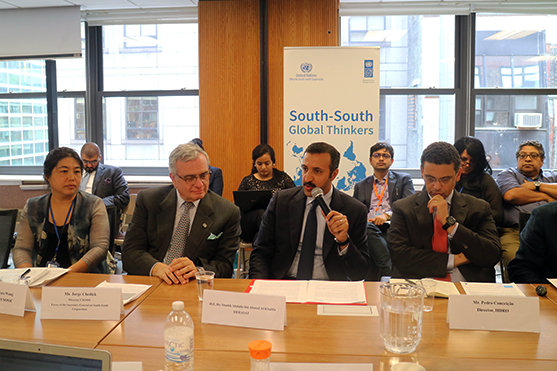
In the lead up to the upcoming 2019 Human Development Report (HDR) on inequality, the United Nations Office for South-South Cooperation (UNOSSC) and the Human Development Report Office (HDRO) recently held a joint meeting in New York with members of the South-South Global Thinkers – a Global Coalition of Think Tank Networks for South-South Cooperation.

The meeting brought together over 13 Southern-based think tanks and many more engaged in an earlier e-discussionon the topic of inequality via the South-South Global Thinkers Platform.

In his opening remarks, Mr. Pedro Conceição, Director of HDRO stressed the importance of this event and how the 2019 HDR will “provide new lenses and an approach that is different from traditional ones of understanding inequality.”

UNOSSC Director and Envoy of the Secretary-General on South-South Cooperation, Mr. Jorge Chediek, and Deputy Director, Ms. Xiaojun Grace Wang, both highlighted how South-South cooperation can develop more effective partnerships to reduce the issue of inequality between and among countries.

H.E Dr. Shaikh Abdulla bin Ahmed Al Khalifa, Chairman of the Bahrain Centre for Strategic, International and Energy Studiesand Undersecretary for International Affairs at the Ministry of Foreign Affairs of the Kingdom of Bahrain, made a special intervention to discuss the steps taken in the Kingdom of Bahrain to tackle inequality. He credited three things: political willingness; a comprehensive reform to ensure equality irrespective of gender, religion, race, or other factors; and the existence of solid legislative structures and legal mechanisms.

The South-South Global Thinkers Network members presented their country and regional experiences, especially noting areas in which a reduction in inequality can have significant economic, social and political returns. However, Professor Sachin Chaturvedi, from the Research and Information System for Developing Countries (RIS)in India, indicated that Southern transformative solutions and efforts to address inequality are not as visible as Northern efforts.

Dr. Bhattacharya a Distinguished Fellow at the Centre for Policy Dialogue in Bangladeshstressed the importance of understanding the relationship between growth, inequality and voice; while Ms. Cai, from Development Alternatives with Women for a New Era, discussed the lack of indicators for measuring things like social norms and cultural values which can have a profound impact on issues such as health, gender equality, gender-based violence and educational attainment.

Dr. André de Mello e Souza, a senior researcher from the Institute for Applied Economic Researchin Brazil, noted that “trickle down effects have not been operating in Latin America, preventing growth from leading to poverty reduction. In addition, inequality can hurt the quality of democracy and political stability (…) What is needed is deeper change and structural transformation.”

Participants also reflected on regional experiences. Dr. Racha Ramadan, from the Economic Research Forum, identified four key drivers contributing to the inequality in the Arab States: mismanaged economic reforms; lack of structural transformation; constrained fiscal space for social expenditures; and poor governance.

Dr. Onyekwena, from the Center for the Study of the Economies of Africain Nigeria, discussed technology, which is likely to widen inequality especially in Africa, given the differential access to technology between countries.

Ms. Ngu Wah Win, from Centre for Economic and Social Development in Myanmar, noted that “Southeast Asian nations have broadened access to schooling and maintained relatively low unemployment, but inclusion in the growth process for a majority of the population increasingly depends on quality of education, skills and jobs”.

The meeting concluded with the sharing of expert insights on the issue of inequality, and recommendations to delve deeper into certain thematic issues such as governance, climate change, technology, gender, health, access to productive resources, social norms, and culture, among others. The issue of data challenges in adequately painting a picture of inequality was also discussed at length; the efforts of the 2019 HDR to go beyond traditional methodological approaches was highly appreciated across the table.

For more information, please contact Ms. Shams Banihani, Knowledge and Research Specialist, UNOSSC, at shams.banihani@unossc.org, or Ms. Tanni Mukhopadhyay, Senior Researcher and Policy Specialist, HDRO, at tanni.mukhopadhyay@undp.org.
Related Post


  • All Post
  • ATCT Featured Publications POM
  • BAPA+40
  • Blog
  • Capacity Development Initiatives
  • CICETE Featured Publications POM
  • CIKD
  • Cities Clusters - Agriculture
  • Cities Clusters - COVID-19
  • Cities Clusters - COVID-19 Knowledge Products
  • Cities Clusters - DRR
  • Cities Clusters - E-commerce
  • Cities Clusters - Tourism
  • Cities Clusters - Tourism Knowledge Products
  • Cities Clusters - Transport
  • Cities Clusters - Waste
  • Cities Project
  • Cities Project COVID-19 Newsletters
  • Cities Project COVID-19 Response
  • Cities Project Knowledge Products
  • Classic (untouched)
  • Climate Action
  • COMSATS Featured Publications POM
  • COMSATS Featured Solutions POM
  • Converted from Divi
  • Converted from Mixed
  • Converted from WPBakery
  • COVID-19
  • COVID-19 Page Featured Solutions
  • DRR Knowledge Products
  • DRR News
  • Empty Post
  • Events
  • Featured Event UN-Habitat POM
  • Financing for Development
  • Financing Mechanisms
  • g7+
  • Gender Events
  • Gender News
  • Good Practices in SSTrC Series
  • Good Practices Publications
  • Good Practices Thematic Series & Special Editions
  • Good Practices Vol. 2
  • Good Practices Vol. 3
  • GSSDC
  • Highlighted
  • Highlighted Publications
  • IAEA Featured Solutions POM
  • IBRAF Featured Publications POM
  • IBSA Fund
  • IBSA Fund Annual Reports
  • IBSA Fund News and Stories
  • IBSA Fund Publication
  • IBSA Fund Story
  • ICGEB Featured Events POM
  • ICGEB Featured Publications POM
  • ICGEB Featured Solutions POM
  • ILO Featured Events POM
  • ILO Featured Publications POM
  • ILO Featured Solutions POM
  • India-UN Development Partnership Fund
  • India-UN Fund Publication
  • India-UN Fund Story
  • IsDB
  • IsDB Featured Publications POM
  • IsDB SCC
  • News
  • Norec Featured Publications POM
  • Norec Featured Solutions POM
  • Peace and Development
  • PGTF Publications
  • PGTF Story
  • PICA Featured News POM
  • PICA Featured Publications POM
  • PICA Featured Solutions POM
  • PIDF Featured Publications POM
  • Publications
  • Regional Updates
  • Research
  • ROK-UNOSSC Facility
  • SGP Featured Publication POM
  • SGP Featured Solutions POM
  • Solution
  • South South in Action
  • South-South Global Thinkers
  • South-South Ideas
  • South-South Ideas Series
  • South-South in Action Series
  • Southern Response to COVID-19
  • SSN4PSI Featured Publications POM
  • SSN4PSI Featured Solutions POM
  • Training
  • UN Day for SSC 2020
  • UN Fund for SSC
  • UN SSC Day Publications
  • UN-Habitat Featured Publications POM
  • UN-HABITAT Featured Solutions POM
  • UNCCT
  • UNEP Featured Publications POM
  • UNFPA
  • UNFSSC Publication
  • UNFSSC Story
  • UNIDO Featured Publications POM
  • UNIDO Featured Solutions POM
  • UNIDO POM Events
  • UNOCT Featured Publications POM
  • UNV
  • UNV Featured Publications POM
  • WB Featured Publications POM
  • WB Featured Solutions POM
  • Webinars
  • WFP Featured Events POM
  • WFP Featured Publication POM
  • WFP Featured Solutions POM
  • WIPO
  • Workshops and Seminars
  • Youth4South
  • z Across the Globe 1
  • z Across the Globe 2
  • z Across the Globe 4
  • z Across the Globe 5
  • z Across the Globe 6
  • z Across the Globe 7
  • z Across the Globe 8
  • z ES BAPA+40
  • z ES Eventos
  • z ES Noticias
  • z ES Noticias Destacadas
  • z ES Publicaciones
  • z ES Publicaciones Destacadas
  • z ES Serie Buenas Prácticas en la CSSyT
  • z ES Serie El Sur-Sur en Acción
  • z FR Actualités
  • z FR BAPA+40
  • z FR Événements
  • z FR Publications
  • z FR Publications en vedette
  • z FR Série Bonnes pratiques en CSST
  • z FR Série Sud-Sud en action
  • z Highlighted News
  • z Photos
  • z Videos
  • z ZH BAPA+40
  • z ZH Events
  • z ZH News

ABOUT

Terms of Service

Privacy Policy

Disclosures

RESOURCES

Terms of Service

Privacy Policy

Disclosures

ENGAGE

Terms of Service

Privacy Policy

Disclosures

Copyright © UNOSSC/UNDP

wpChatIcon
wpChatIcon

Alliance Application Form

Submit an Expression of Interest and/or Demand Signal. UNOSSC reviews submissions on a rolling basis.

1. Official name of organization / institution / government entity (exclusions to apply) *
2. Country *
3. Region *
4. SDG *
Secondary SDG *
5. Partner category *
6. Website *
7. Brief description of your institution (max. 150 words) *
Name for the Lead *
Title for the Lead *
Email address for the Lead *
Name for the co-lead
Title for the co-lead
Email address for the co-lead
Section 3. Expression of Interest in the Alliance *
Additional information on proposed areas of engagement may be requested through the platform following initial review by the Alliance Secretariat.
Section 4. Due Diligence and Integrity Declaration *

Submission Note:

  • Submission of this Expression of Interest form does not automatically confer participation in the Alliance.
  • All submissions will be reviewed by the Alliance Secretariat, including basic eligibility screening and proportionate due diligence, as appropriate.
  • Participation in Alliance activities is determined based on relevance to articulated cooperation needs, alignment with Alliance principles, and integrity considerations.
  • Engagement under the Alliance is voluntary, non-binding, and facilitative in nature, and does not constitute funding approval, contractual commitment, or institutional membership.
  • The Alliance Secretariat may contact submitting entities for additional information or clarification during the review process.

Submission of Demand Form

Description of Demand

Indicate the type of support or cooperation requested through the Alliance.
Please briefly describe the challenge, gap, or priority. (Max. 300 words)

Thematic and Geographic Focus

Please indicate the main focus areas of your demand:

A. Thematic Areas (select up to three)
B. Geographic Focus (select all that apply)

Proposed Engagement Modalities

Please indicate how you would like to engage through the Alliance (select all that apply):

Expected Outcomes

Please indicate the main results you seek to achieve through this engagement. (Max. 200 words)
Examples:
• Capacity strengthened
• Partnerships established
• Sectoral or regional strategies co-developed
• Solutions piloted
• Knowledge generated
• Policies informed

Timeline and Readiness (if applicable)

1. Expected timeframe for engagement:
2. Current stage:

Additional Information

Please provide any additional information, documents, or links relevant to this submission.
(Max. 200 words or upload link)

Submission of Offer Form

Description of Contribution

Indicate the type of contribution your institution can provide and describe the expertise, resources, or solutions you may offer.
Please briefly describe your proposed contribution. (Max. 300 words)

Thematic and Geographic Focus

Please indicate the main focus areas of your interest:

A. Thematic Areas (select up to three)
B. Geographic Focus (select all that apply)

Proposed Engagement Modalities

Please indicate how you would like to engage through the Alliance (select all that apply):

Expected Outcomes

Please indicate the main results you aim to achieve through this engagement. (Max. 200 words)
Examples:
• Capacity strengthened
• Partnerships established
• Sectoral or regional strategies co-developed
• Solutions piloted
• Knowledge generated
• Policies informed

Timeline and Readiness (if applicable)

1. Expected timeframe for engagement:
2. Current stage:

Additional Information

Please provide any additional information, documents, or links relevant to this submission.
(Max. 200 words or upload link)

Organization Registration

Authentication & Due Diligence This prototype simulates identity verification, due diligence confirmation, and an authentication step before submission. *

First Name *
Last Name *
Email address *
Password *
Confirm Password *
Name of institution / organization *
Country / Region *
Organization Type *
Organization other *
Function / role *
Organization logo *
Maximum file size: 1 GB

Login

Login / email *
Password *
Remember me

Forgot password?

Connect form

Your name *
Email *
Organization / institution *
Job title / role *
Reason for connecting:
Short message

Scroll to Top