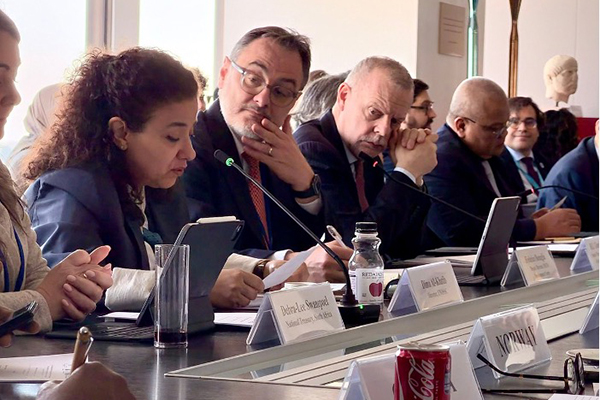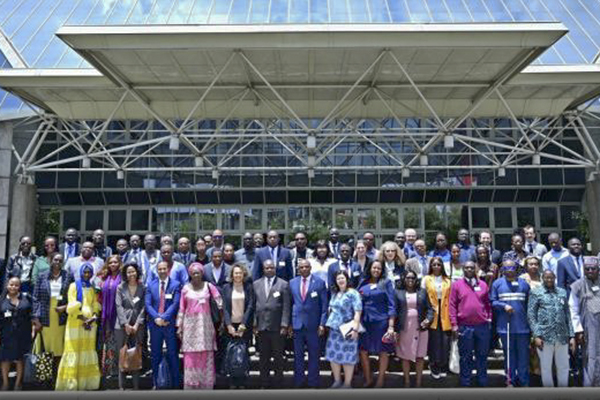
UNOSSC Director Dima Al-Khatib delivered remarks during the opening session of the ‘Preparatory regional workshop on voluntary national and local reviews’ held in Addis Ababa, Ethiopia, in a hybrid format.
“It is remarkable that with this cycle’s conclusion, every one of Africa’s 54 states will have completed at least one Voluntary National Review (VNR),” said the Director. “A clear sign of the continent’s dedication not only to the VNRs but also to both the 2030 Agenda for Sustainable Development and the African Union’s Agenda 2063: The Africa We Want.”
Participants at the workshop focused on strengthening integration, and aligned reporting for the 2030 Agenda and Agenda 2063.
This annual event was co-organized by the United Nations Economic Commission for Africa (UNECA), United Nations Department of Economic and Social Affairs (UNDESA), UN-Habitat, United Nations Office of the Special Advisor on Africa (OSAA), and African Peer Review Mechanism (APRM), on the sidelines of the Tenth Session of the Africa Regional Forum on Sustainable Development (ARFSD). The annual preparatory and capacity-building workshop is part of the ongoing support for voluntary national and local reviews by UNECA and its partners.
The objectives of the 2024 preparatory workshop were to strengthen the capacity of members to implement the 2030 Agenda and Agenda 2063, link local and national processes, support preparations for the submission of national reviews to the high-level political forum at its 2024 meeting, and identify African priorities for the high-level political forum.
The workshop also served as a platform to exchange best practices and experiences at both national and subnational levels, involving stakeholders from voluntary reviews, with the ultimate goal of discussing how these reviews can accelerate the implementation of the 2030 Agenda and Agenda 2063.
Plenary sessions included the role of data in unlocking the relevance and accuracy of voluntary national reviews, how action-oriented voluntary local reviews inform policies that further the implementation of the Sustainable Development Goals and, the contribution of voluntary local reviews to voluntary national reviews.
In her message, the Director underlined the impact and value of South-South cooperation in the VNR process. When developing countries work together and support each other on the preparations of their VNRs, she said, they derive relevant lessons and insights, leading to mutual demand-driven collaborations. She reaffirmed UNOSSC’s commitment to supporting Member States in integrating these perspectives into their VNRs, noting that South-South and triangular cooperation play a crucial role in knowledge and experience exchange for sustainable development; while the VNR process, among other things, facilitates experience-sharing for actualizing the SDGs.
It was noted that the Handbook for integrating South-South and triangular cooperation perspectives into VNRs, launched on the sidelines of the 2023 HLPF, serves as a valuable resource to countries. Notably, Rwanda identified twinning through South-South cooperation as one of the measures to be adopted in enhancing its SDG data generation and utilization capacity.
Other speakers at the opening ceremony included: Director, Subregional Office for Eastern Africa, UNECA, Mama Keita; Under-Secretary-General and Special Adviser on Africa, Cristina Duarte; Under-Secretary-General for Economic and Social Affairs, Department of Economic and Social Affairs (UNDESA), Li Junhua; and Permanent Secretary, Office of the Prime Minister, Uganda, Dunstan Balaba.
The workshop ended with a stakeholders’ townhall meeting that focused on identifying African priorities for the 2024 Summit of the Future.
The workshop also included presentations from Member States such as South Africa, Ghana, and Tunisia on their VNR and VLR experiences to facilitate learning.
? Watch Dima Al-Khatib delivered remarks.