 UNOSSC and UN Development Coordination Office deepen collaboration to support Resident Coordinators and UN Country Teams to mainstream South-South and triangular cooperation into UN Sustainable Development Cooperation Frameworks
Consistent with successive UN General Assembly resolutions, the United Nations Office for South-South Cooperation (UNOSSC) continues to operationalize the
2023 UN Guidelines for the Integration of South-South and Triangular Cooperation and the corresponding
e-learning modules launched in early 2025. As part of its system-wide support to the United Nations development system, UNOSSC is intensifying collaboration with the UN Development Coordination Office (DCO), Resident Coordinators (RCs), and UN Country Teams (UNCTs) to integrate South-South and triangular cooperation into national development strategies and UN Sustainable Development Cooperation Frameworks (UNSDCFs).
This effort supports the United Nations’ commitment to make South-South and triangular cooperation a key accelerator of the Sustainable Development Goals (SDGs), empowering countries to exchange knowledge, solutions, and technologies tailored to their development realities.
Engaging Resident Coordinators and UN Country Teams
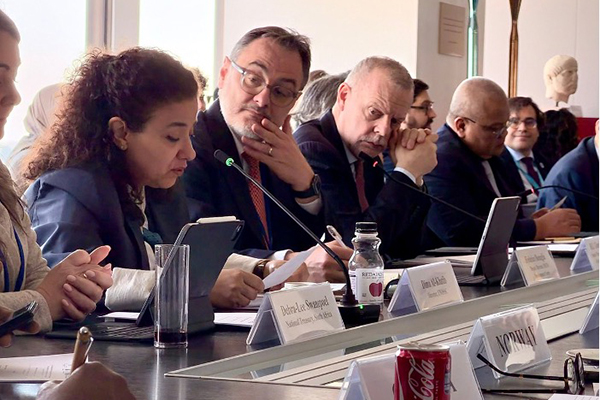
In August 2025, UNOSSC and DCO co-organized a dedicated meeting with Resident Coordinators from Landlocked Developing Countries (LLDCs) to explore opportunities to harness South-South and triangular cooperation in implementing the Awaza Programme of Action.
Ms. Dima Al-Khatib, UNOSSC Director, presented UNOSSC’s mandate and five service lines, emphasizing the critical leadership of RCs in embedding South-South and triangular cooperation within national development planning and UNSDCFs. The discussion showcased a range of UNOSSC-supported initiatives in LLDCs, including over USD 26 million in projects funded through the India-UN Development Partnership Fund and the IBSA Fund, spanning areas such as food security, climate resilience, and maternal health.
Participants also highlighted new initiatives, such as a climate-smart agriculture project in Central Asia, and discussed the use of knowledge platforms including
South-South Galaxy and the
South-South Global Thinkers network, which feature nearly 400 solutions from LLDCs.
RCs welcomed UNOSSC’s support and recommended that the Office present its service offer to the broader RC system during the upcoming Global Meeting of Resident Coordinators in New York.
Building African UN Country Team Capacities
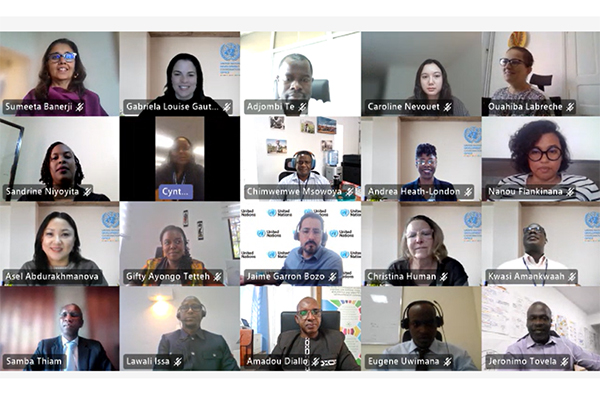
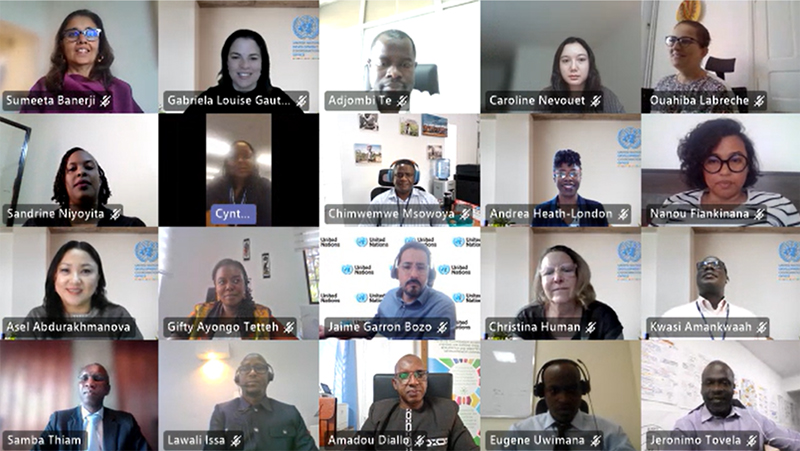
In response to growing demand from UN Country Teams across Africa, UNOSSC and DCO jointly organized a regional webinar on
“Leveraging South-South and Triangular Cooperation for UNSDCF Implementation in Africa” on 10 September 2025.
The session, attended by 35 participants from over 12 UNCTs, brought together Heads of Resident Coordinator Offices and Partnership and Development Finance Officers to explore how South-South and triangular cooperation can be more effectively integrated into the design and implementation of UNSDCFs.
Discussions revealed strong and diverse demand for South-South and triangular cooperation across the region, particularly from Botswana, Central African Republic, Egypt, Mauritius, Nigeria, Rwanda, Seychelles, and Uganda. Requests through Opportunity Issue-Based Coalitions (OIBCs) covered a wide range of thematic priorities – from data and statistics, digitalization, and AI regulation to youth and women’s empowerment, education, and peacebuilding.
Examples included Botswana’s request for South-South cooperation support in designing an SDG data dashboard; Rwanda’s interest in integrating gender and disability data into national statistics; Mauritius and Seychelles’ focus on AI policy and regulation for SIDS; and Egypt’s call for peer learning on youth and women’s skills development. Several UNCTs also showcased their own South-South leadership, such as Rwanda’s digital public services and Namibia’s efforts to align South-South cooperation with Funding Compact dialogues.
As next steps, UNOSSC and DCO are developing a
Joint Roadmap for 2025-2026 to structure follow-up support for African RC Offices and UNCTs, in close collaboration with relevant Issue-Based Coalitions.
From Guidance to Practice: Country-Level Pilots
To translate the
Guidelines for the Integration of South-South and Triangular Cooperation and e-Modules into action, UNOSSC launched pilot collaborations with four UNCTs –
Indonesia, Uganda, Peru, and Mauritius & Seychelles – to identify practical entry points to strategically leverage South-South and triangular cooperation in the UN’s support to national priorities. UNOSSC is providing technical and financial support to 4 UNCTs, including:
- Indonesia: Supporting strategic recommendations to operationalize pathways on South-South and triangular cooperation to achieve outcomes in the new UNSDCF (2026-2030), aligned with the Government’s Grand Design for International Development Cooperation.
- Uganda: Providing technical and financial support for a national stocktaking exercise and development of a national South-South and triangular cooperation strategy to inform a National Platform and the upcoming UNSDCF (2026-2029).
- Peru: Supporting a national stock-taking and UN Country Team mapping of South-South and triangular cooperation initiatives to inform the Common Country Analysis and forthcoming Cooperation Framework.
- Mauritius and Seychelles: Partnering with the RCO on two initiatives – Blue Economy financing for SIDS and AI policy and regulation – to promote peer learning and inform climate and digital priorities under the Antigua and Barbuda Agenda for SIDS.
Institutionalizing South-South and Triangular Cooperation Across the UN System
- Building on these experiences, in 2026, UNOSSC will: Share lessons from UNCT pilot initiatives across regions;
- Develop practical tools such as mapping templates, scopes of work for stocktaking and strategy exercises, and concept notes for national platforms; and
- Establish a roster of experts and webinars to further strengthen RCO capacities to apply these tools in the context of CCAs and UNSDCFs.
Through these efforts, UNOSSC reaffirms its commitment to ensuring that South-South and triangular cooperation becomes a
systemic enabler of sustainable development, fostering collaboration, innovation, and solidarity across the Global South.