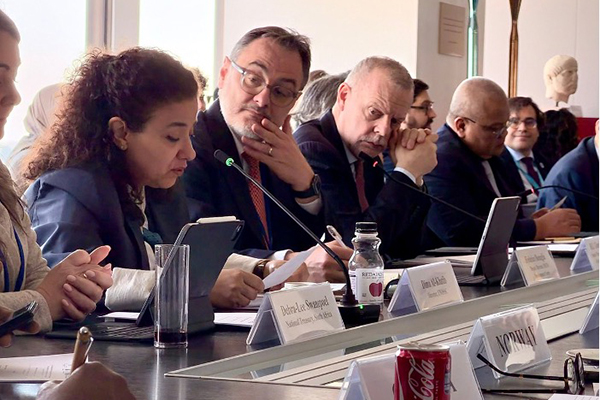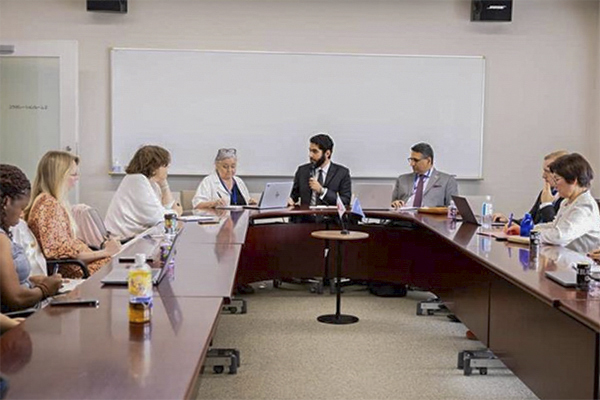
Ambassador Amr Aljowaily, the strategic advisor to the African Union Commission, chaired a special session on the Global South forum at the annual conference of the Academic Council on United Nations Studies (ACUNS), urging the importance of enhancing negotiating capabilities through institutional memory among the negotiators of the Global South.
The conference, which was held in Tokyo, was jointly organized by the United Nations University and the University of Tokyo.
Speakers at the session included Secretary-General of the Organisation of Southern Cooperation Sheikh Manssour Bin Mussallam; Executive Director of the South Centre Dr. Carlos Correa; Director of United Nations Office for South-South Cooperation (UNOSSC) Dima Al-Khatib; Senior Specialist, of the United Nations Institute for Training and Research (UNITAR) Philippe Aubert; and Professor Katie Verlin Laatikainen editor of “Group Politics in UN Multilateralism”.
“The global development cooperation architecture is witnessing a significant transformation,” said Dima Al-Khatib, Director of the United Nations Office for South-South Cooperation (UNOSSC). “Southern development partners are playing an increasingly influential role in multilateral fora, bringing new perspectives, resources, and innovative approaches to the forefront of the international development agenda.”
For example, the 2023 21st Session of the High-Level Committee on South-South Cooperation underscored the importance of a cohesive United Nations system-wide strategy to leverage South-South and triangular cooperation to support Member States.
“In recent years,” Director Al-Khatib said, “demand from Member States for UN system assistance in this area has surged, as illustrated by various inter-governmental processes, including Third South Summit, LDCV, and SIDS4.”
She provided some examples: Since 2021, requests for UN support on South-South or triangular cooperation have risen steadily from 53% to 61% of host country governments. Requests focused mainly on health, climate change, and social protection. And the development system responded to an increased number of governments (71% in 2023 compared to 67% in 2022). In 2023, 81% of UN entities included South-South cooperation in their strategic plans. 86% integrated South-South results in corporate reporting. Since 2021, there has been a significant increase (from 27% to 47%) in Member States reporting that they received UN support for organizing global, regional, or national knowledge-sharing initiatives on solutions from the Global South.
She also highlighted the efforts of UNOSSC in Policy and Intergovernmental Support, Capacity Development, Knowledge Co-creation and Management, and South-South Trust Fund Management.
In his opening remarks, Aljowaily noted the importance of the current year as it witnesses the celebration of the sixtieth anniversary of the establishment of the Group of 77 with the holding of the Third South Summit and the passage of a similar period for the Non-Aligned Movement, which celebrated its sixtieth anniversary at the Ministerial meeting in Belgrade in 2021, in addition to the emergence of minilateral South forums such as BRICS+.
He highlighted the importance of enhancing negotiating capabilities through institutional memory among the negotiators of the South, especially given the lack of a permanent secretariat in most of its groupings, and the importance of using digital platforms and tools to support negotiators from the countries of the South, to compensate for the relative lack of institutional secretariats, and networks of dedicated research centers and specialized academic.
Sheikh Bin Mussallam highlighted the newly established Southern Cooperation Organization, headquartered in Addis Ababa, as a pioneering experience to institutionalize cooperation among the countries of the South from Africa, Asia and Latin America, resting on education as a priority for exchanging relevant experiences among Member States, with the aim of strengthening a sense of collective identity stemming from common challenges and the benefit of cooperation. He called for horizontal solidarity between the countries of the South in addition to vertical cooperation with the Global North.
Mr. Correa, Director of the Geneva-based South Center, reviewed the joint centers established by the Global South, citing the Non-Aligned Movement centers whose focus is on scientific and technological aspects. He recalled that the establishment of Group of 77 was linked to the initiative of convening a United Nations Conference on Trade and Development (UNCTAD) as a platform for issues of priority to developing countries.
He called for allocating more resources to these centers and enhancing cooperation among them to achieve the goal of achieving the interests of the South in multilateral negotiations and forums.
Aubert presented the activities carried out by UNITAR to build the negotiating capabilities of the countries of the South by relying on internal resources and joint projects with some Member States, pointing out to the importance of enhancing skills and knowledge on specialized negotiating topics.
Professor Laatikainen summarized the contents of her reference book “Group Policies in Multilateral Forums,” noting the important role played by the Non-Aligned Movement and the Group of 77 in promoting multilateralism for achieving international cooperation to confront common challenges.