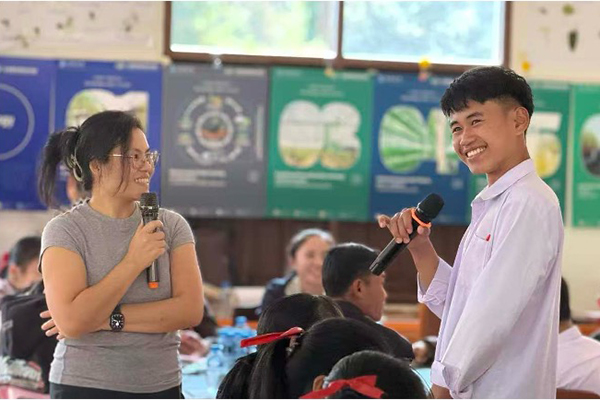
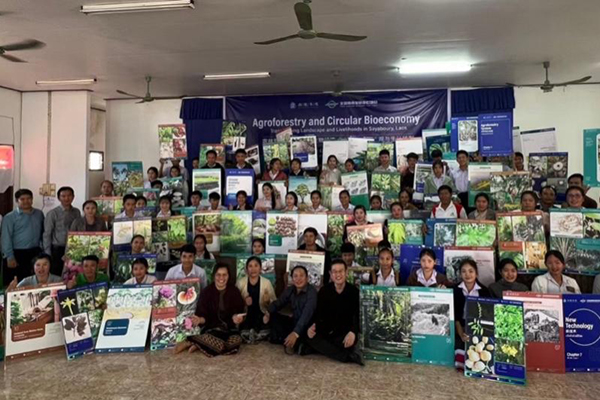
Sayaboury Province, Lao PDR — From 6 to 7 February 2026, the Mountain Futures team from the Kunming Institute of Botany of the Chinese Academy of Sciences delivered a hands-on training on nature-based farming at Sayaboury Ethnic School.
The workshop, titled “Agroforestry Systems and Circular Bioeconomy,” brought together nearly 100 participants, including teachers, students and local agricultural technicians, to explore practical approaches to sustainable agriculture.
A partnership to strengthen local capacity
The training forms part of the small-grant initiative “Demonstration and Capacity Building for Agroforestry and Circular Agriculture in Sayaboury, Lao PDR,” implemented under Phase II of the Global South-South Development Center Project (GSSDC) .
The initiative supports communities to apply agroforestry and circular agriculture practices, strengthen resilience, restore ecosystems and improve livelihoods—contributing to a green transition in Sayaboury Province.
The workshop was co-organized with partners including the Department of Land Administration and Management of the Lao Ministry of Agriculture and Environment, the World Agroforestry Centre and the Wyss Academy for Nature.
 Making science accessible
To translate technical concepts into practical knowledge, facilitators used simple, relatable language. Agroforestry was described as a “garden in the forest,” while the circular bioeconomy was framed as ensuring that “nature’s gifts are not wasted.”
The training featured eight interactive modules covering key elements of sustainable development. Set in Sayaboury—along the Mekong River and known for its rich agricultural traditions—the programme connected scientific approaches with local knowledge and practices.
By combining traditional farming wisdom with modern techniques, the initiative aims to build skills, inspire young people and support community-led pathways toward sustainable agriculture.
Watch a project video by clicking here.
About GSSDC Phase II:
The Global South-South Development Center (GSSDC) is a flagship initiative of the United Nations Office for South-South Cooperation, funded by the Government of China, under the framework of the United Nations Fund for South-South Cooperation (UNFSSC). Jointly implemented with the China International Center for Economic and Technical Exchanges (CICETE), GSSDC Phase II (2025–2030) will expand both thematically and geographically, prioritizing: agriculture and rural transformation, green and resilient development, new industrialization, cultural and creative economy. Phase II seeks to leverage the technical expertise and resources of the China South-South Cooperation Network (CSSCN) to advance practical and technological cooperation, capacity development, knowledge exchange and network-building, while promoting South-South and triangular cooperation among cities and sub-national entities globally.
Making science accessible
To translate technical concepts into practical knowledge, facilitators used simple, relatable language. Agroforestry was described as a “garden in the forest,” while the circular bioeconomy was framed as ensuring that “nature’s gifts are not wasted.”
The training featured eight interactive modules covering key elements of sustainable development. Set in Sayaboury—along the Mekong River and known for its rich agricultural traditions—the programme connected scientific approaches with local knowledge and practices.
By combining traditional farming wisdom with modern techniques, the initiative aims to build skills, inspire young people and support community-led pathways toward sustainable agriculture.
Watch a project video by clicking here.
About GSSDC Phase II:
The Global South-South Development Center (GSSDC) is a flagship initiative of the United Nations Office for South-South Cooperation, funded by the Government of China, under the framework of the United Nations Fund for South-South Cooperation (UNFSSC). Jointly implemented with the China International Center for Economic and Technical Exchanges (CICETE), GSSDC Phase II (2025–2030) will expand both thematically and geographically, prioritizing: agriculture and rural transformation, green and resilient development, new industrialization, cultural and creative economy. Phase II seeks to leverage the technical expertise and resources of the China South-South Cooperation Network (CSSCN) to advance practical and technological cooperation, capacity development, knowledge exchange and network-building, while promoting South-South and triangular cooperation among cities and sub-national entities globally.
Making science accessible
To translate technical concepts into practical knowledge, facilitators used simple, relatable language. Agroforestry was described as a “garden in the forest,” while the circular bioeconomy was framed as ensuring that “nature’s gifts are not wasted.”
The training featured eight interactive modules covering key elements of sustainable development. Set in Sayaboury—along the Mekong River and known for its rich agricultural traditions—the programme connected scientific approaches with local knowledge and practices.
By combining traditional farming wisdom with modern techniques, the initiative aims to build skills, inspire young people and support community-led pathways toward sustainable agriculture.
Watch a project video by clicking here.
About GSSDC Phase II:
The Global South-South Development Center (GSSDC) is a flagship initiative of the United Nations Office for South-South Cooperation, funded by the Government of China, under the framework of the United Nations Fund for South-South Cooperation (UNFSSC). Jointly implemented with the China International Center for Economic and Technical Exchanges (CICETE), GSSDC Phase II (2025–2030) will expand both thematically and geographically, prioritizing: agriculture and rural transformation, green and resilient development, new industrialization, cultural and creative economy. Phase II seeks to leverage the technical expertise and resources of the China South-South Cooperation Network (CSSCN) to advance practical and technological cooperation, capacity development, knowledge exchange and network-building, while promoting South-South and triangular cooperation among cities and sub-national entities globally.