United by Water: Securing Our Collective Water Future Amidst Rising Seas and Melting Glaciers
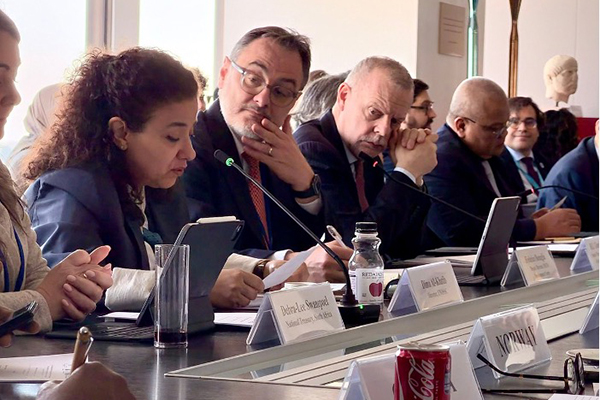
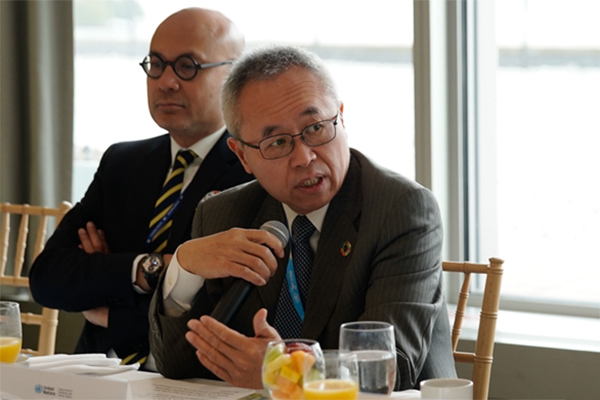
Mr. Li Junhua, United Nations Under-Secretary-General for Economic and Social Affairs delivering opening remarks at the high-level meeting.Addressing transborder water issues and climate change through regional-level South-South and triangular cooperation
The State of the Global Climate Report released by the World Meteorological Organization (WMO) in March 2024 warned that every single climate indicator was broken last year, marking 2023 the warmest year on record. Sea level rise, Antarctic sea ice loss and glacier retreat, among others, were particularly high, figuring in the increased frequency and intensity of water-related disasters.
The major shifts in the global water cycle in recent years play out, with some regions seeing greater annual or seasonal precipitation, while others see much less. Demonstrating this vividly – as the global community convened for the 79th UN General Assembly in September 2024 – were prolonged droughts plaguing some parts of the world, while other parts were being hit by floods at levels they have not seen before (in amounts “statistically rare it’s considered a one-in-a-thousand-year event”).
In a global call to action, the Permanent Missions to the United Nations of Antigua and Barbuda, Argentina, France, Indonesia, Saint Lucia, Samoa and Tajikistan, along with partners within and beyond the United Nations (United Nations Office for Disaster Risk Reduction; United Nations Educational, Scientific and Cultural Organization; World Meteorological Organization; UNOSSC; and the Present and Future Institute/PFI) co-organized a high-level meeting on the side of UNGA79 entitled “United by Water: Securing Our Collective Water Future Amidst Rising Seas and Melting Glaciers.”
The meeting brought attention to the role of water in the future of humanity, to the impact of climatic change and sea level rise for all countries (starting with Small Island Developing States) and, to the urgency new data indicates. The meeting was also organized by partners in the lead up to the 2025 UN Ocean Conference and the 2026 UN Water Conference.
The Global South is particularly hit hard by climatic changes, which complicate efforts to accelerate progress on the Sustainable Development Goals (SDGs).
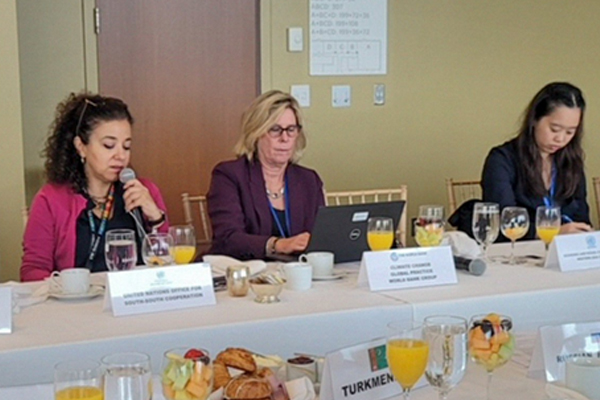
UNOSSC Director Dima Al-Khatib underlined at the event that solidarity is necessary to propel this kind of action and that South-South and triangular cooperation, at its core, is about this solidarity among countries on similar or relatable development pathways, working with partners committed to advancing developing countries’ self-defined priorities. The Director also noted that proximity of experience as well as geography will be crucial in tackling the differentiated impact of interlocking crises. The “water agenda” not only cuts across but underpins all our goals for a more peaceful, inclusive, sustainable future, she said. Extreme weather patterns and disasters affect communities and economies across borders; floods know no territorial boundaries; and cooperation among neighbors and at the regional level therefore will be critical.
The Intergovernmental Panel on Climate Change (IPCC) noted that “all components of the global water cycle have been modified due to climate change in recent decades”, and the Copernicus Climate Change Service (C3S) reported that glaciers lost 600 Gt of water in 2023, the largest annual mass loss on record since 1976. Glaciers (along with snow cover, ice caps and permafrost, collectively known as the cryosphere) are the world’s largest natural reservoir of freshwater on which billions rely; changes to these reservoirs therefore have significant impact on climate and ecosystems as well as human, social and economic development.
Recognizing the urgent need to protect the cryosphere, Member States passed UNGA Resolution 77/158 declaring 2025-2034 as the Decade of Action for Cryospheric Sciences and 2025 as the International Year of Glacier Preservation. Tajikistan played a crucial role in establishing the latter, which aligns with its efforts on the Dushanbe Water Process that aims to mobilize global action on the protection as well as sustainable management and use of water resources in the context of climate change.
For more information on this dialogue, please contact Minerva Novero-Belec, Regional Policy Specialist (minerva.novero@unossc.org).

 The Global South is particularly hit hard by climatic changes, which complicate efforts to accelerate progress on the Sustainable Development Goals (SDGs).
UNOSSC Director Dima Al-Khatib underlined at the event that solidarity is necessary to propel this kind of action and that South-South and triangular cooperation, at its core, is about this solidarity among countries on similar or relatable development pathways, working with partners committed to advancing developing countries’ self-defined priorities. The Director also noted that proximity of experience as well as geography will be crucial in tackling the differentiated impact of interlocking crises. The “water agenda” not only cuts across but underpins all our goals for a more peaceful, inclusive, sustainable future, she said. Extreme weather patterns and disasters affect communities and economies across borders; floods know no territorial boundaries; and cooperation among neighbors and at the regional level therefore will be critical.
The Intergovernmental Panel on Climate Change (IPCC) noted that “all components of the global water cycle have been modified due to climate change in recent decades”, and the Copernicus Climate Change Service (C3S) reported that glaciers lost 600 Gt of water in 2023, the largest annual mass loss on record since 1976. Glaciers (along with snow cover, ice caps and permafrost, collectively known as the cryosphere) are the world’s largest natural reservoir of freshwater on which billions rely; changes to these reservoirs therefore have significant impact on climate and ecosystems as well as human, social and economic development.
Recognizing the urgent need to protect the cryosphere, Member States passed UNGA Resolution 77/158 declaring 2025-2034 as the Decade of Action for Cryospheric Sciences and 2025 as the International Year of Glacier Preservation. Tajikistan played a crucial role in establishing the latter, which aligns with its efforts on the Dushanbe Water Process that aims to mobilize global action on the protection as well as sustainable management and use of water resources in the context of climate change.
For more information on this dialogue, please contact Minerva Novero-Belec, Regional Policy Specialist (minerva.novero@unossc.org).
The Global South is particularly hit hard by climatic changes, which complicate efforts to accelerate progress on the Sustainable Development Goals (SDGs).
UNOSSC Director Dima Al-Khatib underlined at the event that solidarity is necessary to propel this kind of action and that South-South and triangular cooperation, at its core, is about this solidarity among countries on similar or relatable development pathways, working with partners committed to advancing developing countries’ self-defined priorities. The Director also noted that proximity of experience as well as geography will be crucial in tackling the differentiated impact of interlocking crises. The “water agenda” not only cuts across but underpins all our goals for a more peaceful, inclusive, sustainable future, she said. Extreme weather patterns and disasters affect communities and economies across borders; floods know no territorial boundaries; and cooperation among neighbors and at the regional level therefore will be critical.
The Intergovernmental Panel on Climate Change (IPCC) noted that “all components of the global water cycle have been modified due to climate change in recent decades”, and the Copernicus Climate Change Service (C3S) reported that glaciers lost 600 Gt of water in 2023, the largest annual mass loss on record since 1976. Glaciers (along with snow cover, ice caps and permafrost, collectively known as the cryosphere) are the world’s largest natural reservoir of freshwater on which billions rely; changes to these reservoirs therefore have significant impact on climate and ecosystems as well as human, social and economic development.
Recognizing the urgent need to protect the cryosphere, Member States passed UNGA Resolution 77/158 declaring 2025-2034 as the Decade of Action for Cryospheric Sciences and 2025 as the International Year of Glacier Preservation. Tajikistan played a crucial role in establishing the latter, which aligns with its efforts on the Dushanbe Water Process that aims to mobilize global action on the protection as well as sustainable management and use of water resources in the context of climate change.
For more information on this dialogue, please contact Minerva Novero-Belec, Regional Policy Specialist (minerva.novero@unossc.org).