Least Developed Countries (LDCs) face persistent food insecurity driven by poverty, limited fiscal space, high debt, climate shocks and, in some contexts, conflict. Heavy reliance on food imports – 15 per cent of total merchandise imports in 2020, nearly double the global average – heightens exposure to price volatility and supply disruptions. In 2023, 57.3 per cent of people in LDCs were food-insecure, while undernourishment reached 22.1 per cent in 2022, more than twice the global average.
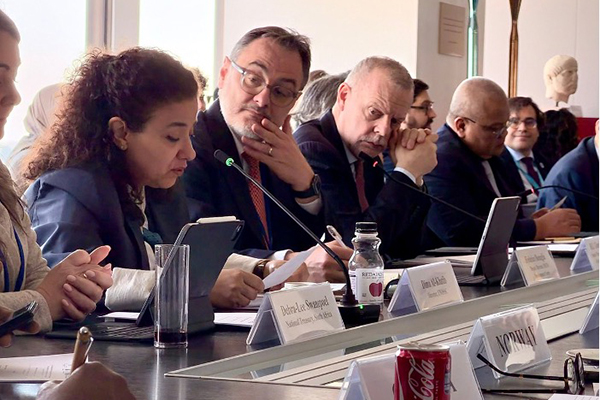
Against this backdrop, the United Nations Office of the High Representative for the Least Developed Countries, Landlocked Developing Countries and Small Island Developing States (UNOHRLLS) convened a two-day Expert Group Meeting on the Operationalization of the Food Stockholding Mechanism (FSM) for Least Developed Countries (LDCs). The meeting advanced the design of a flagship deliverable of the Doha Programme of Action (DPoA), which mandates the United Nations Secretary-General to assess the feasibility and modalities of establishing a dedicated food stockholding system for LDCs.
Director of the United Nations Office for South-South Cooperation (UNOSSC), Ms. Dima Al Khatib, provided strategic insights to the session titled “Establishing LDC Food Stockholding Mechanism: Leveraging International Initiatives, Building Partnerships and Synergies f the Meeting which focused on positioning the FSM within the broader global and regional food security architecture.
She reminded participants that South-South and triangular cooperation provide practical opportunities for shaping a Food Stockholding Mechanism that is responsive to LDC realities and grounded in proven experience from the Global South. The Director also emphasized that food insecurity in LDCs is not episodic but structural, driven by climate shocks, conflict, debt distress, fiscal constraints, and heavy import dependence. She therefore underscored that the FSM must strengthen emergency response capacity while contributing to longer-term resilience.
Participants examined how the mechanism can reinforce – not duplicate – existing initiatives, while addressing structural gaps that leave many LDCs vulnerable to recurrent food crises.
Lessons from Regional and National Mechanisms
The Director highlighted several Southern-led initiatives that offer relevant lessons for FSM design. Building on the presentation by Dr. Choomjet Karnjanakesorn, General Manager of the ASEAN Plus Three Emergency Rice Reserve (APTERR) Secretariat, she noted that APTERR demonstrates how advance agreements and earmarked national stocks can facilitate rapid emergency response, while also revealing the importance of streamlined decision-making and adequate scale.
From West Africa, she pointed to the ECOWAS Regional Food Security Reserve, which has combined pooled physical reserves, financial instruments, and decentralized stocks to support coordinated crisis responses. Since its establishment, this mechanism has supported 22 interventions benefiting over 4 million vulnerable people, reinforcing both regional solidarity and market integration.
The Director also referenced the Global Alliance Against Hunger and Poverty, spearheaded by the G20 under Brazil’s presidency, as an example of coordinated policy, financing, and peer learning across the Global South. Its focus on scaling evidence-based policies – including school feeding and support to smallholder farmers – and offers important insights for aligning emergency stockholding with food systems transformation.
Identified gaps in the current food security architecture, included uneven regional reserve coverage, underutilized financial instruments, and weak integration between early warning platforms and stock release protocols.
In this context, the UNOSSC Director underscored the Office’s role under its Strategic Framework 2026-2029 in facilitating structured knowledge exchanges among LDCs and other developing countries. UNOSSC will continue to support peer learning, policy dialogue, and documentation of good practices, particularly in areas related to governance models, operational modalities, and partnership design.
She further highlighted UNOSSC’s role in mobilizing triangular cooperation – aligning Southern-led initiatives with multilateral instruments and financing – to reduce fragmentation and enhance coherence across the food security and resilience landscape.
Advancing the Doha Programme of Action
The Expert Group Meeting marked an important step toward operational clarity for the FSM, which will be further refined ahead of presentation to the General Assembly. The outcomes will inform a detailed feasibility study, including a proposed pilot phase and resource mobilization strategy.
In closing, the UNOSSC Director reaffirmed that the FSM represents a concrete pathway to advance the DPoA by strengthening emergency food responses while reinforcing resilience and food systems transformation. “By drawing on existing initiatives, leveraging South-South and triangular cooperation, and fostering effective partnerships, this process can help reduce vulnerability to shocks and support more sustainable food security outcomes for the LDCs,” she concluded.
As momentum builds toward the 2027 Doha Midterm Review, the integration of South-South perspectives into the FSM’s design will remain essential to ensuring that no Least Developed Country is left behind in the global fight against hunger.
Read more about the event.