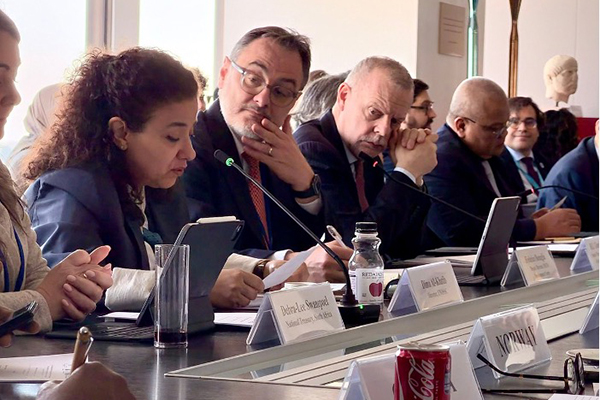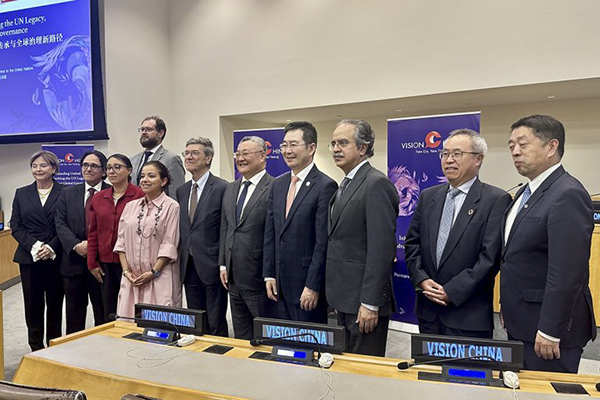
Leaders, diplomats, and experts gathered at the United Nations headquarters in New York on September 15 for a special Vision China event focused on strengthening multilateralism and ensuring that the voices of developing countries play a central role in shaping the future of international cooperation.
The forum, themed “Standing United: Inheriting the UN Legacy, Advancing Global Governance,” highlighted the Global Governance Initiative (GGI), a proposal launched earlier this month by Chinese President Xi Jinping at the Shanghai Cooperation Organization Summit in Tianjin. Participants emphasized that the initiative represents a timely call to reform global governance at a moment of intensifying crises, inequalities, and climate challenges.
China’s Permanent Representative to the UN, Ambassador Fu Cong, urged the international community to reaffirm the United Nations’ central role as the core of the multilateral system. “What we are grappling with today are the underrepresentation of the Global South, the undermined authority of multilateralism,” Fu said. “The rise of developing countries and emerging economies is reshaping the global landscape.”
Ambassador Fu positioned the GGI as China’s fourth global initiative, complementing the Global Development Initiative, Global Security Initiative, and Global Civilization Initiative.
UN Leaders and Partners Voice Support
The event took place ahead of the UN’s 80th anniversary, a milestone that many speakers saw as an opportunity to revitalize the organization.
Li Junhua, UN Under-Secretary-General for Economic and Social Affairs, underscored the urgency of strengthening multilateralism amid “persistent conflicts, rising debt distress, deepening inequalities and intensifying climate impacts.” He highlighted recent UN agreements such as the Pact for the Future and the Seville Commitment on financing for development as key frameworks for reform. “Progress toward our shared commitments for people, planet, peace, and prosperity is alarmingly off track,” Li warned. “With China’s partnership, alongside all Member States, we can strengthen multilateralism and chart a path toward peace, justice, and sustainability for all.”
Director of the United Nations Office for South-South Cooperation (UNOSSC) Dima Al-Khatib commended China’s leadership in advancing cooperation among developing nations, noting that it has played a pivotal role in building solidarity across the Global South. “Through the collaboration and support we have been having with China and other partners, we have been able to demonstrate South-South cooperation in action,” she said. She also pointed to an upcoming initiative to further expand collaboration: “We look forward to launching the China-UN Global South-South Development Facility to support green and resilient development, digital transformation, risk reduction, sustainable industrialization, and the economic empowerment of youth and women.”
Global South Voices
Diplomats from across the Global South echoed calls for reforms that would ensure their countries are fully represented in decision-making.
H.E. Majda Moutchou, Morocco’s Deputy Permanent Representative to the UN, praised the GGI for amplifying the perspectives of developing nations. “The current international landscape is increasingly shaped by turbulence and widening governance fragmentation. As the largest developing country and permanent member of the Security Council, China has the capacity to echo the voice of the Global South.”
H.E. Asim Iftikhar Ahmad, Pakistan’s Ambassador to the UN, added: “Today multilateralism stands at a crossroads, compelling us to reflect if our organizations are equipped to address these challenges. The answer lies in strengthening – not bypassing – the United Nations.”
From Nicaragua, Ambassador Jaime Hermida Castillo expressed deep appreciation for China’s leadership: “In this time of uncertainties and inequalities, China’s contribution represents a real help for balance, respect, and true development – and therefore for peace in our modern era.”
Russia’s Deputy Permanent Representative, H.E. Dmity Chumakov, signaled his country’s willingness to engage with the GGI: “It is essential that developing countries receive full recognition and that their voices are meaningfully heard in decision-making processes.”
UNOSSC Director Dima Al-Khatib underscored the shared responsibility among all actors to make these aspirations a reality: “South-South and triangular cooperation are practical pathways to results and vital channels for a more representative multilateral system,” she said. “By leveraging the knowledge, technologies, and policies emerging from the Global South, we can accelerate the implementation of the 2030 Agenda while strengthening resilience and collective self-reliance.”
A Shared Future
The event also featured remarks by Qu Yingpu, Publisher and Editor-in-Chief of China Daily, who linked today’s challenges to the founding ideals of the UN. Reflecting on the iconic “Knotted Gun” sculpture at UN headquarters, Qu described it as a symbol of humanity’s shared aspiration to “end war, prohibit killing, and pursue peace and development.”
“That aspiration is as pertinent today as it was on the UN’s founding,” Qu said.
Renowned economist Jeffrey Sachs, a professor at Columbia University, urged China to further scale up its role in sustainable development: “China is the only country in the world that can guide the path to zero-carbon energy and sustainable solutions for climate,” he said, proposing the creation of a major new UN campus in China to advance these goals.
UN at 80
With the United Nations approaching its 80th anniversary, speakers stressed that this milestone must be a turning point for reform and renewal.
“Under the guidance of the Global Governance Initiative, we stand ready to join hands with the United Nations and all partners to promote the building of a fairer and more equitable system of global governance,” Ambassador Fu declared. “Together, we can build a community with a shared future for humanity.”
The UNOSSC Director closed her remarks by highlighting the central role of the Global South in shaping renewed multilateralism: “At 80, the UN’s mission is both familiar and newly urgent. Our task is not only to respond to crises, but to help shape a multilateral system that is more inclusive, more resilient, and more capable of advancing human dignity,” she said. “UNOSSC stands ready to work with all partners to expand the exchange of knowledge, mobilize resources, and scale solutions that leave no one behind.”
The Vision China forum was co-hosted by China Daily and the Permanent Mission of China to the United Nations, and co-organized by the Bank of China.
Watch the event on the China Daily page here.