Youth Spotlight South-South Solutions at the 2025 World Social Summit
At the Second World Summit for Social Development, the United Nations Office for South-South Cooperation (UNOSSC) spotlighted the power of youth innovation through the showcasing of a youth-led tech prototype incubated through the joint UNESCO-UNOSSC South-South University Cooperation Network (SUCN).
The Summit brought together more than 40 Heads of State, 230 ministers, and 14,000 participants, with a strong call to “turn social pledges into action.” Youth, universities, and innovators from across the Global South were at the forefront, echoing the Summit’s message that investing in people is the most sustained investment a nation can make.
Universities as Engines of Innovation and Sustainability
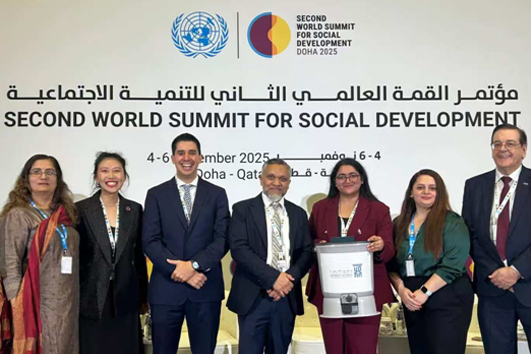
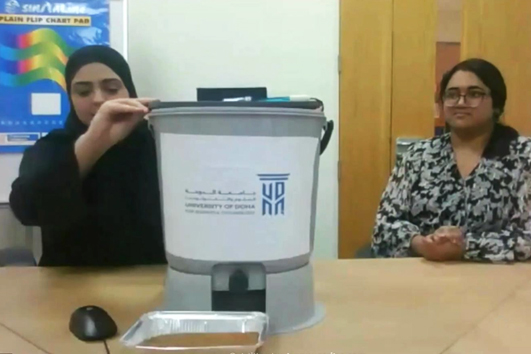
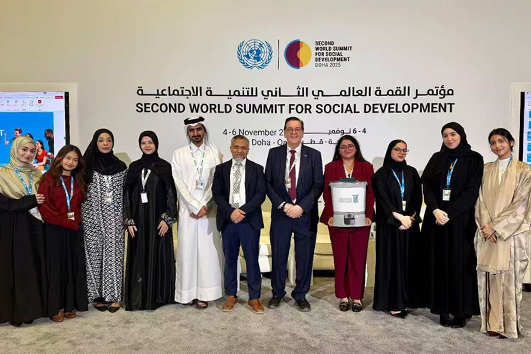
During the “Scaling up Investments in Youth for Social Justice and Decent Work” session organized by the UN Youth Office and ILO, the University of Doha for Science and Technology (UDST) – a Leader University in SUCN – showcased the Smart Bokashi Bucket, a student-designed innovation that turns food waste into nutrient-rich compost while monitoring greenhouse gas emissions.
The project was developed through the Greening-with-STI Bootcamp, co-led by UNESCO IESALC and UNOSSC, connecting universities across the Global South to co-create sustainability prototypes.
UDST students presenting the Smart Bokashi Bucket prototype at the Summit.
“The Smart Bokashi Bucket shows how universities can be engines of sustainability and youth-driven innovation,” said UDST’s Prof. Michael Phillips, UDST’s SUCN focal point.
Building on this success, UDST announced the establishment of the SUCN Regional University Cooperation Hub for the Arab States (2026–2030), positioning Qatar as a regional center for applied research, innovation, and sustainability. The Hub will connect academic institutions, industries, and governments across the Arab States to advance science, technology, and innovation (STI) for sustainable development – reinforcing the role of universities as catalysts for South-South learning and youth-led transformation.
Showcasing of Youth Footprints under UNOSSC managed South-South Trust Fund Portfolio
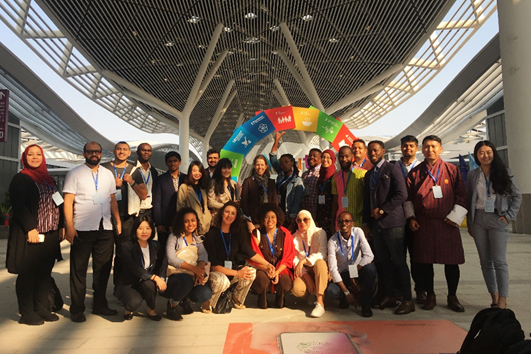
On the sidelines of the Second World Summit for Social Development, UNOSSC also introduced the Youth Footprints: UNOSSC-Managed South-South Trust Funds Portfolio, via social media and other channels, a vibrant showcase of 21 youth-focused projects implemented with 14 UN entities in over 70 countries.
The publication highlights that more than 60,000 young people have benefited from over $14 million in funding from the UN Fund for South-South Cooperation, the India-UN Development Partnership Fund, and the India, Brazil, and South Africa Facility for Poverty and Hunger Alleviation(IBSA Fund), supporting initiatives in skills development, digital innovation, and green entrepreneurship.
Featured initiatives include:
Youth4South – Building the capacity of 6,700+ youth leaders across 50+ countries.
EMPOWER Fellowship – Supporting women scientists in biotechnology research.
Greening Higher Education (SUCN) – 225 students from 10 universities designing 22 prototypes, from AI-powered agriculture tools to solar transport systems.
Youth Employment and Entrepreneurship initiatives – Bridging education and entrepreneurship across Nigeria, Pakistan, and Cambodia.
Burundi: Human Capital Development for Youth – Advancing Health, Entrepreneurship and E-Commerce.
Micronesia: Empowering Young Women Athletes through South-South Cooperation.
Saint Lucia: Providing Impactful Vocational Training for Marginalized Youth.
Zambia: Empowering Women and Youth through Digital Utility and Financial Services.
Timor-Leste: Leveraging ICT to Improve Education and Skills.
Benin: Promoting Youth and Women Employment through Agricultural Diversification.
Gabon: Empowering Youth and Women-led SMEs in the Cassava Value Chain.
Palau: Rehabilitation of a High School Teacher Training Center.
The Gambia: Enhanced Vegetable Production and Processing for Rural Women and Youth.
Viet Nam: Innovative e-Learning Approaches for Health Education.
Cambodia: Poverty Reduction among Youth through Volunteer Skills.
A Call to Action: Investing in Youth for Inclusive Futures
The Summit concluded with renewed commitment to translate social pledges into practical outcomes. The Doha Political Declaration underscored the need to accelerate youth employment, education, and social inclusion – with the UN Deputy Secretary-General Amina Mohammed emphasizing that “people expect results, not just declarations.”
UNOSSC reaffirmed its commitment to scale up youth-led South-South and triangular cooperation, ensuring that young innovators, researchers, and entrepreneurs continue shaping inclusive, sustainable futures for all.
For more information, please visit https://ssg.undp.org.rs/our-work/south-south-trust-fund-management/

 Universities as Engines of Innovation and Sustainability
During the “Scaling up Investments in Youth for Social Justice and Decent Work” session organized by the UN Youth Office and ILO, the University of Doha for Science and Technology (UDST) – a Leader University in SUCN – showcased the Smart Bokashi Bucket, a student-designed innovation that turns food waste into nutrient-rich compost while monitoring greenhouse gas emissions.
The project was developed through the Greening-with-STI Bootcamp, co-led by UNESCO IESALC and UNOSSC, connecting universities across the Global South to co-create sustainability prototypes.
Universities as Engines of Innovation and Sustainability
During the “Scaling up Investments in Youth for Social Justice and Decent Work” session organized by the UN Youth Office and ILO, the University of Doha for Science and Technology (UDST) – a Leader University in SUCN – showcased the Smart Bokashi Bucket, a student-designed innovation that turns food waste into nutrient-rich compost while monitoring greenhouse gas emissions.
The project was developed through the Greening-with-STI Bootcamp, co-led by UNESCO IESALC and UNOSSC, connecting universities across the Global South to co-create sustainability prototypes.
 Showcasing of Youth Footprints under UNOSSC managed South-South Trust Fund Portfolio
On the sidelines of the Second World Summit for Social Development, UNOSSC also introduced the Youth Footprints: UNOSSC-Managed South-South Trust Funds Portfolio, via social media and other channels, a vibrant showcase of 21 youth-focused projects implemented with 14 UN entities in over 70 countries.
Showcasing of Youth Footprints under UNOSSC managed South-South Trust Fund Portfolio
On the sidelines of the Second World Summit for Social Development, UNOSSC also introduced the Youth Footprints: UNOSSC-Managed South-South Trust Funds Portfolio, via social media and other channels, a vibrant showcase of 21 youth-focused projects implemented with 14 UN entities in over 70 countries.
 The publication highlights that more than 60,000 young people have benefited from over $14 million in funding from the UN Fund for South-South Cooperation, the India-UN Development Partnership Fund, and the India, Brazil, and South Africa Facility for Poverty and Hunger Alleviation (IBSA Fund), supporting initiatives in skills development, digital innovation, and green entrepreneurship.
Featured initiatives include:
The publication highlights that more than 60,000 young people have benefited from over $14 million in funding from the UN Fund for South-South Cooperation, the India-UN Development Partnership Fund, and the India, Brazil, and South Africa Facility for Poverty and Hunger Alleviation (IBSA Fund), supporting initiatives in skills development, digital innovation, and green entrepreneurship.
Featured initiatives include: