• Home
  • /
  • FAO Featured Publications POM
  • /
  • Systematization of the Sustainable School Feeding Model & Proposition of Recommendations as Way Forwards to the Government of Belize (FAO, 2020)

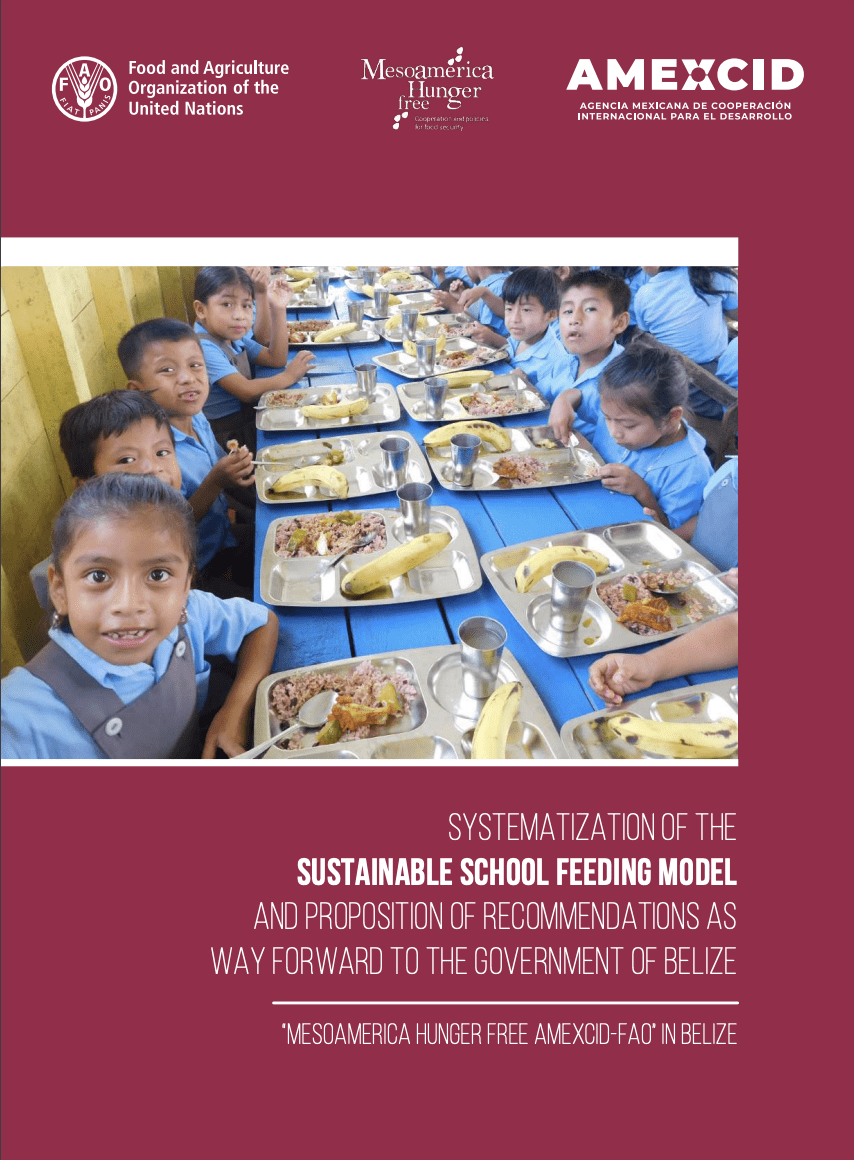
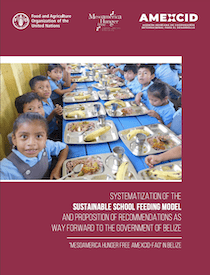
Systematization of the Sustainable School Feeding Model & Proposition of Recommendations as Way Forwards to the Government of Belize (FAO, 2020)


Systematization of the Sustainable School Feeding Model and Proposition of Recommendations as Way Forwards to the Government of Belize “Mesoamerica Hunger-Free AMEXCID-FAO” in Belize

“Mesoamerica Hunger-Free AMEXCID-FAO” is a South-South and Triangular Cooperation initiative, jointly led by the Mexican Agency for International Development Cooperation (AMEXCID) and the Food and Agriculture Organization of the United Nations (FAO), under implementation in nine countries (Belize, Colombia, Costa Rica, El Salvador, Guatemala, Honduras, Nicaragua, Panama and the Dominican Republic). The pilot project of the “Sustainable Schools” model in Belize has been implemented within the framework of this Programme, which contributes to strengthening institutional mechanisms and public policies focused on eradicating hunger and promoting rural development.

Following the trend of many other countries worldwide and in Latin America and the Caribbean, Belize has been putting a lot of effort in redesigning, scaling up and strengthening its national school feeding program, as a strategy to promote food security and nutrition in the country. Belize is strengthening its school feeding program through the implementation of a pilot project of a model called “Sustainable Schools” (hereinafter referred to as SS) in four communities in the Toledo District (Pueblo Viejo, Santa Elena, Santa Cruz and San Antonio) in the southern part of the country.
Download PDF

This model is based on six main components and establishes the necessary methodologies, steps and parameters for a sustainable national school feeding program; one that goes beyond just providing food to poor or vulnerable children and is based on the human right to food.

The six components are:

  1. Inter-institutional and intersectoral coordination
  2. Social participation
  3. Adoption of healthy, adequate and culturally appropriate menus
  4. Food and nutrition education through educational school gardens
  5. Establishment of direct purchases from family (small-scale) farming for school feeding
  6. Improvement of school infrastructure for school feeding The pilot project is a learning and demonstration space.

It contributes to the creation of the bases to scale-up the SS model towards a sustainable national school feeding program, as well as develop a national policy of sustainable school feeding while, at the same time, strengthening the country´s governance and institutional mechanisms for designing, implementing and monitoring its programs and public policies for food security and nutrition. Through this experience, Belize has become one of the six Caribbean countries, along with Jamaica, Granada, Guyana, Saint Lucia and Saint Vincent and Grenadines, where school feeding models have been piloted with FAO’s technical assistance, inspired by the Brazilian experience with its school feeding program.

This document is aimed at presenting the systematization of the SS model pilot implementation in Belize, and it describes the implementation process of the pilot project, from its beginning in early 2016 to November 2018.

Primarily, a brief introduction is made on the importance of school feeding programs as a strategy towards compliance with the 2030 Agenda and Sustainable Development Goals (SDG), and for the promotion of food security and nutrition, education, health and social protection of the students and the community. Secondly, some general information on agriculture, food security and nutrition, and existing school feeding and school garden programs and initiatives of Belize is presented.

The following section addresses the concept and methodology of the SS model. Next, a critical analysis of the implementation of the six components of the SS model is provided, focusing on its process, challenges, results, as well as on the lessons learned and best practices identified. Lastly, recommendations for scaling up the SS model and for the improvement and strengthening of the national school feeding program in the country are presented. It is expected that this publication will contribute to the strengthening of the coordination among the sectors involved in school feeding and the institutionalization and sustainability of the school feeding policies in the country, so that, in the medium and long term, the school feeding program of Belize can contribute to food security and nutrition, the human right to food, as well as to the health and social development of its citizens.
Connect with UNOSSC

Stay updated with the latest trends in South-South cooperation and access our vast repository of knowledge.

Copyright © UNOSSC/UNDP

Alliance Application Form

Submit an Expression of Interest and/or Demand Signal. UNOSSC reviews submissions on a rolling basis.

1. Official name of organization / institution / government entity (exclusions to apply) *
Organization logo
Maximum file size: 20 MB
2. Country *
3. Region *
4. SDG *
5. Partner category *
6. Website *
7. Brief description of your institution (max. 150 words) *
Name for the Lead *
Title for the Lead *
Email address for the Lead *
Name for the co-lead
Title for the co-lead
Email address for the co-lead
Section 3. Expression of Interest in the Alliance *
Additional information on proposed areas of engagement may be requested through the platform following initial review by the Alliance Secretariat.
Section 4. Due Diligence and Integrity Declaration *

Submission Note:

  • Submission of this Expression of Interest form does not automatically confer participation in the Alliance.
  • All submissions will be reviewed by the Alliance Secretariat, including basic eligibility screening and proportionate due diligence, as appropriate.
  • Participation in Alliance activities is determined based on relevance to articulated cooperation needs, alignment with Alliance principles, and integrity considerations.
  • Engagement under the Alliance is voluntary, non-binding, and facilitative in nature, and does not constitute funding approval, contractual commitment, or institutional membership.
  • The Alliance Secretariat may contact submitting entities for additional information or clarification during the review process.

Submission of Demand Form

Description of Demand

Indicate the type of support or cooperation requested through the Alliance.
Please briefly describe the challenge, gap, or priority. (Max. 300 words)

Thematic and Geographic Focus

Please indicate the main focus areas of your demand:

A. Thematic Areas (select up to three)
B. Geographic Focus (select all that apply)

Proposed Engagement Modalities

Please indicate how you would like to engage through the Alliance (select all that apply):

Expected Outcomes

Please indicate the main results you seek to achieve through this engagement. (Max. 200 words)
Examples:
• Capacity strengthened
• Partnerships established
• Sectoral or regional strategies co-developed
• Solutions piloted
• Knowledge generated
• Policies informed

Timeline and Readiness (if applicable)

1. Expected timeframe for engagement:
2. Current stage:

Additional Information

Please provide any additional information, documents, or links relevant to this submission.
(Max. 200 words or upload link)

Submission of Offer Form

Description of Contribution

Indicate the type of contribution your institution can provide and describe the expertise, resources, or solutions you may offer.
Please briefly describe your proposed contribution. (Max. 300 words)

Thematic and Geographic Focus

Please indicate the main focus areas of your interest:

A. Thematic Areas (select up to three)
B. Geographic Focus (select all that apply)

Proposed Engagement Modalities

Please indicate how you would like to engage through the Alliance (select all that apply):

Expected Outcomes

Please indicate the main results you aim to achieve through this engagement. (Max. 200 words)
Examples:
• Capacity strengthened
• Partnerships established
• Sectoral or regional strategies co-developed
• Solutions piloted
• Knowledge generated
• Policies informed

Timeline and Readiness (if applicable)

1. Expected timeframe for engagement:
2. Current stage:

Additional Information

Please provide any additional information, documents, or links relevant to this submission.
(Max. 200 words or upload link)

Organization Registration

Authentication & Due Diligence This prototype simulates identity verification, due diligence confirmation, and an authentication step before submission. *

First Name *
Last Name *
Email address *
Password *
Confirm Password *
Name of institution / organization *
Country / Region *
Organization Type *
Organization other *
Function / role *
Organization logo *
Maximum file size: 1 GB

Login

Login / email *
Password *
Remember me

Forgot password?

Connect form

Your name *
Email *
Organization / institution *
Job title / role *
Reason for connecting:
Short message

Scroll to Top