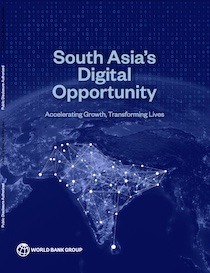
This report by the World Bank looks at the opportunities and challenges related to digitalizing the economies, societies and governments of Afghanistan, Bangladesh, Bhutan, India, Maldives, Nepal, Pakistan and Sri Lanka. The report finds that while some countries are benefiting from expanded access to services and markets, new jobs, innovation, reduced transaction costs and a better quality of life due to increased digitalization, its full game-changing potential remains untapped. A concrete, comprehensive approach to digitalization can help advance South Asia’s green, resilient and inclusive development.
Main Challenges to Digitalization
- Most South Asian countries have expanded 4G mobile networks in the last five years, but broadband internet and smartphones remain unaffordable for the region’s poorest people. 61% of South Asians live within range of a telecom network, but still do not use the internet, the largest usage gap in the world. International bandwidth is especially expensive in landlocked countries such as Nepal.
- Digital transformation of government, including digital public platforms and digital stacks, can make government services and support more inclusive, accessible and effective. Digitalization of governments in South Asia has progressed steadily but more needs to be done to improve interoperability, integration, data protection and cybersecurity, and to make digital platforms more accessible to the most vulnerable people.
- Stronger, more accessible digital financial services could improve financial inclusion in South Asia, which accounts for more than 20 percent of the world’s unbanked adults.
- Digital businesses create value for economies, but across South Asia, some digital business ecosystems are more mature than others. This is due to varying levels of support from government institutions and other organizations, and differences in the enabling environment and access to early-stage financing.
- Digital skills are critical for a globally competitive workforce and digitally literate citizens. However, there remain low levels of digital literacy in the region, especially among women.
- South Asian countries are making progress in creating environments and frameworks that encourage digital confidence and trust, with several countries considering legislation on data protection. More can be done to implement cybersecurity protections, both within the legal framework and in eventual implementation.
- Regional cooperation on cross-border connectivity and data infrastructure, cross-border data flows, and cross-border payment systems can enable greater access to markets, improve knowledge, capital and innovation and help countries achieve development goals.
Policy Recommendations
- Increase affordability of data and devices, ensure reliable and affordable international connectivity and build infrastructure to allow more people to connect.
- A “whole-of-government approach“ to digitalization of government that consolidates and coordinates policy, strategy, planning and operational responsibilities should be adopted. This approach should be supported by policies that promote data protection and cybersecurity, stronger data governance and interoperability frameworks and a focus on human-centered design to bridge gender and digital divides.
- Build “digital stacks“ — including digital ID, digital payments, and trusted data sharing platforms, which are the basis for most transactions — as “rails“ to allow governments and businesses to build and innovate digital services.
- Implement government policies that encourage innovation in the digital financial ecosystem, actions to modernize credit reporting systems, initiatives to promote financial literacy and greater trust in digital financial services and reforms to facilitate cross-border payments to make digital financial services accessible to more people.
- To support digital businesses, the report recommends developing “digital business“ enabling frameworks and that governments provide financial incentives for early-stage financing. To close the gender gap, greater focus should be put on training, supporting and funding women-led businesses.
- To boost digital skills in South Asia, the report recommends that governments make the digital skills agenda a key part of their national strategies. The education sector can also play a key role in developing digital skills and literacy by including digital skills in curriculums from primary school onwards, in technical and vocational education and training, and in on-the-job training programs developed in collaboration with the private sector. Fostering women’s access to educational opportunities will also be vital.
- The report finds that more progress to build digital confidence and trust can be made by developing robust legal and regulatory frameworks for data protection, and establishing independent and competent institutions to enforce data protection and cybersecurity.
- Infrastructure sharing — for example, of mobile network towers — between countries can help make infrastructure deployment more affordable.
- A collaborative and robust regional digital economy could also pave the way for smoother intraregional trade, expanded e-commerce markets and greater financial inclusion. To build a thriving regional digital economy, South Asian countries could consider regional coordination in three areas: cross-border connectivity and data infrastructure, an enabling environment for cross-border data flows; and integrated cross-border payment systems.