• Home
  • /
  • Publications
  • /
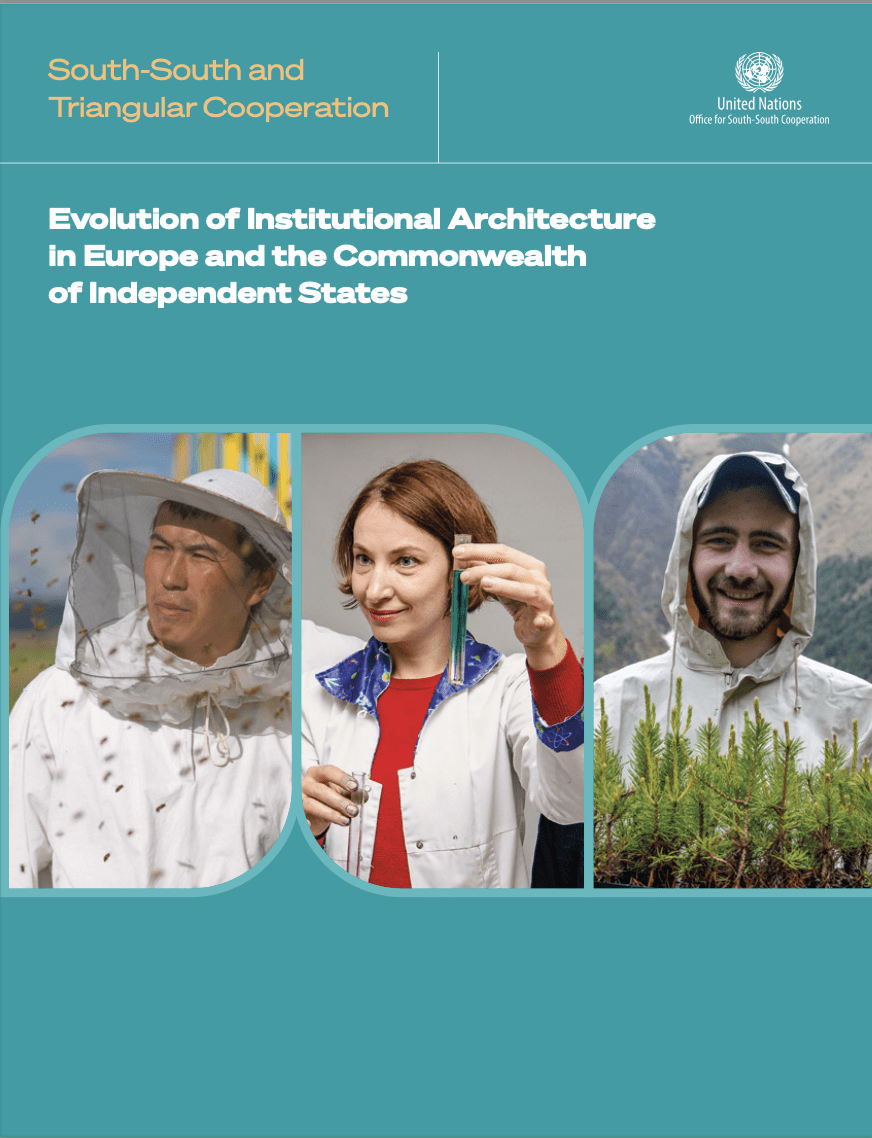
  • Evolution of Institutional Architecture in Europe and the Commonwealth of Independent States (UNOSSC, 2024)

Evolution of Institutional Architecture in Europe and the Commonwealth of Independent States (UNOSSC, 2024)


The study aims to reflect on some of the developments in the ECIS region related to the ‘incremental institutionalization in South-South cooperation and its incorporation into policymaking by some countries and regions’, as noted in the Outcome Document of the Second High-level United Nations Conference on South-South Cooperation (BAPA+40). More specifically, the study aims to: (i) provide an overview of the recent developments and latest trends in South-South and triangular cooperation in the region and how countries’ national interests intertwine within South-South and triangular cooperation; (ii) explore the institutional diversity in the region and outline the main elements in building institutional foundations; and (iii) provide recommendations in terms of further institutionalization of South-South and triangular cooperation for sustainable development in the ECIS region. The institutionalization process has also witnessed significant progress in other regions, thus providing further lessons learned and experiences to draw from for all future efforts in this area.
ECIS

Download PDF: Full Report | Summary of Conclusions & Recommendations

The study covers the 17 countries and one territory that are covered by the UNDP Regional Programme for ECIS region. Overall, it emerges that, although limited data do not do justice to the richness of cooperation experiences in the region, the region does present a diversity of institutional architectures, models and practices of South-South and triangular cooperation at the national level. The institutional structures in place are evolving, while new structures are being set up. Elements of South-South and triangular cooperation have been and/or are being incorporated in countries’ strategies and legal frameworks. Commitment at the highest level is also helping to define the strategic goals that each country wishes to pursue through this form of cooperation. Some countries explicitly define South-South and triangular cooperation as part of implementing their foreign policies and strategies or as a diplomacy tool; others emphasize it in the context of development and humanitarian needs of their partner countries.

As the study demonstrates, each country in the ECIS region has a unique national approach: there is no ‘one-size-fits-all’ approach to institutionalization. This form of cooperation also depends on the legal and institutional framework of more than one country. Coherence between the applicable national norms can be a challenge. The situation can be even more complicated when more than two countries’ normative frameworks and/or international rules are applicable. This requires cooperation efforts in legislative and administrative processes for removing possible obstacles and achieving cohesion between partner countries.
Connect with UNOSSC

Stay updated with the latest trends in South-South cooperation and access our vast repository of knowledge.

Copyright © UNOSSC/UNDP

Alliance Application Form

Submit an Expression of Interest and/or Demand Signal. UNOSSC reviews submissions on a rolling basis.

1. Official name of organization / institution / government entity (exclusions to apply) *
Organization logo
Maximum file size: 20 MB
2. Country *
3. Region *
4. SDG *
5. Partner category *
6. Website *
7. Brief description of your institution (max. 150 words) *
Name for the Lead *
Title for the Lead *
Email address for the Lead *
Name for the co-lead
Title for the co-lead
Email address for the co-lead
Section 3. Expression of Interest in the Alliance *
Additional information on proposed areas of engagement may be requested through the platform following initial review by the Alliance Secretariat.
Section 4. Due Diligence and Integrity Declaration *

Submission Note:

  • Submission of this Expression of Interest form does not automatically confer participation in the Alliance.
  • All submissions will be reviewed by the Alliance Secretariat, including basic eligibility screening and proportionate due diligence, as appropriate.
  • Participation in Alliance activities is determined based on relevance to articulated cooperation needs, alignment with Alliance principles, and integrity considerations.
  • Engagement under the Alliance is voluntary, non-binding, and facilitative in nature, and does not constitute funding approval, contractual commitment, or institutional membership.
  • The Alliance Secretariat may contact submitting entities for additional information or clarification during the review process.

Submission of Demand Form

Description of Demand

Indicate the type of support or cooperation requested through the Alliance.
Please briefly describe the challenge, gap, or priority. (Max. 300 words)

Thematic and Geographic Focus

Please indicate the main focus areas of your demand:

A. Thematic Areas (select up to three)
B. Geographic Focus (select all that apply)

Proposed Engagement Modalities

Please indicate how you would like to engage through the Alliance (select all that apply):

Expected Outcomes

Please indicate the main results you seek to achieve through this engagement. (Max. 200 words)
Examples:
• Capacity strengthened
• Partnerships established
• Sectoral or regional strategies co-developed
• Solutions piloted
• Knowledge generated
• Policies informed

Timeline and Readiness (if applicable)

1. Expected timeframe for engagement:
2. Current stage:

Additional Information

Please provide any additional information, documents, or links relevant to this submission.
(Max. 200 words or upload link)

Submission of Offer Form

Description of Contribution

Indicate the type of contribution your institution can provide and describe the expertise, resources, or solutions you may offer.
Please briefly describe your proposed contribution. (Max. 300 words)

Thematic and Geographic Focus

Please indicate the main focus areas of your interest:

A. Thematic Areas (select up to three)
B. Geographic Focus (select all that apply)

Proposed Engagement Modalities

Please indicate how you would like to engage through the Alliance (select all that apply):

Expected Outcomes

Please indicate the main results you aim to achieve through this engagement. (Max. 200 words)
Examples:
• Capacity strengthened
• Partnerships established
• Sectoral or regional strategies co-developed
• Solutions piloted
• Knowledge generated
• Policies informed

Timeline and Readiness (if applicable)

1. Expected timeframe for engagement:
2. Current stage:

Additional Information

Please provide any additional information, documents, or links relevant to this submission.
(Max. 200 words or upload link)

Organization Registration

Authentication & Due Diligence This prototype simulates identity verification, due diligence confirmation, and an authentication step before submission. *

First Name *
Last Name *
Email address *
Password *
Confirm Password *
Name of institution / organization *
Country / Region *
Organization Type *
Organization other *
Function / role *
Organization logo *
Maximum file size: 1 GB

Login

Login / email *
Password *
Remember me

Forgot password?

Connect form

Your name *
Email *
Organization / institution *
Job title / role *
Reason for connecting:
Short message

Scroll to Top