A relatively easy COVID-19 pandemic helped Tonga prepare for the next health disaster


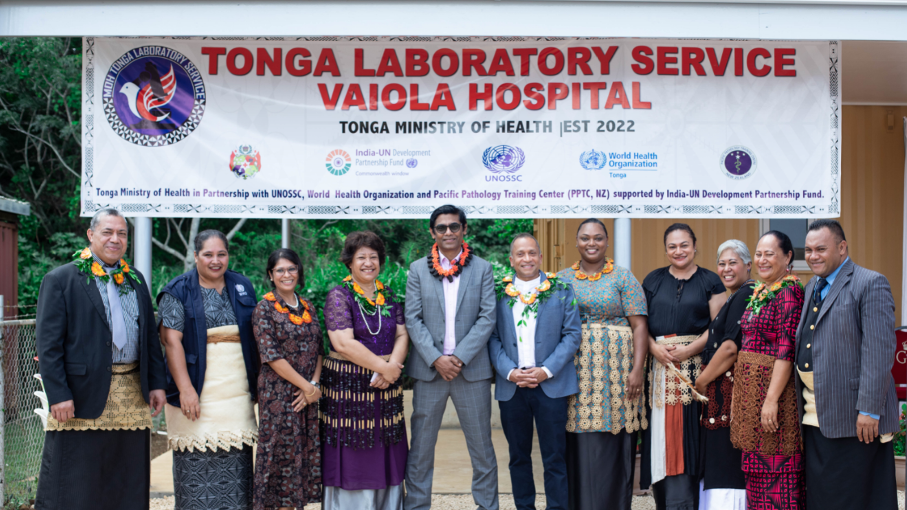
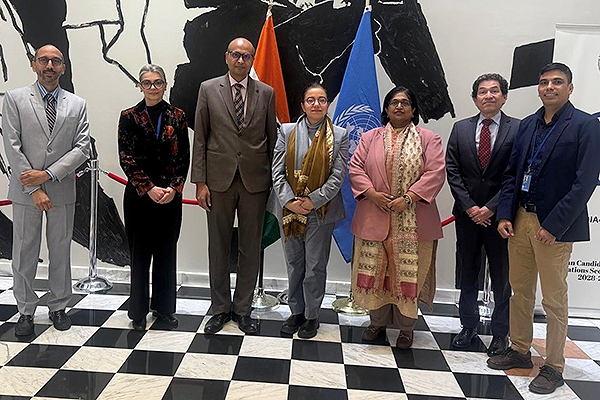
Tonga Ministry of Health CEO Dr. Siale ‘Akau’ola (first from left), High Commissioner of India P.S. Karthigeyan (fifth from left), United Nations Resident Coordinator Mr. Sanaka Samarasinha (sixth from left) and other guests during the launch of the new laboratory. ©WHO 2022

In March of 2020, the world turned upside down. Across the globe, COVID-19 forced closures at borders, businesses and schools. Hospitals were overwhelmed. Governments scrambled to develop socially and economically balanced policies. And pharmaceutical companies worked round the clock to develop testing modalities and vaccines.

In the small island nation of the Kingdom of Tonga, however, while most of the world struggled with the pandemic, strict border measures coupled with a 90+ per cent primary series vaccine rate meant that the country was able to stave off its first community transmission until 1 February 2022, a solid two years after the World Health Organization (WHO) declared the pandemic.

Yet rather than resting on the relative calm that the Government’s policies had helped to create, Tonga’s Ministry of Health used that extraordinary grace period to ensure that, when the disease finally did arrive in the 170+ island archipelago, the country would be ready.

With the support of the India-UN Development Partnership Fund and in partnership with WHO, the Government implemented a three-pronged containment plan to strengthen its capacity for quarantine and/or isolation in multiple health facilities in Tonga. The project included mechanisms to strengthen (a) infection prevention and control, case management, testing and dead body management; (b) the cold chain for vaccine delivery; and (c) the capacity of the health information system for better data collection, analysis and reporting of COVID-19 cases and registration of COVID-19 vaccinations.

As the project implementer, WHO procured and donated essential items – from hospital beds, mattresses and sheets to professional washing machines, and from portable IV stands to wheelchairs – all to strengthen isolation and quarantine capacity.

In an example of South-South knowledge-sharing, the project took a cue from neighbouring Fiji, which was quickly overwhelmed once community transmission occurred and sought to strengthen its laboratory capacity. Among other things, this included the acquisition of GeneXpert. This rapid diagnostic testing machine — originally developed to detect the presence of tuberculosis — returns coronavirus results in roughly 45 minutes, requires less expertise than standard rapid testing mechanisms, and is generally more cost-effective than the alternatives.

Donated technological equipment, including laptops and tablets, were instrumental in strengthening the vaccine command centres’ capacity to collect, analyse, and report vaccine coverage data, and as well as helped to improve the efficiency of decision-making. It also supported individual health centres to utilize the newly introduced electronic medical record system, as well as their capacity for disease surveillance.
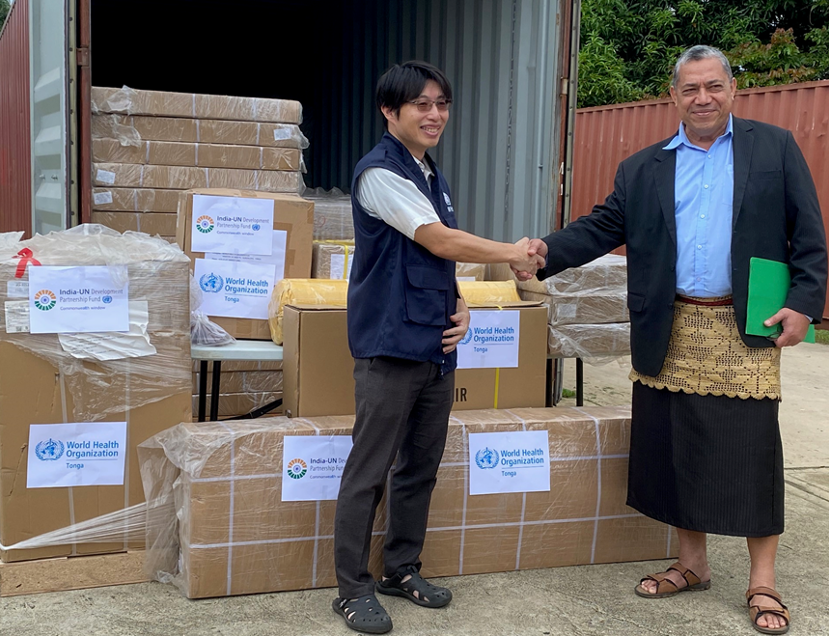
Handover of beds, mattresses and linens. Tonga Ministry of Health CEO Dr. Siale ‘Akau’ola (right) and WHO Tonga Country Liaison Officer, Dr. Yutaro Setoya. ©WHO 2022

Ongoing, detailed discussions with Tonga’s Ministry of Health helped to ensure that any planned procurement was not duplicated with the WHO donations and was consistent with the Ministry’s needs. They also aimed for the sustainable development of Tonga’s health system capacity to respond to future communicable disease outbreaks.

By project’s end in December 2022, there had been no COVID-19 outbreaks in the country. But with the support of the project, Tonga is well-positioned to deal not only with ongoing, routine health challenges but also any potential return of COVID-19 or even a future respiratory disease pandemic. While testing runs, on average, 40 tests per week, during the February–March 2023 influenza outbreak, the average doubled to 90 per week. In the event of an outbreak, the Ministry of Health is equipped to handle approximately 500 tests per day.

Overall, through the support of the India-UN Development Partnership Fund and WHO, Tonga’s overall health system is stronger than at the start of the pandemic as well as well-positioned to address future health challenges. These are significant benefits for the people of Tonga.


For more information please contact Ms. Ines Tofalo, Trust Fund and Project Management Specialist at UNOSSC: ines.tofalo@unoscc.org

More India-UN Fund Stories


Related Post


  • All Post
  • ATCT Featured Publications POM
  • BAPA+40
  • Blog
  • Capacity Development Initiatives
  • CICETE Featured Publications POM
  • CIKD
  • Cities Clusters - Agriculture
  • Cities Clusters - COVID-19
  • Cities Clusters - COVID-19 Knowledge Products
  • Cities Clusters - DRR
  • Cities Clusters - E-commerce
  • Cities Clusters - Tourism
  • Cities Clusters - Tourism Knowledge Products
  • Cities Clusters - Transport
  • Cities Clusters - Waste
  • Cities Project
  • Cities Project COVID-19 Newsletters
  • Cities Project COVID-19 Response
  • Cities Project Knowledge Products
  • Classic (untouched)
  • Climate Action
  • COMSATS Featured Publications POM
  • COMSATS Featured Solutions POM
  • Converted from Divi
  • Converted from Mixed
  • Converted from WPBakery
  • COVID-19
  • COVID-19 Page Featured Solutions
  • DRR Knowledge Products
  • DRR News
  • Empty Post
  • Events
  • Featured Event UN-Habitat POM
  • Financing for Development
  • Financing Mechanisms
  • g7+
  • Gender Events
  • Gender News
  • Good Practices in SSTrC Series
  • Good Practices Publications
  • Good Practices Thematic Series & Special Editions
  • Good Practices Vol. 2
  • Good Practices Vol. 3
  • GSSDC
  • Highlighted
  • Highlighted Publications
  • IAEA Featured Solutions POM
  • IBRAF Featured Publications POM
  • IBSA Fund
  • IBSA Fund Annual Reports
  • IBSA Fund News and Stories
  • IBSA Fund Publication
  • IBSA Fund Story
  • ICGEB Featured Events POM
  • ICGEB Featured Publications POM
  • ICGEB Featured Solutions POM
  • ILO Featured Events POM
  • ILO Featured Publications POM
  • ILO Featured Solutions POM
  • India-UN Development Partnership Fund
  • India-UN Fund Publication
  • India-UN Fund Story
  • IsDB
  • IsDB Featured Publications POM
  • IsDB SCC
  • News
  • Norec Featured Publications POM
  • Norec Featured Solutions POM
  • Peace and Development
  • PGTF Publications
  • PGTF Story
  • PICA Featured News POM
  • PICA Featured Publications POM
  • PICA Featured Solutions POM
  • PIDF Featured Publications POM
  • Publications
  • Regional Updates
  • Research
  • ROK-UNOSSC Facility
  • SGP Featured Publication POM
  • SGP Featured Solutions POM
  • Solution
  • South South in Action
  • South-South Global Thinkers
  • South-South Ideas
  • South-South Ideas Series
  • South-South in Action Series
  • Southern Response to COVID-19
  • SSN4PSI Featured Publications POM
  • SSN4PSI Featured Solutions POM
  • Training
  • UN Day for SSC 2020
  • UN Fund for SSC
  • UN SSC Day Publications
  • UN-Habitat Featured Publications POM
  • UN-HABITAT Featured Solutions POM
  • UNCCT
  • UNEP Featured Publications POM
  • UNFPA
  • UNFSSC Publication
  • UNFSSC Story
  • UNIDO Featured Publications POM
  • UNIDO Featured Solutions POM
  • UNIDO POM Events
  • UNOCT Featured Publications POM
  • UNV
  • UNV Featured Publications POM
  • WB Featured Publications POM
  • WB Featured Solutions POM
  • Webinars
  • WFP Featured Events POM
  • WFP Featured Publication POM
  • WFP Featured Solutions POM
  • WIPO
  • Workshops and Seminars
  • Youth4South
  • z Across the Globe 1
  • z Across the Globe 2
  • z Across the Globe 4
  • z Across the Globe 5
  • z Across the Globe 6
  • z Across the Globe 7
  • z Across the Globe 8
  • z ES BAPA+40
  • z ES Eventos
  • z ES Noticias
  • z ES Noticias Destacadas
  • z ES Publicaciones
  • z ES Publicaciones Destacadas
  • z ES Serie Buenas Prácticas en la CSSyT
  • z ES Serie El Sur-Sur en Acción
  • z FR Actualités
  • z FR BAPA+40
  • z FR Événements
  • z FR Publications
  • z FR Publications en vedette
  • z FR Série Bonnes pratiques en CSST
  • z FR Série Sud-Sud en action
  • z Highlighted News
  • z Photos
  • z Videos
  • z ZH BAPA+40
  • z ZH Events
  • z ZH News

ABOUT

Terms of Service

Privacy Policy

Disclosures

RESOURCES

Terms of Service

Privacy Policy

Disclosures

ENGAGE

Terms of Service

Privacy Policy

Disclosures

Copyright © UNOSSC/UNDP

wpChatIcon
wpChatIcon

Alliance Application Form

Submit an Expression of Interest and/or Demand Signal. UNOSSC reviews submissions on a rolling basis.

1. Official name of organization / institution / government entity (exclusions to apply) *
2. Country *
3. Region *
4. SDG *
Secondary SDG *
5. Partner category *
6. Website *
7. Brief description of your institution (max. 150 words) *
Name for the Lead *
Title for the Lead *
Email address for the Lead *
Name for the co-lead
Title for the co-lead
Email address for the co-lead
Section 3. Expression of Interest in the Alliance *
Additional information on proposed areas of engagement may be requested through the platform following initial review by the Alliance Secretariat.
Section 4. Due Diligence and Integrity Declaration *

Submission Note:

  • Submission of this Expression of Interest form does not automatically confer participation in the Alliance.
  • All submissions will be reviewed by the Alliance Secretariat, including basic eligibility screening and proportionate due diligence, as appropriate.
  • Participation in Alliance activities is determined based on relevance to articulated cooperation needs, alignment with Alliance principles, and integrity considerations.
  • Engagement under the Alliance is voluntary, non-binding, and facilitative in nature, and does not constitute funding approval, contractual commitment, or institutional membership.
  • The Alliance Secretariat may contact submitting entities for additional information or clarification during the review process.

Submission of Demand Form

Description of Demand

Indicate the type of support or cooperation requested through the Alliance.
Please briefly describe the challenge, gap, or priority. (Max. 300 words)

Thematic and Geographic Focus

Please indicate the main focus areas of your demand:

A. Thematic Areas (select up to three)
B. Geographic Focus (select all that apply)

Proposed Engagement Modalities

Please indicate how you would like to engage through the Alliance (select all that apply):

Expected Outcomes

Please indicate the main results you seek to achieve through this engagement. (Max. 200 words)
Examples:
• Capacity strengthened
• Partnerships established
• Sectoral or regional strategies co-developed
• Solutions piloted
• Knowledge generated
• Policies informed

Timeline and Readiness (if applicable)

1. Expected timeframe for engagement:
2. Current stage:

Additional Information

Please provide any additional information, documents, or links relevant to this submission.
(Max. 200 words or upload link)

Submission of Offer Form

Description of Contribution

Indicate the type of contribution your institution can provide and describe the expertise, resources, or solutions you may offer.
Please briefly describe your proposed contribution. (Max. 300 words)

Thematic and Geographic Focus

Please indicate the main focus areas of your interest:

A. Thematic Areas (select up to three)
B. Geographic Focus (select all that apply)

Proposed Engagement Modalities

Please indicate how you would like to engage through the Alliance (select all that apply):

Expected Outcomes

Please indicate the main results you aim to achieve through this engagement. (Max. 200 words)
Examples:
• Capacity strengthened
• Partnerships established
• Sectoral or regional strategies co-developed
• Solutions piloted
• Knowledge generated
• Policies informed

Timeline and Readiness (if applicable)

1. Expected timeframe for engagement:
2. Current stage:

Additional Information

Please provide any additional information, documents, or links relevant to this submission.
(Max. 200 words or upload link)

Organization Registration

Authentication & Due Diligence This prototype simulates identity verification, due diligence confirmation, and an authentication step before submission. *

First Name *
Last Name *
Email address *
Password *
Confirm Password *
Name of institution / organization *
Country / Region *
Organization Type *
Organization other *
Function / role *
Organization logo *
Maximum file size: 1 GB

Login

Login / email *
Password *
Remember me

Forgot password?

Connect form

Your name *
Email *
Organization / institution *
Job title / role *
Reason for connecting:
Short message

Scroll to Top