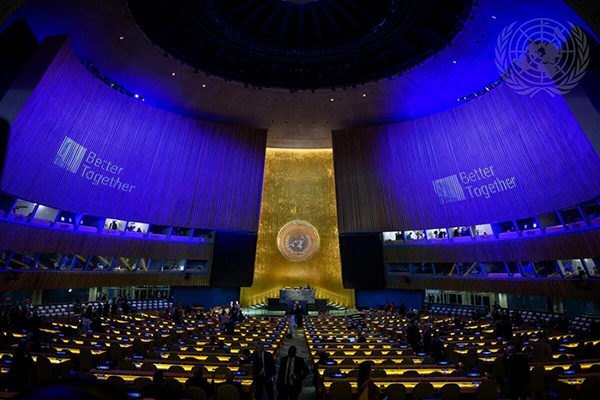
Global leaders highlight solidarity, innovation, and partnerships to accelerate the Sustainable Development Goals
South-South cooperation emerged as a recurring theme throughout the 80th session of the United Nations General Assembly (UNGA), with numerous delegations, UN officials, and diplomats emphasizing its vital role in advancing sustainable development and fostering global solidarity. Across high-level plenaries, side events, and thematic meetings, leaders underscored the power of collaboration among developing countries to address shared challenges and unlock transformative opportunities.
Held under the theme “Better Together: 80 Years and More for Peace, Development and Human Rights,” this landmark session comes at a pivotal moment to renew global commitment to multilateralism, solidarity, and collective action for people and planet. The session not only reflects on eight decades of achievement and challenge but also looks ahead to shaping a more inclusive, resilient, and sustainable future.
This year’s High-Level Week underscored the urgency of delivering on the promise of the SDGs, accelerating climate action, addressing inequalities, and reinvigorating multilateralism. In this context, South-South and triangular cooperation were highlighted as indispensable: bringing forward solutions rooted in shared experiences, expanding space for innovation and trust-building, and ensuring that global progress is both inclusive and sustainable.
Global South Calls for Scaled-Up Action
Milestone declarations adopted during UNGA 2025 reaffirmed the centrality of South-South cooperation. For example, Group of 77 Ministerial Declaration – endorsed at the group’s 49th Annual Meeting – calls for strengthening South-South trade cooperation, enhancing collaboration in science, technology, and innovation, and expanding resources for the Perez-Guerrero Trust Fund (PGTF), which has supported more than 400 projects over four decades. It also welcomes the launch of the Manual for the Framework to Measure South-South Cooperation, a groundbreaking tool to help countries assess and strengthen their cooperative efforts.
The Declaration of the Annual Ministerial Meeting of the Foreign Ministers of Least Developed Countries recognized the “significance of South-South and triangular cooperation in the changing global economic landscape and stress that the potential of this cooperation for trade, investment, and economic and technological cooperation should be fully harnessed in a predictable manner in line with the Buenos Aires outcome document of the second High-Level United Nations Conference on South-South Cooperation…”
The Like-Minded Group of Middle-Income Countries (MICs), in their ninth ministerial declaration, included a chapter dedicated to South-South cooperation, reinforcing its role as a driver of inclusive growth and resilience.
The 24th Annual Ministerial Meeting of Landlocked Developing Countries endorsed a Ministerial Declaration calling for strengthened partnerships between LLDCs, transit countries, development partners, the UN system and the private sector to ensure effective implementation.
Calls were also made for engagement with civil society, the private sector, and local governments, while upholding the principles of national ownership, equality, and mutual benefit.
Thematic Highlights
Recurring themes throughout the week included:
- Innovation and Digital Transformation – Leaders cited technology partnerships as critical to addressing complex development challenges, including food security, artificial intelligence, and vaccine development.
- Financing and Integration – Calls were made to integrate South-South cooperation more fully into the UN development system, increase predictable financing, and leverage innovative resource mobilization mechanisms.
- Governance, opportunities and risks associated with artificial intelligence.
- Ongoing global challenges such as climate change, and persistent conflict.
- Ownership and Solidarity – Member States reaffirmed that South-South cooperation must remain owned and driven by developing countries, rooted in solidarity and free from conditionalities.
- UNOSSC and Saudi Arabia co-hosted a UNGA roundtable calling for scalable action to accelerate the 2030 Agenda.
- A Ministerial Roundtable on African Connectivity, was co-hosted by Morocco, UNECA and UNOSSC, calling for strengthened partnerships.
- At the 10th Ministerial Meeting of the Like-Minded Group for Middle-Income Countries (LMG-MICs), UNOSSC Director Dima Al-Khatib recalled that the 22nd session of the High-level Committee on South-South Cooperation reaffirmed the central role of South-South cooperation in advancing the priorities of middle-income countries. The Committee emphasized the value of South-South and triangular cooperation in building institutional and human capacities, fostering peer learning, and sharing best practices across regions.
- During the high-level side event on Responding to Loss and Damage: Scaling Up Finance and Partnerships, Dima Al-Khatib stressed that climate change impacts are global, but the Global South faces disproportionate challenges. She highlighted how South-South and triangular cooperation can accelerate action by mobilizing finance, sharing technical expertise, and offering solutions that are mutually beneficial.
- The Unstoppable Africa 2025 forum, organized by the Global Africa Business Initiative (GABI), brought together heads of state, business leaders, and investors under the theme “The BIG Push: Africa Shapes the Markets.” Discussions focused on Africa’s potential in energy, trade, digital innovation, and the creative economy. Leaders, including UN Secretary-General António Guterres, underscored the African Continental Free Trade Area (AfCFTA) as a driver of integration, calling for stronger infrastructure and harmonized regulations. A panel on “Trade Winds of Change: Africa’s New Agency in Global South Alliances” emphasized scaling up South-South trade and private sector leadership.
- At a high-level event on Africa’s industrial future, UNOSSC promoted South-South and triangular cooperation as key to the Third Industrial Development Decade for Africa (IDDA III). As IDDA III ended in July 2025, preparations are underway for IDDA IV. During a high-level event alongside UNGA80, UNOSSC Senior Development Policy Advisor Samba Thiam highlighted how South-South cooperation has supported industrialization through frameworks such as AfCFTA, FOCAC, and TICAD, with strong backing from the UN and African Union. He confirmed UNOSSC’s commitment to the IDDA IV agenda through advocacy, coordination, knowledge-sharing, and partnership brokering.
- The African Peer Review Mechanism (APRM) hosted the High-level Multi-stakeholder Dialogue on APRM: Renewed Vision for Adaptive Governance and Sustainable Development in Africa, where UNOSSC was recognized as a key partner. The collaboration includes APRM’s E-Training on South-South and triangular cooperation, the Africa High-Level Forum on South-South and Triangular Cooperation, and joint policy dialogues. Dima Al-Khatib noted that UNOSSC is helping strengthen governance frameworks by scaling up partnerships, expanding knowledge platforms, and embedding South-South benchmarks into national and regional strategies.
- UNOSSC also supported efforts to reform global credit rating systems at the high-level side event on Reconfiguring Global Credit Rating Practices: African Perspectives on Reforming the Financial Architecture. Co-organized by UNECA, APRM, the African Union, UNDP, AfriCatalyst, and others, the event announced that Mauritius will host the headquarters of the Africa Credit Rating Agency (AfCRA). UNOSSC highlighted South-South and triangular cooperation as a means of sharing knowledge and best practices in establishing the agency.
- At the launch of Morocco’s Digital for Sustainable Development (D4SD) Hub, Dima Al-Khatib underlined its role in driving inclusive and scalable digital transformation in the region. She framed the initiative in the context of the Global Digital Compact (GDC), approved a year earlier, and noted UNOSSC’s work in brokering partnerships and facilitating South-South digital cooperation to accelerate transformation across sectors.
- UNOSSC also co-sponsored, alongside UNDP, UNICEF, WHO, UNIATF, and the FCTC Secretariat, a high-level dialogue on Scaling up Action on NCDs and Mental Health. The event brought together ministers, UN agencies, and civil society. Dima Al-Khatib stressed how South-South cooperation can drive progress in health by enabling peer learning, knowledge-sharing, and investment through initiatives supported by UNOSSC Trust Funds.