UNOSSC Highlights South-South and Triangular Cooperation at “Bandung at 70” Commemorations in Berlin
The United Nations Office for South-South Cooperation (UNOSSC) joined global policymakers, historians, and development experts in Berlin on 7–8 October to commemorate the 70th anniversary of the 1955 Bandung Conference – a milestone in the history of solidarity among developing nations.
Hosted by the Körber-Stiftung and the Robert Bosch Stiftung, the two days of dialogues – comprising a panel discussion and a high-level roundtable – marked the launch of the joint publication Bandung at 70: Multilateralism in a New Era of Multi-Alignment. UNOSSC Director Dima Al-Khatib contributed an article to the volume, titled ‘A Fairer Future Through South-South and Triangular Cooperation’.
Bandung Principles Revived in Berlin
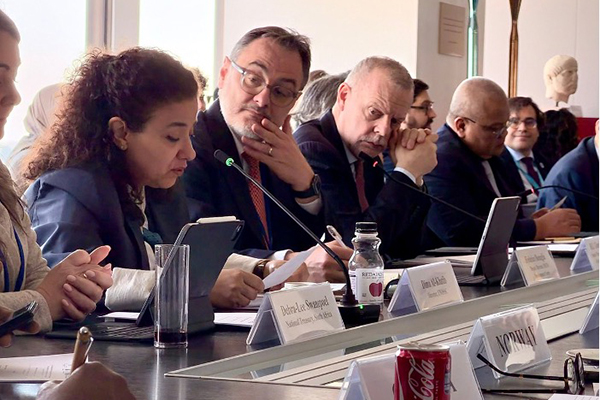
Held under the theme “Multilateralism in a New Era of Multi-Alignment,” the Berlin conference revived the Bandung Spirit of solidarity, equality, and cooperation among equals. During the Robert Bosch Stiftung Forum, Director Al-Khatib joined Nils Schmid and Huang Jing in a discussion on how Bandung’s principles continue to shape a rapidly evolving global order.
She underscored that South-South and triangular cooperation are “living expressions” of Bandung’s call for self-reliant and equitable development, now realized through UNOSSC-managed trust funds and joint innovation platforms such as the South-South Galaxy digital platform, the South-South and Triangular Cooperation Solutions Lab, and the Triangular Cooperation Funding Window.
Renewing Multilateralism Through Partnership
In her remarks and written contribution, Director Al-Khatib emphasized that the United Nations remains the central convener for inclusive coalition-building, grounded in the equal standing of all Member States. She highlighted that “countries of the Global South are not merely beneficiaries but co-creators of global solutions – from digital public goods and renewable energy transitions to climate resilience.”
She noted that practical, Southern-led collaboration builds trust and offers a blueprint for multilateralism “based on credibility, inclusion, and shared results.”
Global South Leadership at the Forefront
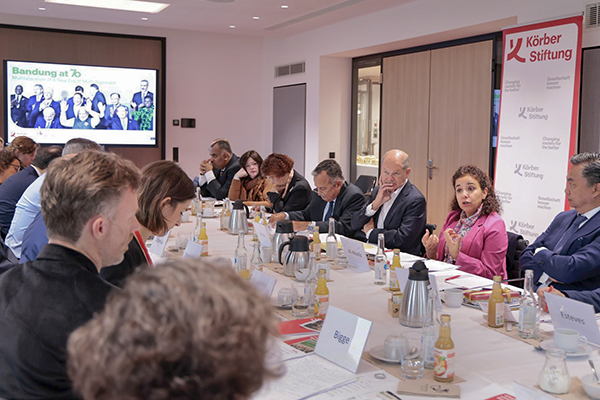
The high-level Berlin roundtable, held under the Chatham House Rule, gathered 30 policymakers and experts – including former German Chancellor Olaf Scholz and Indonesian diplomat Dino Patti Djalal – to assess how Europe and the Global South can jointly renew multilateral cooperation.
Participants discussed the Global South’s growing influence, noting that South-South trade has surpassed North-South flows since 2023, and that successive G20 presidencies from Indonesia, India, Brazil to South Africa reflect a deepening shift in global leadership. Regional initiatives led by ASEAN, the African Union, and CELAC were cited as examples of institutionalized cooperation inspired by the Bandung legacy.
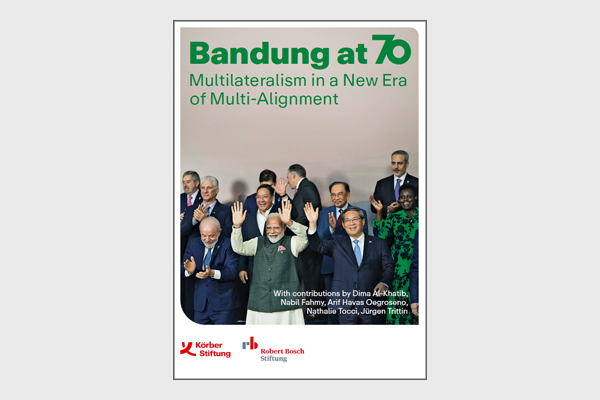
Bandung at 70: A Bridge Between Eras click on the image download the report
The Bandung at 70 report – produced with contributions from the BRICS Policy Center, Chatham House, the South African Institute of International Affairs, and the Foreign Policy Community of Indonesia – situates the 1955 Bandung Conference as a foundation stone for today’s “multi-aligned” world.
Featuring essays by Dima Al-Khatib, Nabil Fahmy, Nathalie Tocci, Jürgen Trittin, Arif Havas Oegroseno, and others, the publication explores how the principles of sovereignty, solidarity, and cooperation articulated in Bandung continue to shape contemporary debates on global governance reform. It highlights the enduring relevance of the “Bandung Spirit” – not as a relic of the post-colonial era, but as a toolkit for renewing multilateralism amid today’s geopolitical fragmentation and shifting alliances.
The essays call for “contextual, equitable reform” to empower middle powers and emerging economies as genuine co-creators of global norms – from climate justice and digital governance to equitable trade and debt sustainability.
Among its key policy recommendations, the publication urges:
Europe to engage Global South partners as equal stakeholders, co-financing South-South initiatives through triangular cooperation and reshaping global aid architecture;
Global South countries to reaffirm the Bandung Principles of sovereignty and solidarity by advancing a practical South-South economic architecture, launching Africa–Asia partnerships, and building “buddy systems” for shared learning and innovation;
All countries to ground cooperation in international law, promote hybrid diplomacy involving civil society, and reimagine solidarity beyond traditional state-led models.
Reflecting on this, UNOSSC Director Dima Al-Khatib writes that “South-South and triangular cooperation embody Bandung’s legacy in action – they are living instruments of inclusive multilateralism, designed to deliver collective progress through shared knowledge, trust, and mutual benefit.”
A Living Spirit for a Multipolar Future
Across both Berlin events, participants reaffirmed that the Bandung Spirit endures – not as nostalgia, but as a living guide for collective action in a multipolar world.
UNOSSC’s engagement underscored how South-South and triangular cooperation provide the operational framework for translating those ideals into tangible outcomes: advancing demand-driven partnerships, strengthening multilateral trust, and renewing commitment to the UN Charter’s principles of equality, solidarity, and peaceful coexistence.