• Home
  • /
  • Publications
  • /
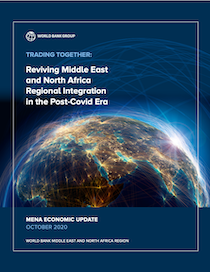
  • Trading Together — Reviving Middle East & North Africa Regional Integration in the Post-COVID Era (World Bank, 2020)

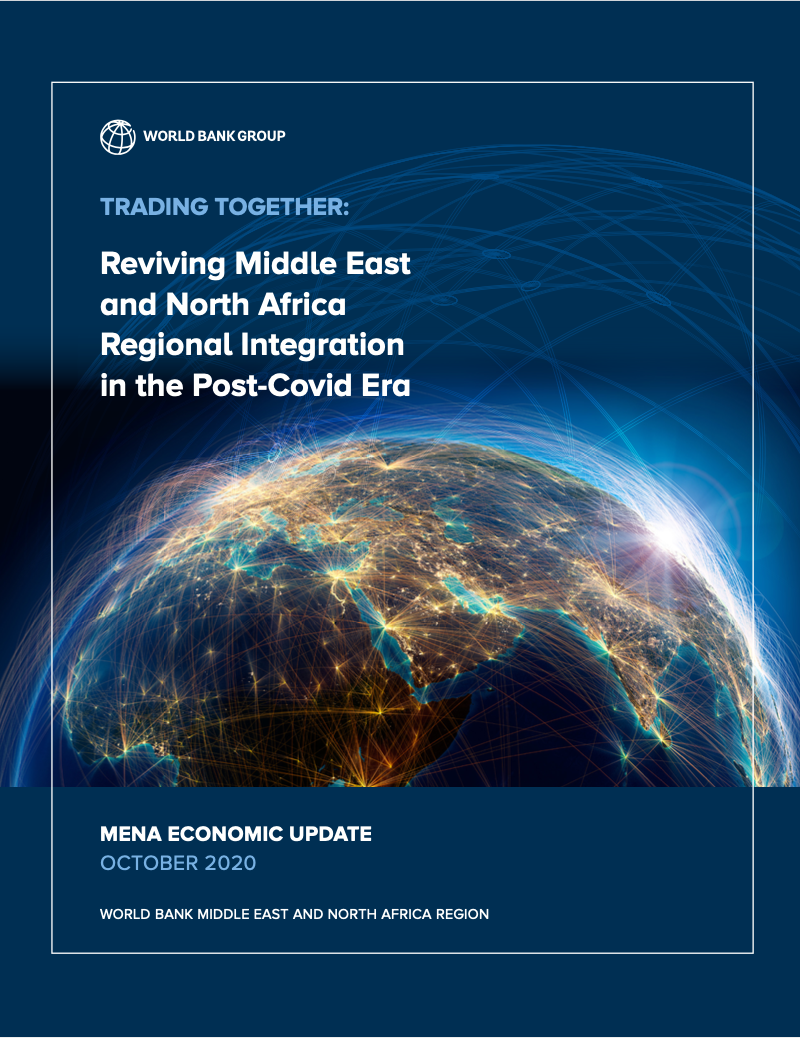
Trading Together — Reviving Middle East & North Africa Regional Integration in the Post-COVID Era (World Bank, 2020)


Trade and integration — within the Middle East and North Africa (MENA) region and with the rest of the world — will be critical to lowering poverty, empowering the poor, and igniting economic growth in the post-COVID era, according to the World Bank’s latest regional economic update. This report by World Bank, titled Trading Together: Reviving Middle East and North Africa Regional Integration in the Post-Covid Era, paints a comprehensive picture of MENA’s economic situation six months into the COVID-19 pandemic. It examines the lasting effects of the dual economic shocks from the spread of the coronavirus and the collapse in oil prices, and it recommends policy changes and reforms to build a new integration framework across the region.

The dual economic shocks of the COVID-19 pandemic and decline in oil prices have affected all aspects of MENA’s economies, which are projected to contract by 5.2% in 2020 — 4.1 percentage points below the forecast in April 2020, and 7.8 percentage points worse than the forecast in October 2019. The latest data reflect an increasingly pessimistic outlook for the regional economy, which is expected to recover only partially in 2021.
Download PDF: English | Arabic | French

The outlook for MENA’s current account and fiscal balances has also deteriorated. Driven by lower oil export revenue, declines in other fiscal revenues and the high expenditures required to respond to the pandemic, the region’s current account and fiscal balances in 2020 are forecast at -4.8% and -10.1% of GDP respectively, much lower than the forecasts from October 2019. Public debt is projected to rise significantly in the next few years, from about 45% of GDP in 2019 to 58% in 2022.

According to the report, MENA’s integration — both within the region and with the rest of the world — was underperforming before the pandemic. This is due to economic reasons, such as poor logistics’ performance, inefficient customs, high infrastructure costs, the inadequacy of legal frameworks for investments, and disparate regulations that add up to high trade costs and have become non-tariff impediments to trade. Political economy obstacles have also prevented regional cooperation, while the effects of conflicts and violence have hindered trade and deterred economic growth.

The report proposes a new trade integration framework that goes beyond reducing tariffs. Some of the suggestions it makes indicate that trade liberalization must be comprehensive and benefit all sectors, including agriculture and services. Without improving the overall business environment and without encouraging the role of the private sector, the region will not reap the benefits of trade liberalization. In terms of implementation, a better balance between political and economic objectives will be needed to ensure that trade agreements do not fail. Simultaneous, behind-the-border reforms — within the MENA region and in collaboration with Europe and Africa — necessitate clear rules and effective implementation mechanisms.

A coordinated MENA trade integration framework would facilitate regional value chains and pave the way toward integrating into global value chains. The report recommends focusing on trading regionally in sectors such as food security, health systems, renewable energy, and the knowledge economy. It suggests creating a common MENA digital market so that MENA countries can improve both trade and digital connectivity, with broader markets in Africa and the Mediterranean. This should help increase productivity; coordinate efficient responses to the pandemic; and promote inclusive, resilient, and sustainable jobs in the region.

The African Continental Free Trade Area (AfCFTA) offers an opportunity for MENA and sub-Saharan Africa to simplify and harmonize non-tariff measures between them. Ongoing bilateral dialogue with the European Union could at the same time focus on including agriculture and services, which would greatly benefit MENA countries while addressing issues of labor mobility as they relate to trade.

Click here for the link to the report.
Connect with UNOSSC

Stay updated with the latest trends in South-South cooperation and access our vast repository of knowledge.

Copyright © UNOSSC/UNDP

Alliance Application Form

Submit an Expression of Interest and/or Demand Signal. UNOSSC reviews submissions on a rolling basis.

1. Official name of organization / institution / government entity (exclusions to apply) *
Organization logo
Maximum file size: 20 MB
2. Country *
3. Region *
4. SDG *
5. Partner category *
6. Website *
7. Brief description of your institution (max. 150 words) *
Name for the Lead *
Title for the Lead *
Email address for the Lead *
Name for the co-lead
Title for the co-lead
Email address for the co-lead
Section 3. Expression of Interest in the Alliance *
Additional information on proposed areas of engagement may be requested through the platform following initial review by the Alliance Secretariat.
Section 4. Due Diligence and Integrity Declaration *

Submission Note:

  • Submission of this Expression of Interest form does not automatically confer participation in the Alliance.
  • All submissions will be reviewed by the Alliance Secretariat, including basic eligibility screening and proportionate due diligence, as appropriate.
  • Participation in Alliance activities is determined based on relevance to articulated cooperation needs, alignment with Alliance principles, and integrity considerations.
  • Engagement under the Alliance is voluntary, non-binding, and facilitative in nature, and does not constitute funding approval, contractual commitment, or institutional membership.
  • The Alliance Secretariat may contact submitting entities for additional information or clarification during the review process.

Submission of Demand Form

Description of Demand

Indicate the type of support or cooperation requested through the Alliance.
Please briefly describe the challenge, gap, or priority. (Max. 300 words)

Thematic and Geographic Focus

Please indicate the main focus areas of your demand:

A. Thematic Areas (select up to three)
B. Geographic Focus (select all that apply)

Proposed Engagement Modalities

Please indicate how you would like to engage through the Alliance (select all that apply):

Expected Outcomes

Please indicate the main results you seek to achieve through this engagement. (Max. 200 words)
Examples:
• Capacity strengthened
• Partnerships established
• Sectoral or regional strategies co-developed
• Solutions piloted
• Knowledge generated
• Policies informed

Timeline and Readiness (if applicable)

1. Expected timeframe for engagement:
2. Current stage:

Additional Information

Please provide any additional information, documents, or links relevant to this submission.
(Max. 200 words or upload link)

Submission of Offer Form

Description of Contribution

Indicate the type of contribution your institution can provide and describe the expertise, resources, or solutions you may offer.
Please briefly describe your proposed contribution. (Max. 300 words)

Thematic and Geographic Focus

Please indicate the main focus areas of your interest:

A. Thematic Areas (select up to three)
B. Geographic Focus (select all that apply)

Proposed Engagement Modalities

Please indicate how you would like to engage through the Alliance (select all that apply):

Expected Outcomes

Please indicate the main results you aim to achieve through this engagement. (Max. 200 words)
Examples:
• Capacity strengthened
• Partnerships established
• Sectoral or regional strategies co-developed
• Solutions piloted
• Knowledge generated
• Policies informed

Timeline and Readiness (if applicable)

1. Expected timeframe for engagement:
2. Current stage:

Additional Information

Please provide any additional information, documents, or links relevant to this submission.
(Max. 200 words or upload link)

Organization Registration

Authentication & Due Diligence This prototype simulates identity verification, due diligence confirmation, and an authentication step before submission. *

First Name *
Last Name *
Email address *
Password *
Confirm Password *
Name of institution / organization *
Country / Region *
Organization Type *
Organization other *
Function / role *
Organization logo *
Maximum file size: 1 GB

Login

Login / email *
Password *
Remember me

Forgot password?

Connect form

Your name *
Email *
Organization / institution *
Job title / role *
Reason for connecting:
Short message

Scroll to Top