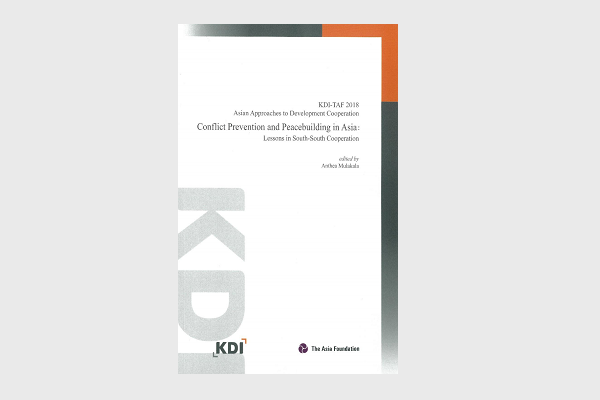
Conflict Prevention and Peacebuilding in Asia: Lessons in South-South Cooperation


FOREWORD AND ACKNOWLEDGEMENT

Asia’s remarkable growth has substantially improved the economic and social well-being of people in the region. At the same time, Asia has hosted some of the world’s most violent interstate and subnational conflicts. The latter count among the world’s longest running, averaging 40 years (Parks et al., 2013), and most intractable, often fueled by uneven resource distribution, ethnic and religious tensions, violent extremism, and/or urban crime. When such conflicts spill across national borders, they affect neighboring societies, economies, and politics in devastating ways.

Aid and development-cooperation actors — governments, nongovernmental organizations (NGOs), United Nations agencies, and others — have recognized the nexus between conflict and development, leading many Organisation for Economic Development and Cooperation Development Assistance Committee (OECD-DAC) donors to fund programs that address the underlying causes of conflict while building the necessary conditions for peace. However, the actors of South-South cooperation (SSC) have not historically addressed conflicts in the Global South, preferring to respect national sovereignty and not interfere in a country’s domestic affairs. As SSC and particularly Asian-led development cooperation expands, its actors can no longer ignore intra-Asian conflicts because they create challenges that impede sustainable development and prevent shared prosperity in the region. Therefore, developed and less-developed Asian countries increasingly support or participate in various peacebuilding activities, ranging from economic development projects to conflict mediation and humanitarian assistance, often acting in concert with or alongside international and Asian NGOs and regional bodies, such as the Association of Southeast Asian Nations (ASEAN).

Since late 2010, the Asian Approaches to Development Cooperation (AADC) series — jointly hosted by the Korea Development Institute (KDI) and The Asia Foundation (TAF) — has provided a forum for Asian officials, experts, policymakers, and practitioners of development and South-South cooperation to explore and debate ways of confronting the challenges and opportunities that the region faces. In annual dialogues and resulting publications, participants from Asia and beyond have shared their experiences, strategies, and actions in addressing contemporary concerns, ranging from gender-inclusive growth to climate change mitigation. In 2018, the series focused on how Asian development cooperation is addressing conflict challenges in the region.

Despite the complexities of Asian conflicts, Asian actors demonstrate some exemplary conflict-prevention and peacebuilding practices. During the 2018 AADC dialogue in Kathmandu, participants from Afghanistan, ASEAN, China, India, Indonesia, Japan, Myanmar, Nepal, Pakistan, Philippines, South Korea, and the United Nations shared experiences of navigating, mediating, and programming in conflict-affected partner countries. This volume captures these rich and varied experiences and offers lessons in conflict prevention and peacebuilding for policy-makers and practitioners.

The collaboration between KDI and TAF rests largely on the vision and leadership of KDI’s Director Cheonsik Woo and Professor Wonhyuk Lim, and of TAF representatives, Senior Vice President Dr. Gordon Hein and Senior Director of International Development Cooperation Ms. Anthea Mulakala, the volume’s editor. We acknowledge their ongoing support and commitment to the partnership. We also extend thanks to The Asia Foundation office in Nepal for hosting the 2018 dialogue. We would also like to thank individuals working at KDI and TAF who provided invaluable assistance: Ms. Hyemin Yoon from KDI, and Mr. Kwang Kim, Ms. Kyung-sook Lee, and Ms. Kyoungsun Lee of TAF for providing their skills in coordination, research, editing, and logistics in support of the dialogue participants, authors, and editors. Finally, from BlueSky International, we thank Ms. Laura Pierson and Ms. Leila Whittemore for their meticulous editorial work and Ms. Suzan Nolan for her patient yet persistent project management.

Jeong Pyo Choi

President
Korea Development Institute

David D. Arnold

President
The Asia Foundation
ABOUT

Terms of Service

Privacy Policy

Disclosures

RESOURCES

Terms of Service

Privacy Policy

Disclosures

ENGAGE

Terms of Service

Privacy Policy

Disclosures

Copyright © UNOSSC/UNDP

wpChatIcon
wpChatIcon

Alliance Application Form

Submit an Expression of Interest and/or Demand Signal. UNOSSC reviews submissions on a rolling basis.

1. Official name of organization / institution / government entity (exclusions to apply) *
2. Country *
3. Region *
4. SDG *
Secondary SDG *
5. Partner category *
6. Website *
7. Brief description of your institution (max. 150 words) *
Name for the Lead *
Title for the Lead *
Email address for the Lead *
Name for the co-lead
Title for the co-lead
Email address for the co-lead
Section 3. Expression of Interest in the Alliance *
Additional information on proposed areas of engagement may be requested through the platform following initial review by the Alliance Secretariat.
Section 4. Due Diligence and Integrity Declaration *

Submission Note:

  • Submission of this Expression of Interest form does not automatically confer participation in the Alliance.
  • All submissions will be reviewed by the Alliance Secretariat, including basic eligibility screening and proportionate due diligence, as appropriate.
  • Participation in Alliance activities is determined based on relevance to articulated cooperation needs, alignment with Alliance principles, and integrity considerations.
  • Engagement under the Alliance is voluntary, non-binding, and facilitative in nature, and does not constitute funding approval, contractual commitment, or institutional membership.
  • The Alliance Secretariat may contact submitting entities for additional information or clarification during the review process.

Submission of Demand Form

Description of Demand

Indicate the type of support or cooperation requested through the Alliance.
Please briefly describe the challenge, gap, or priority. (Max. 300 words)

Thematic and Geographic Focus

Please indicate the main focus areas of your demand:

A. Thematic Areas (select up to three)
B. Geographic Focus (select all that apply)

Proposed Engagement Modalities

Please indicate how you would like to engage through the Alliance (select all that apply):

Expected Outcomes

Please indicate the main results you seek to achieve through this engagement. (Max. 200 words)
Examples:
• Capacity strengthened
• Partnerships established
• Sectoral or regional strategies co-developed
• Solutions piloted
• Knowledge generated
• Policies informed

Timeline and Readiness (if applicable)

1. Expected timeframe for engagement:
2. Current stage:

Additional Information

Please provide any additional information, documents, or links relevant to this submission.
(Max. 200 words or upload link)

Submission of Offer Form

Description of Contribution

Indicate the type of contribution your institution can provide and describe the expertise, resources, or solutions you may offer.
Please briefly describe your proposed contribution. (Max. 300 words)

Thematic and Geographic Focus

Please indicate the main focus areas of your interest:

A. Thematic Areas (select up to three)
B. Geographic Focus (select all that apply)

Proposed Engagement Modalities

Please indicate how you would like to engage through the Alliance (select all that apply):

Expected Outcomes

Please indicate the main results you aim to achieve through this engagement. (Max. 200 words)
Examples:
• Capacity strengthened
• Partnerships established
• Sectoral or regional strategies co-developed
• Solutions piloted
• Knowledge generated
• Policies informed

Timeline and Readiness (if applicable)

1. Expected timeframe for engagement:
2. Current stage:

Additional Information

Please provide any additional information, documents, or links relevant to this submission.
(Max. 200 words or upload link)

Organization Registration

Authentication & Due Diligence This prototype simulates identity verification, due diligence confirmation, and an authentication step before submission. *

First Name *
Last Name *
Email address *
Password *
Confirm Password *
Name of institution / organization *
Country / Region *
Organization Type *
Organization other *
Function / role *
Organization logo *
Maximum file size: 1 GB

Login

Login / email *
Password *
Remember me

Forgot password?

Connect form

Your name *
Email *
Organization / institution *
Job title / role *
Reason for connecting:
Short message

Scroll to Top