Access to information is the foundation of equitable development. Information not only empowers people to make decisions, but also allows them to exercise their rights, be economically active, learn new skills, and hold their governments accountable. For the people of the Independent State of Samoa, access to information is closely connected to freedom of expression, and while recognized in Article 13 of the Constitution, has yet to be entirely legislated to become a reality.
The Samoa Knowledge Society Initiative (SKSI) was developed by the Government of Samoa, UNDP and UNESCO, with funding from the India-UN Development Partnership Fund, Commonwealth Window. The India-UN Fund is administered by the United Nations Office for South-South Cooperation (UNOSSC). The project, concluded in December 2022, focused on supporting the country in safeguarding citizens’ freedom of expression and access to information.
“The contribution of the rights to freedom of expression and access to information to good governance requires the willingness of government to be transparent and protect the rights of citizens as well as the ability of citizens to access and use relevant information. It is critical, therefore, that policy priorities and legislative frameworks are put in place for both,” said Hon. Toelupe Poumulinuku Onesemo, Minister for Communications and Information Technology.
In the quest to implement statutory guarantees for public access to information, it is important to assist public institutions and public service officials to provide information and meet their obligations to citizens. The SKSI foresaw the importance of capacity-building to improve data management and improved information and communication technologies to access information.
The Samoa Knowledge Society Initiative (SKSI)
Aiming to create capacity in the country to match digital transformation expectations, the Samoa Knowledge Society Initiative (SKSI) was conceived to support access to information, technical skills development, and knowledge creation, use, exchange and preservation, by using a “lifelong” learning approach.
The Initiative started supporting the Ministry of Communication and Information Technology (MCIT) in the development of a historic Freedom of Access to Information Policy, and Right to Information Legislation. Through multi-stakeholder consultation, the initiative obtained feedback from the public and private sectors and the proposals were sent to the National Policy Coordination Committee (NPCC) to become officially approved. Once passed into legislation, Samoa will achieve one of the Sustainable Development Goals (SDG) targets; SDG 16 Target 10, “Ensure public access to information and protect fundamental freedoms.”
Developing capacities for freedom of expression and access to information
Obstacles to access to information can undermine the enjoyment of civil and political rights as well as
economic, social, and cultural rights. Speaking on the issue, Ms. Nisha, Director of the Office and UNESCO Representative to the Pacific States, pointed out that “freedom of expression and access to information, coupled with a public service that is committed to citizens’ rights, is vital for empowering citizens, in particular those who are poor and socially disempowered, to claim their rights and entitlements.”
To advance on that, the SKSI project focused on increasing access to information and knowledge for the general public through online and offline knowledge-sharing services. With the support of the National University of Samoa (NUS), the project carried out the creation of the Samoa Digital Library (SADIL).
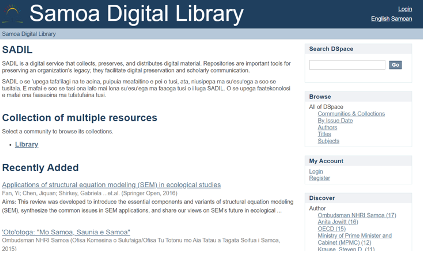
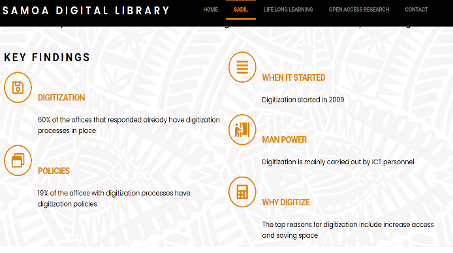
Officially launched on 17 January 2022, SADIL was built to give the people of Samoa access to bibliographic and institutional information, in both English and Samoan.
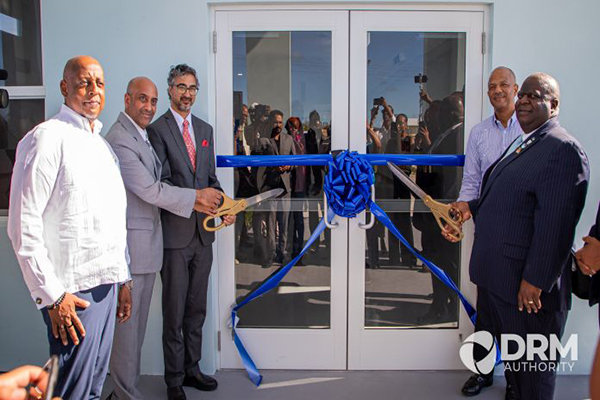
The SKSI also supported the Ministry of Education, Sports, and Culture (MESC) in the establishment of the Innovative Lifelong Learning Lab (MILLL) or Soifua A’oa’oina. The lab was officially opened on 30 June 2022, at the MESC Headquarters, with the participation of authorities from MESC, UNESCO Office for the Pacific States, the Consulate of India in Samoa, leaders from the education and private sector, and students.
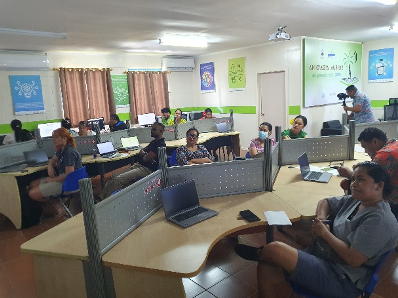
MILLL is an inclusive innovation hub for training and collaboration that draws and identifies talents, mentors, and youths, providing accessible learning opportunities to people with disabilities, and pathways and skills required to meet the contemporary and future challenges of Samoa. This lifelong learning lab offers a range of learning opportunities and encourages and facilitates access to information, collaboration, and advanced information literacy. Beyond an actual physical lab, MILL has a virtual branch with open-access courses on digital information literacy.
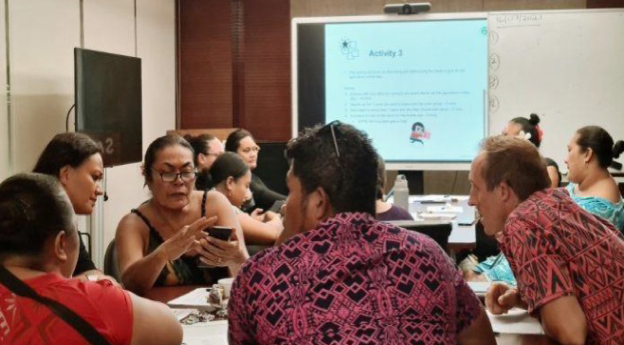
With the introduction of the many technologies and opportunities to Samoan citizens, training and capacity building have been a major focus throughout the SKSI project. The UNESCO Office for the Pacific States engaged many partners to build a solid knowledge base and the sharing of ideas. The Open Education Resources Foundation (OERF) supported MESC in introducing Free and Open-Source Software (FOSS) tools. The first round of training to present the MILLL platform included an introduction to the Learning Management System, an online discussion forum to facilitate communities of practice and a WordPress multisite to host the Open Educations Resources (OER) course content. The Learning Management System presented a working model for potential replication to support other Pacific SIDS and countries in the Global South.
South-South Cooperation on Digital Transformation
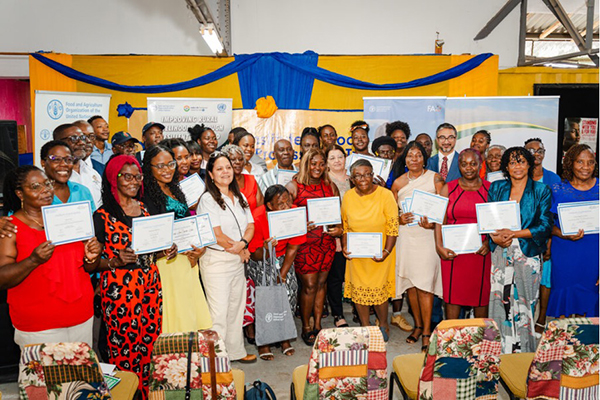
Under the SKSI, UNESCO led the OERF team in conducting training for library services teams in Samoa on open education, open licensing, and copyright workshops. With a South-South cooperation vision, the Management Development Institute (MDI) of India conducted a virtual international training workshop on data management at the MESC Lifelong Learning Lab in December 2022. Twenty-six data managers from ten Samoa government ministries, entities, and private organisations were trained on how to encourage the curation of data so it can be accessed and used by people looking for information.
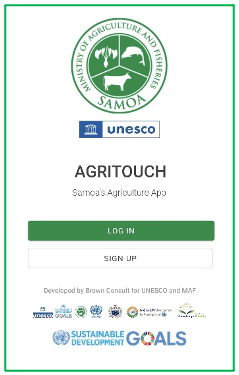
Along the same lines, the Ministry of Agriculture and Fisheries (MAF) of Samoa led a consultative process to develop a mobile application for farmers to promote and ensure access to information. AgriTouch App aims to address knowledge gaps identified by farmers in consultations with MAF and SKSI partners in July and October 2021. The app provides farmers with up-to-date information focused on markets, crop management, current projects coordinated by the Ministry, funding opportunities, as well as a tool to track their farms’ production and expenses. The first version of the app was available on the Google Play Store (Android) and Apple App Store. Local telecommunications vendors Vodafone Samoa and Digicel Samoa offered their customers the app free of charge under their respective networks.
SIDS-to-SIDS knowledge exchange and cooperation
The experience of the SKSI in Samoa provided opportunities for foresight, feasibility, scaling-up and replication in Asia and the Pacific region, particularly in the context of SIDS-to-SIDS cooperation.
In order to evaluate where the country currently stands, and to serve as a benchmark for the future evolution of KSI in Samoa and the region, a Media and Information Literacy (MIL) Assessment was carried out following the UNESCO Global Media and Information Literacy Assessment Framework, followed by several exchange events to engage the partners of the Pacific States.
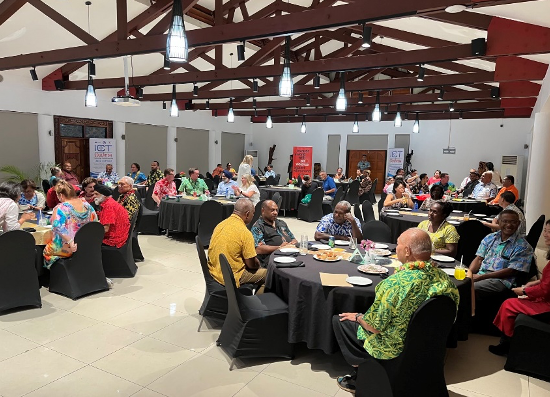
One of these was a SIDS-SIDS exchange led by the University of the South Pacific (USP) Council on 9 November 2022. During the event, representatives of USP presented the SKSI model to country leaders of the region, proposing to replicate it in other SIDS and pacific countries. Vanuatu, Solomon Islands and Kiribati took interest in knowledge exchange and having similar initiatives take place in their countries.
Before the conclusion of the Samoa Knowledge Society Initiative (SKSI) project in December 2022, the Government of Samoa took measures to guarantee that the work on freedom of expression and access to information continues.
MCIT agreed to continue managing the request for information portal to ensure timely dissemination of requested information. MESCC will operate the Lifelong Learning Lab with the support of the education sector. Training events will be carried out with the Public Service Committee, with the support of a pool of trainers from key partners from MCIT, MESC, Office of the Regulator, NUS and professional association representatives. The mobile application for the farmers’ associations will be now integrated into the Ministry of Agriculture and Fisheries work, and new staff will be incorporated into the team to ensure the app maintains updated information and is upgraded in the future.
More India-UN Fund Stories