• Home
  • /
  • Climate Action
  • /
  • Potential of South-South and Triangular Cooperation on Climate Technologies

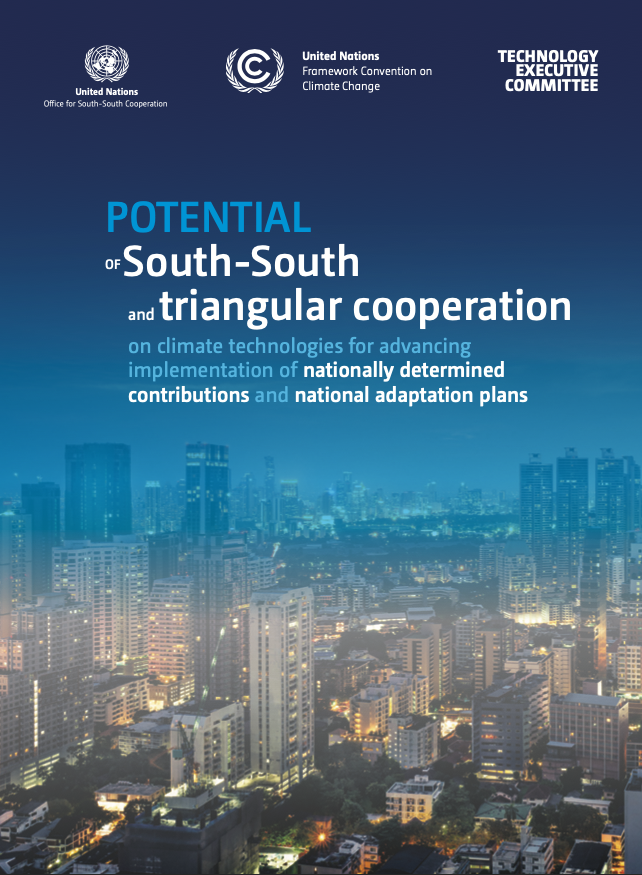
Potential of South-South and Triangular Cooperation on Climate Technologies


The Technology Executive Committee (TEC) is the policy arm of the Technology Mechanism of the Convention and the Paris Agreement, mandated to, inter alia, promote and facilitate collaboration on the development and transfer of technologies for mitigation and adaptation between governments, the private sector, non-profit organizations and academic and research communities. In accordance with its mandate and acknowledging the pivotal role that collaboration between governments and relevant institutions in developing countries can play in advancing the proliferation of climate technologies, the TEC has included South–South and triangular technology cooperation in its rolling workplan, considered the matter at each of its meetings and developed related knowledge products (e.g. TEC, 2016; TEC, 2017a; TEC, 2017b).

There is growing recognition worldwide of the potential of SSC and TrC to accelerate climate action in developing countries. Fifteen developing countries referred directly to SSC in their NDCs, with eight mentioning that they consider SSC to be a suitable complement to North–South cooperation for both mitigation and adaptation action, in particular regarding technology transfer and innovation and capacity-building (United Nations Climate Partnerships for the Global South (UNCPGS), 2017). SSC and TrC were also mentioned by 32 developing and 5 developed countries in their latest national communications, biennial update reports and biennial reports.

In this context, the TEC agreed in 2017, to undertake an analysis of the potential that SSC and TrC offer for assisting developing countries with implementing their NDCs and NAPs. To enrich the work and align it with the broader development agenda, in 2018 the TEC entered into a collaboration with the United Nations Office for South–South Cooperation (UNOSSC). This publication is the first fruit of the collaboration between the two entities and draws on the deliberations that took place at the workshops on SSC and TrC for climate action and sustainable development jointly organized by the TEC and UNOSSC in conjunction with the 2018 Asia-Pacific Climate Week and Latin America and Caribbean Climate Week.

This publication aims to provide insights into trends and good practices in, as well as barriers to and enablers of, SSC and TrC on climate technologies. The eight case studies presented provide concrete examples of SSC and TrC on climate change adaptation and mitigation through technology development and transfer in the areas of agriculture, coastal zones, early warning, transport, energy and waste. The publication concludes with recommendations for making better use of the potential of SSC and TrC in these areas for advancing the implementation of NDCs and NAPs. Target audience This publication is targeted at policymakers and practitioners in developing and developed countries that are involved or interested in making use of SSC and TrC for advancing climate action in line with priorities contained in NDCs and NAPs.
Download PDF

ABOUT

Terms of Service

Privacy Policy

Disclosures

RESOURCES

Terms of Service

Privacy Policy

Disclosures

ENGAGE

Terms of Service

Privacy Policy

Disclosures

Copyright © UNOSSC/UNDP

wpChatIcon
wpChatIcon

Alliance Application Form

Submit an Expression of Interest and/or Demand Signal. UNOSSC reviews submissions on a rolling basis.

1. Official name of organization / institution / government entity (exclusions to apply) *
2. Country *
3. Region *
4. SDG *
Secondary SDG *
5. Partner category *
6. Website *
7. Brief description of your institution (max. 150 words) *
Name for the Lead *
Title for the Lead *
Email address for the Lead *
Name for the co-lead
Title for the co-lead
Email address for the co-lead
Section 3. Expression of Interest in the Alliance *
Additional information on proposed areas of engagement may be requested through the platform following initial review by the Alliance Secretariat.
Section 4. Due Diligence and Integrity Declaration *

Submission Note:

  • Submission of this Expression of Interest form does not automatically confer participation in the Alliance.
  • All submissions will be reviewed by the Alliance Secretariat, including basic eligibility screening and proportionate due diligence, as appropriate.
  • Participation in Alliance activities is determined based on relevance to articulated cooperation needs, alignment with Alliance principles, and integrity considerations.
  • Engagement under the Alliance is voluntary, non-binding, and facilitative in nature, and does not constitute funding approval, contractual commitment, or institutional membership.
  • The Alliance Secretariat may contact submitting entities for additional information or clarification during the review process.

Submission of Demand Form

Description of Demand

Indicate the type of support or cooperation requested through the Alliance.
Please briefly describe the challenge, gap, or priority. (Max. 300 words)

Thematic and Geographic Focus

Please indicate the main focus areas of your demand:

A. Thematic Areas (select up to three)
B. Geographic Focus (select all that apply)

Proposed Engagement Modalities

Please indicate how you would like to engage through the Alliance (select all that apply):

Expected Outcomes

Please indicate the main results you seek to achieve through this engagement. (Max. 200 words)
Examples:
• Capacity strengthened
• Partnerships established
• Sectoral or regional strategies co-developed
• Solutions piloted
• Knowledge generated
• Policies informed

Timeline and Readiness (if applicable)

1. Expected timeframe for engagement:
2. Current stage:

Additional Information

Please provide any additional information, documents, or links relevant to this submission.
(Max. 200 words or upload link)

Submission of Offer Form

Description of Contribution

Indicate the type of contribution your institution can provide and describe the expertise, resources, or solutions you may offer.
Please briefly describe your proposed contribution. (Max. 300 words)

Thematic and Geographic Focus

Please indicate the main focus areas of your interest:

A. Thematic Areas (select up to three)
B. Geographic Focus (select all that apply)

Proposed Engagement Modalities

Please indicate how you would like to engage through the Alliance (select all that apply):

Expected Outcomes

Please indicate the main results you aim to achieve through this engagement. (Max. 200 words)
Examples:
• Capacity strengthened
• Partnerships established
• Sectoral or regional strategies co-developed
• Solutions piloted
• Knowledge generated
• Policies informed

Timeline and Readiness (if applicable)

1. Expected timeframe for engagement:
2. Current stage:

Additional Information

Please provide any additional information, documents, or links relevant to this submission.
(Max. 200 words or upload link)

Organization Registration

Authentication & Due Diligence This prototype simulates identity verification, due diligence confirmation, and an authentication step before submission. *

First Name *
Last Name *
Email address *
Password *
Confirm Password *
Name of institution / organization *
Country / Region *
Organization Type *
Organization other *
Function / role *
Organization logo *
Maximum file size: 1 GB

Login

Login / email *
Password *
Remember me

Forgot password?

Connect form

Your name *
Email *
Organization / institution *
Job title / role *
Reason for connecting:
Short message

Scroll to Top