Seville, Spain | 30 June – 3 July 2025 – The United Nations Office for South-South Cooperation (UNOSSC) played a prominent role at the 4th International Conference on Financing for Development (FFD4), held in Seville, Spain. Through high-level plenary and roundtable interventions, four co-organized side events, and a series of strategic bilateral meetings, UNOSSC amplified the voice of the Global South and underscored the pivotal role of South-South and triangular cooperation in transforming the global development financing architecture.
Elevating South-South Cooperation in the Global Financing Discourse
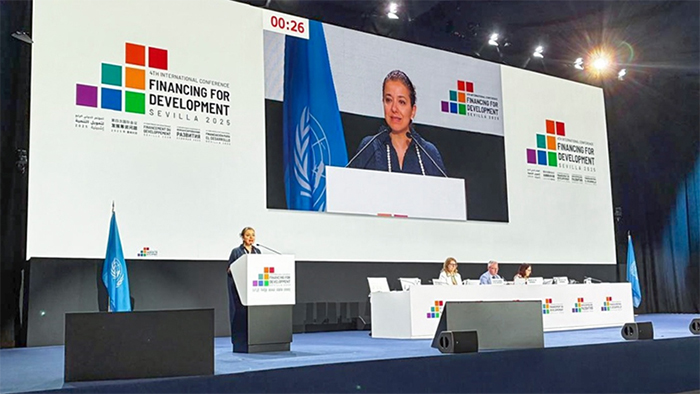 UNOSSC Director Ms. Dima Al-Khatib addressed the Seventh Plenary of FFD4, calling for bold reforms to global financial governance. “South-South and triangular cooperation will not solve every challenge,” the Director said. “But they offer unique comparative advantages. They are cost-effective, rooted in ownership, and designed to build capacity from within.” She emphasized that the Compromiso de Sevilla reflects an evolved understanding of the catalytic, effective, and transformative potential of South-South and triangular cooperation. Her remarks called for scaling up voluntary support for SSTC – from financing and capacity-building to technology transfers – and highlighted the need for inclusive partnerships and innovative financing mechanisms, especially through regional platforms.
Previewing the new UNOSSC Global Report “Bridging Horizons and Continents,” the Director positioned UNOSSC as a strategic actor in intergovernmental and UN system engagement, supporting knowledge platforms like South-South Galaxy and the South-South and Triangular Cooperation Solutions Lab, and funding modalities including the recently launched UN Fund for South-South Cooperation (UNFSSC) Triangular Cooperation Window.
Debt Solutions and LLDC Support
“The potential of South-South and triangular cooperation is immense and can deliver through the use of tested instruments and approaches,” said Director Dima Al-Khatib High-level Roundtable 5 on ‘Realizing a development-oriented sovereign debt architecture’. “With unsustainable debt and large financing gaps weighing on many countries the Global South, it is of utmost importance to enable South-South exchanges on innovative financial solutions and instruments, for a better global debt architecture and national debt management systems.”
During the Roundtable, Ms. Al-Khatib spotlighted the debt burdens faced by many developing countries and the critical role of peer exchange in creating more resilient and fair financial systems. She shared success stories such as the India-UN Development Partnership Fund’s support to The Bahamas’ public debt management, in collaboration with the Commonwealth Secretariat and UNDP.
UNOSSC Director Ms. Dima Al-Khatib addressed the Seventh Plenary of FFD4, calling for bold reforms to global financial governance. “South-South and triangular cooperation will not solve every challenge,” the Director said. “But they offer unique comparative advantages. They are cost-effective, rooted in ownership, and designed to build capacity from within.” She emphasized that the Compromiso de Sevilla reflects an evolved understanding of the catalytic, effective, and transformative potential of South-South and triangular cooperation. Her remarks called for scaling up voluntary support for SSTC – from financing and capacity-building to technology transfers – and highlighted the need for inclusive partnerships and innovative financing mechanisms, especially through regional platforms.
Previewing the new UNOSSC Global Report “Bridging Horizons and Continents,” the Director positioned UNOSSC as a strategic actor in intergovernmental and UN system engagement, supporting knowledge platforms like South-South Galaxy and the South-South and Triangular Cooperation Solutions Lab, and funding modalities including the recently launched UN Fund for South-South Cooperation (UNFSSC) Triangular Cooperation Window.
Debt Solutions and LLDC Support
“The potential of South-South and triangular cooperation is immense and can deliver through the use of tested instruments and approaches,” said Director Dima Al-Khatib High-level Roundtable 5 on ‘Realizing a development-oriented sovereign debt architecture’. “With unsustainable debt and large financing gaps weighing on many countries the Global South, it is of utmost importance to enable South-South exchanges on innovative financial solutions and instruments, for a better global debt architecture and national debt management systems.”
During the Roundtable, Ms. Al-Khatib spotlighted the debt burdens faced by many developing countries and the critical role of peer exchange in creating more resilient and fair financial systems. She shared success stories such as the India-UN Development Partnership Fund’s support to The Bahamas’ public debt management, in collaboration with the Commonwealth Secretariat and UNDP.
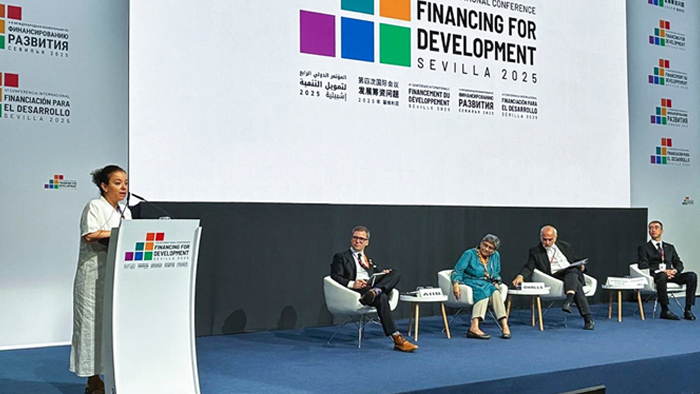 Speaking at the Ministerial Meeting for Landlocked Developing Countries (LLDCs), organized by OHRLLS, the Director urged the use of South-South and triangular cooperation as a pathway to unlock finance, technology, and partnerships tailored to LLDCs. She highlighted UNOSSC’s support to the Awaza Programme of Action and ongoing contributions through policy dialogues, analytical work, and Trust Fund initiatives. “UNOSSC has intensified its support for LLDCs through concrete initiatives,” said the Director. “We have worked with UNOHRLLS to ensure that South-South and triangular cooperation are anchored as avenues for implementation of the Awaza Programme of Action,” the Director added, noting mobilization of blended finance, debt swaps for development and climate, and thematic bonds.
Side-Event Discussions on Emerging Priorities
UNOSSC co-organized four side-events during FFD4 that showcased the diversity and depth of its work in financing for development:
Speaking at the Ministerial Meeting for Landlocked Developing Countries (LLDCs), organized by OHRLLS, the Director urged the use of South-South and triangular cooperation as a pathway to unlock finance, technology, and partnerships tailored to LLDCs. She highlighted UNOSSC’s support to the Awaza Programme of Action and ongoing contributions through policy dialogues, analytical work, and Trust Fund initiatives. “UNOSSC has intensified its support for LLDCs through concrete initiatives,” said the Director. “We have worked with UNOHRLLS to ensure that South-South and triangular cooperation are anchored as avenues for implementation of the Awaza Programme of Action,” the Director added, noting mobilization of blended finance, debt swaps for development and climate, and thematic bonds.
Side-Event Discussions on Emerging Priorities
UNOSSC co-organized four side-events during FFD4 that showcased the diversity and depth of its work in financing for development:
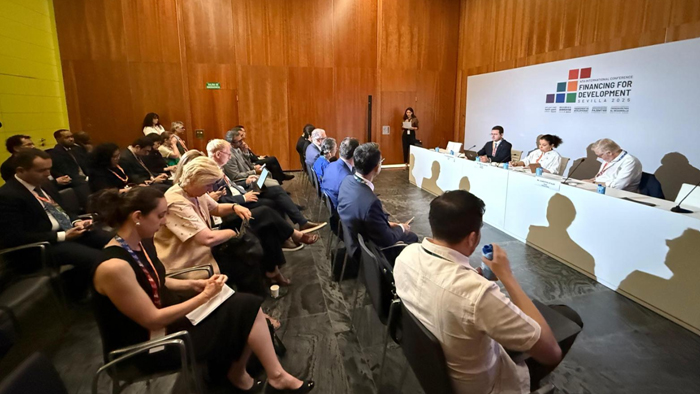
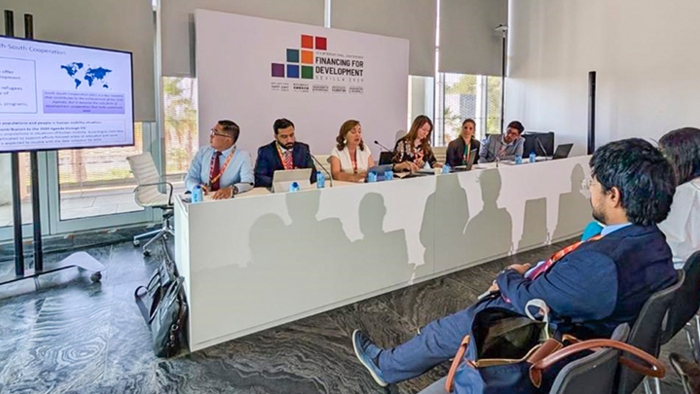
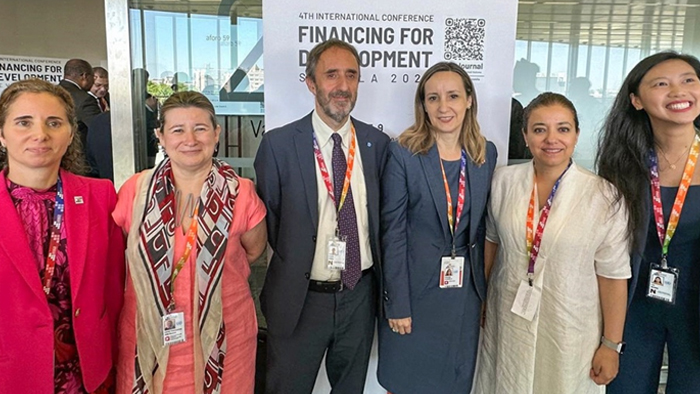
UNOSSC Director Ms. Dima Al-Khatib addressed the Seventh Plenary of FFD4, calling for bold reforms to global financial governance. “South-South and triangular cooperation will not solve every challenge,” the Director said. “But they offer unique comparative advantages. They are cost-effective, rooted in ownership, and designed to build capacity from within.” She emphasized that the Compromiso de Sevilla reflects an evolved understanding of the catalytic, effective, and transformative potential of South-South and triangular cooperation. Her remarks called for scaling up voluntary support for SSTC – from financing and capacity-building to technology transfers – and highlighted the need for inclusive partnerships and innovative financing mechanisms, especially through regional platforms.
Previewing the new UNOSSC Global Report “Bridging Horizons and Continents,” the Director positioned UNOSSC as a strategic actor in intergovernmental and UN system engagement, supporting knowledge platforms like South-South Galaxy and the South-South and Triangular Cooperation Solutions Lab, and funding modalities including the recently launched UN Fund for South-South Cooperation (UNFSSC) Triangular Cooperation Window.
Debt Solutions and LLDC Support
“The potential of South-South and triangular cooperation is immense and can deliver through the use of tested instruments and approaches,” said Director Dima Al-Khatib High-level Roundtable 5 on ‘Realizing a development-oriented sovereign debt architecture’. “With unsustainable debt and large financing gaps weighing on many countries the Global South, it is of utmost importance to enable South-South exchanges on innovative financial solutions and instruments, for a better global debt architecture and national debt management systems.”
During the Roundtable, Ms. Al-Khatib spotlighted the debt burdens faced by many developing countries and the critical role of peer exchange in creating more resilient and fair financial systems. She shared success stories such as the India-UN Development Partnership Fund’s support to The Bahamas’ public debt management, in collaboration with the Commonwealth Secretariat and UNDP.
Speaking at the Ministerial Meeting for Landlocked Developing Countries (LLDCs), organized by OHRLLS, the Director urged the use of South-South and triangular cooperation as a pathway to unlock finance, technology, and partnerships tailored to LLDCs. She highlighted UNOSSC’s support to the Awaza Programme of Action and ongoing contributions through policy dialogues, analytical work, and Trust Fund initiatives. “UNOSSC has intensified its support for LLDCs through concrete initiatives,” said the Director. “We have worked with UNOHRLLS to ensure that South-South and triangular cooperation are anchored as avenues for implementation of the Awaza Programme of Action,” the Director added, noting mobilization of blended finance, debt swaps for development and climate, and thematic bonds.
Side-Event Discussions on Emerging Priorities
UNOSSC co-organized four side-events during FFD4 that showcased the diversity and depth of its work in financing for development:
- Enhancing South-South Cooperation for the SDGs, co-organized with Azerbaijan International Development Agency (AIDA) and OECD/DAC, emphasized the transformative role of emerging development partners (EDPs). Ms. Al-Khatib called for a shift in the development architecture to better reflect the dynamic realities and contributions of the Global South. “A socio-economic-political reordering is underway across all regions,” said the Director. “Leading to the FFD4, Member States called for more innovative partnerships that recognize the new expectations for, and contributions of, the Global South beyond ‘financial envelopes’, but towards building inclusive financial and development cooperation models.” Emerging Development Partners are rising in response, through efforts that are essentially South-South cooperation, which is leveraging the experience and expertise of countries in contexts they deeply understand, delivered in a manner that ensures mutual benefit and poses no burden.
- South-South Data for Development, co-hosted with UNCTAD, underlined the foundational role of data in enabling effective South-South and triangular cooperation. Ms. Ines Tofalo of UNOSSC showcased tools such as the Handbook on Integrating South-South and Triangular Cooperation in the Voluntary National Reviews (VNRs), Guidelines for the Integration of South-South and Triangular-Cooperation into the Country and Regional-level Work of the UN-Development System, and a new initiatives under the Triangular Cooperation Window.
- Mobilizing Resources through Innovative Partnerships, a joint event with Portugal, OECD, Germany, Mexico, and Morocco, provided a platform to illustrate how triangular cooperation can be a scalable and pragmatic tool. Ms. Tofalo moderated a session where partners shared their experiences with the UNFSSC Triangular Cooperation Window. “Tapping into knowledge and innovations emerging from the Global South, triangular cooperation amplifies the effectiveness of limited financial resources,” said the Director. “By pooling funds, sharing risks and investing in capacity development, partners can achieve more with less.”
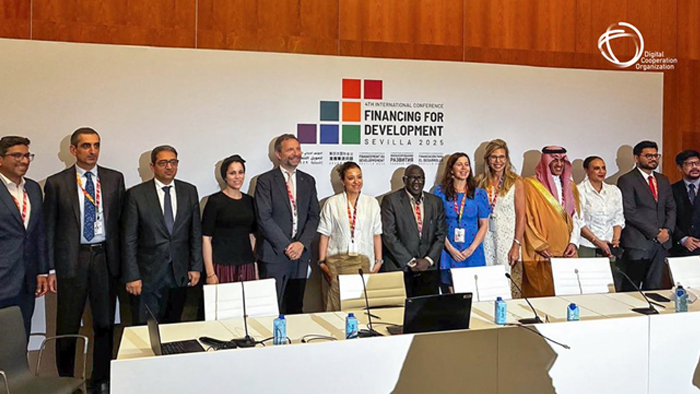
- Unlocking Digital Prosperity, organized with the Digital Cooperation Organization (DCO), focused on financing digital transformation in the Global South. The Director linked the event’s themes to findings from the upcoming Global Report and elaborated on UNOSSC’s initiatives to strengthen regional coordination and foster private sector engagement. “South-South and triangular cooperation offer transformative pathways for FFD4 outcomes,” said the Director. For example, M-PESA’s transformative impact in Kenya exemplifies how Southern-led digital innovation can address financing challenges while creating replicable models for other developing countries, she said. “Youth digital literacy represents both our greatest opportunity and most urgent challenge in bridging the digital divide,” she noted. “With 60% of Africa’s population under 25, investing in digital skill creates a multiplier effect to accelerate economic transformation across generations.”