This research work was carried out with financial and scientific support from the UNOSSC and UNDP under the ‘South-South Global Thinkers – the Global Coalition of Think Tank Networks for SSC’ initiative. The research was conducted by the Department of International Development Cooperation of the Institute of New Structural Economics (INSE) at Peking University. The research team is composed of two principal investigators (Dr. Wen Chen and Dr. Jia Yu) and three team members (Chenmei Li, Dr. Kokou Wotodjio Tozo and Xinyue Wu).
Technology has taken centre stage of modern economic growth. In particular, rapid advances in information technology have drastically changed the organization and production of economic activities worldwide. The outbreak of COVID-19 further prompted companies and countries to adopt digital technologies to cope with the pandemic and many of these changes could be here for the long haul or may even be nonreversible. It is of critical importance for countries in the global South to strengthen technology cooperation both with countries from the global North and among themselves.
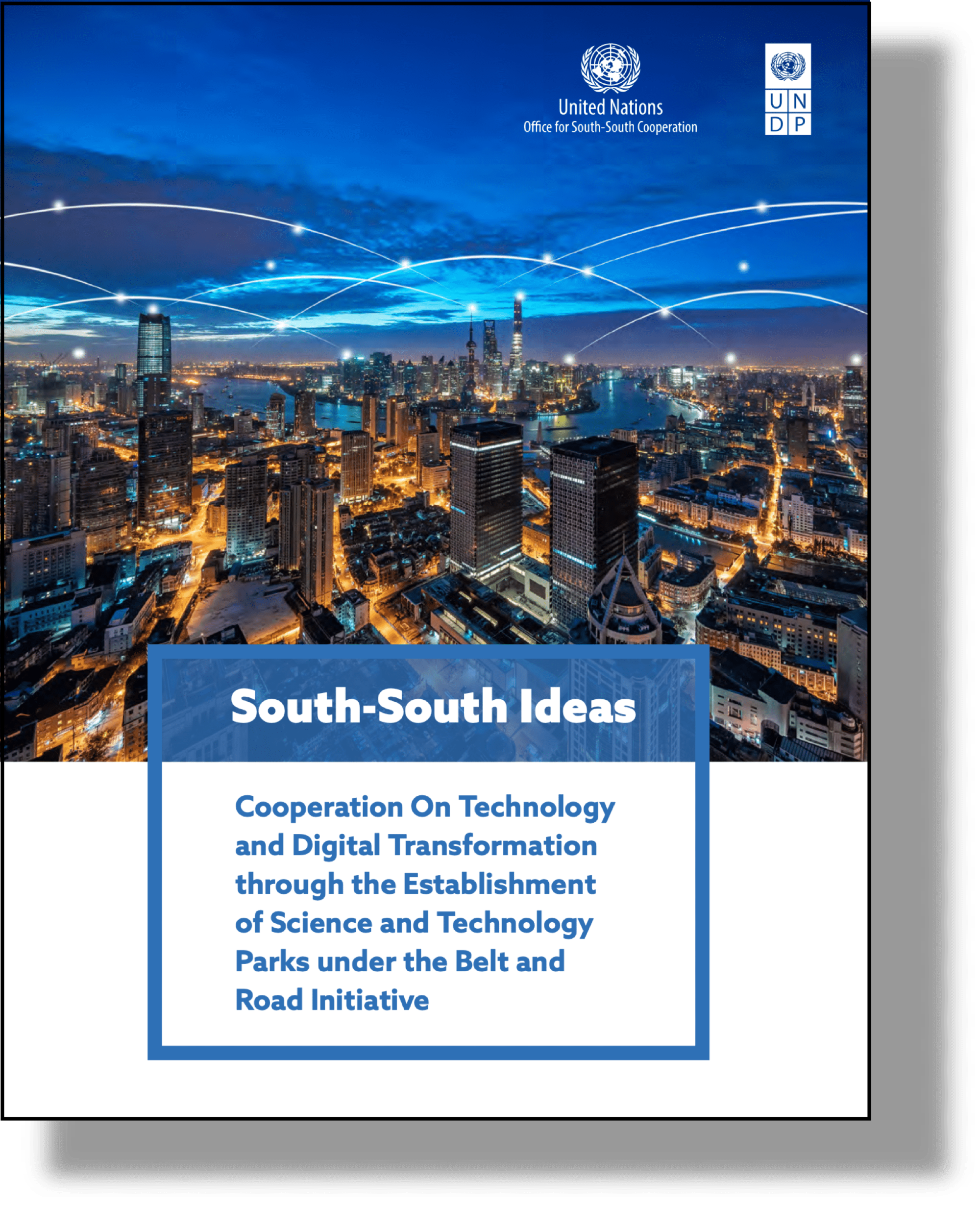
The latter cooperation might be even more important and needed, as the absorptive capacity of developing countries may not allow them to successfully assimilate (frontier) technologies from advanced countries. Joined by over 140 countries around the world (of which 50 come from Africa, the continent with the largest number of developing countries), China’s Belt and Road Initiative (BRI) plays a pivotal role in promoting South-South cooperation (SSC) in technology and digital transformation in the contemporary world.
The aim of this research is to explore the avenues of cooperation between China and other countries in the global South on setting up science and technology parks (STPs) under the BRI, which may serve as a cornerstone for contemporary South-South cooperation in scaling up technological transfers and innovation, as well as bridging the digital divide with advanced countries and accelerating digital transformation in the global South. Furthermore, this endeavor could contribute to the attainment of the United Nations Sustainable Development Goals (SDGs), as the pro-motion of SSC in science, technology and innovation are identified as a specific target under Goal 17.
Thus, this study is both timely and critically important for developing countries in an era of innovation- and digital technology-driven growth. This research draws on the theory of New Structural Economics (NSE) and combines desk research with field research (i.e., interviews with representatives from the Ministry of Science and Technology of the People’s Republic of China) for analysis. Although it is not exhaustive, a set of targeted policy recommendations are provided to key stakeholders, aiming to set the scene for a closer and more successful SSC on technology and digital transformation under the BRI.
First, to bridge the digital divide and promote digital transformation in the global South, host governments from Southern countries should give priority to foreign investments in sectors that support the use and production of digital technologies. This is especially important in the wake of the COVID-19 pandemic. Given China’s successful experience in using digital technologies fighting against the pandemic and the fact that China has quite a large number of high-tech companies looking for expansion in foreign markets, targeted efforts to attract investments from those companies are likely to pay off.
Second, alternative or complementary sources of funds to the BRI, such as the involvement of development financing institutions (DFIs), is highly recommended to further advance South-South cooperation. Most DFIs (e.g., the World Bank, the Asian Development Bank, the Asian Infrastructure and Investment Bank) have flexible financial schemes, and with their own agenda and financial instruments, can assist in incubating innovative businesses and catalyze the process of industrialization in less developed countries.
Third, STP developers, as well as the International Association of Science Parks and Areas of Innovation, are encouraged to promote interaction and share information with other regional STPs. To live up to the expectation and stay competitive, STPs need to be evaluated using dynamic performance data, which are currently lacking. In hopes of bridging the data gap, a monitoring and evaluation programme has been launched by Peking University’s Institute of New Structural Economics.
Fourth, to strengthen cooperation on STPs under the BRI, policymakers from China and the BRI-participating countries could consider upgrading the existing STPs with a special focus on STI cooperation.
Lastly, while SSC on technology is the central focus of this research and China’s BRI plays a pivotal role in this regard, it is also highly important to have countries from the global North and/or international organizations involved in dif- fusing technologies and reducing digital divides.