In a region where shared water systems, agricultural livelihoods, and climate risks transcend national borders, the Food and Agriculture Organization of the United Nations (FAO), together with the United Nations Office for South-South Cooperation (UNOSSC) and the Russian Federation, has launched a new South-South and triangular cooperation initiative to advance sustainable agriculture in the Fergana Valley.
Officially inaugurated at a Regional Inception Workshop in Moscow, the project will utilize funds contributed by the Russian Federation to the United Nations Fund for South-South Cooperation and brings Kyrgyzstan, Tajikistan, and Uzbekistan together around a shared vision: strengthening institutional capacity, knowledge exchange, and human capital to address deeply interconnected agricultural and environmental challenges.
The two-day workshop marked a critical first step in translating that vision into action, aligning partners on governance, cooperation frameworks, and implementation priorities. Rather than focusing on large-scale infrastructure, the initiative positions knowledge, innovation, and regional collaboration as its primary levers – demonstrating how targeted South-South and triangular cooperation investments can generate scalable and replicable impact across regions.
Discussions focused on setting strategic foundations for implementation, including project rationale, cooperation frameworks, governance structures and expectations.
Mr. Oleg Kobiakov, FAO Liaison Office with the Russian Federation Director, in his opening remarks framed the project in historical, geopolitical, and systemic terms. He emphasized that the Fergana Valley is not only an agricultural hub but a civilizational landscape with long-standing irrigation traditions now under pressure from climate change, demographic growth, and aging infrastructure.
The Director specifically noted that the project’s value lies not in capital construction, but in knowledge, institutional capacity, and human capital. Russian scientific and technical institutions are positioned as core implementing partners, particularly in irrigation and land reclamation. Moreover, there are strong expectations of scalability and future donor engagement beyond the pilot phase. The project is a small financial intervention designed to unlock larger systemic effects. As Mr Kobiakov phrased it, “a small pill could cure a serious disease.”
Mr. Anping Ye, Director of the South-South and Triangular Cooperation Division at FAO HQ, noted the importance of the project as part of FAO’s broader South-South and Triangular Cooperation portfolio, particularly in the context of declining global development resources.
He emphasized the project’s unique institutional significance, highlighting its strong linkage to the United Nations Fund for South-South Cooperation, and support from the Russian Federation. Despite a modest funding envelope, the initiative will need to focus on delivering tangible, demonstrable results that make a real impact on the ground.
In his closing remarks, Mr. Anping Ye placed emphasis on capacity building (FAO staff and national institutions), continuous dialogue with beneficiary governments, and on leveraging the project to mobilize additional partnerships and resources.
The UNOSSC intervention from Ms. Xiaojun Grace Wang, Trust Fund Director, articulated the normative logic of South-South and triangular cooperation, which goes far beyond a traditional donor-recipient model. As explicitly stated, beneficiary countries are co-creators and contributors, not passive recipients. The Russian Federation and FAO would provide the triangular dimension, combining programmatic support, technical expertise, and global knowledge.
UNOSSC strongly asserted that success will be measured not only by local outcomes, but by transferability of solutions, documentation of good practices, and visibility and replication across regions. On top of that, visibility and communication were highlighted as strategic assets, not secondary activities.
Mr. Nafis Khan, Senior Programme Officer at FAO HQ, provided a structured walkthrough of project objectives, outputs, and governance, clarifying the importance of intercountry coordination, alignment and ownership of the project and of stakeholders’ consultation as a mandatory output.
Mr. Nafis Khan also noted that the workshop highlighted varying levels of readiness among participating countries – some ready to dive into detailed negotiations, while others offered broader overviews.
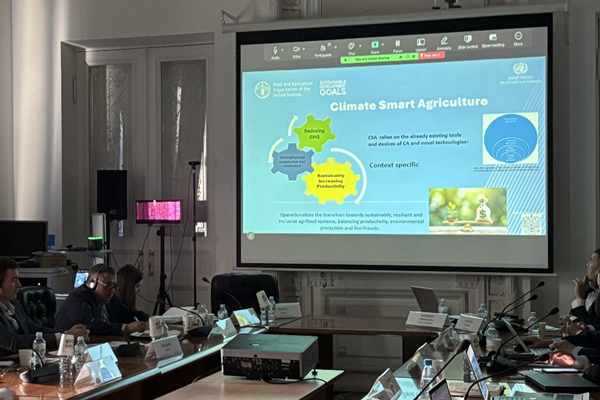
Ms. Tania Santivanez, Lead Technical Officer (LTO), and Ms. Sebnem Gurbuz, Team Leader, both from FAO, presented the project architecture, highlighting alignment with FAO’s Climate-Smart Agriculture framework; governance and coordination structures; and stakeholder roles across national, regional, and technical levels.
The speakers underscored three key elements: the process-driven approach of the project; pilot activities designed to create scalable and replicable models rather than isolated successes, and country engagement to ensure realistic outputs and timelines.
National consultants and FAO country representatives, Nurali Saidov from Kyrgyzstan and Muhammadjon Kosimov from Uzbekistan, welcomed the launch of the Fergana Valley project and confirmed high expectations from beneficiary countries regarding its practical applicability. The speakers recognized shared challenges across borders (water scarcity, system aging, climate variability) and showed readiness to use pilot sites as learning platforms.
Diverse actors confirmed their commitment to contributing to the success of the Fergana Valley project, such as renown Russian scientific centers, namely Kostyakov Federal Research Center for Hydraulic Engineering and Land Reclamation, Federal Research Center for Agroecology, Land Reclamation, and Protective Afforestation of the Russian Academy of Sciences, and Agrarian and Technological Institute of the Patrice Lumumba People’s Friendship University of Russia.
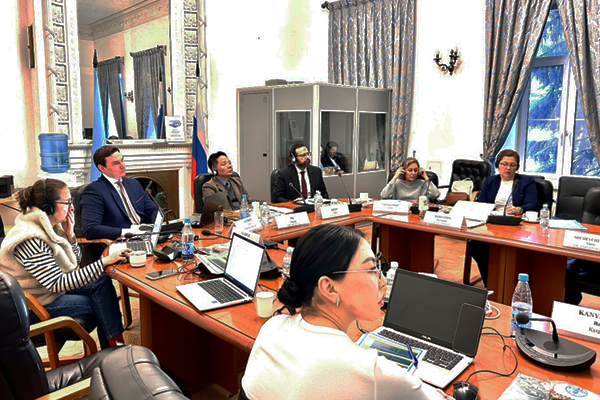 The workshop fostered a deeper understanding of both the challenges and opportunities pertaining to project implementation. Participants highlighted human capital investment as the project’s key comparative advantage, while framing the modest budget not as a constraint, but as a strategic catalyst for innovation and further impact.
The FAO Liaison Office with the Russian Federation will play a fundamental role of strategic convener and facilitator of South-South and triangular cooperation within the Fergana Valley project. It will be a bridge connecting the Russian Federation technical expertise with the demand from Central Asia countries, and a key player in ensuring visibility, credibility, and future scalability of the initiative.
Participants expressed strong confidence in the coordinating role of the FAO’s Liaison office in Moscow, which will serve as a vital link between the donor, the Russian implementation partners, and actors in beneficiary countries, national authorities and FAO country offices.
The workshop concluded with clear expectations for the Sustainable Agriculture in the Fergana Valley project: results will be rigorously documented, best practices will be transferred, and the project will serve as a reference model for future South-South and triangular cooperation initiatives.
The workshop fostered a deeper understanding of both the challenges and opportunities pertaining to project implementation. Participants highlighted human capital investment as the project’s key comparative advantage, while framing the modest budget not as a constraint, but as a strategic catalyst for innovation and further impact.
The FAO Liaison Office with the Russian Federation will play a fundamental role of strategic convener and facilitator of South-South and triangular cooperation within the Fergana Valley project. It will be a bridge connecting the Russian Federation technical expertise with the demand from Central Asia countries, and a key player in ensuring visibility, credibility, and future scalability of the initiative.
Participants expressed strong confidence in the coordinating role of the FAO’s Liaison office in Moscow, which will serve as a vital link between the donor, the Russian implementation partners, and actors in beneficiary countries, national authorities and FAO country offices.
The workshop concluded with clear expectations for the Sustainable Agriculture in the Fergana Valley project: results will be rigorously documented, best practices will be transferred, and the project will serve as a reference model for future South-South and triangular cooperation initiatives.
The workshop fostered a deeper understanding of both the challenges and opportunities pertaining to project implementation. Participants highlighted human capital investment as the project’s key comparative advantage, while framing the modest budget not as a constraint, but as a strategic catalyst for innovation and further impact.
The FAO Liaison Office with the Russian Federation will play a fundamental role of strategic convener and facilitator of South-South and triangular cooperation within the Fergana Valley project. It will be a bridge connecting the Russian Federation technical expertise with the demand from Central Asia countries, and a key player in ensuring visibility, credibility, and future scalability of the initiative.
Participants expressed strong confidence in the coordinating role of the FAO’s Liaison office in Moscow, which will serve as a vital link between the donor, the Russian implementation partners, and actors in beneficiary countries, national authorities and FAO country offices.
The workshop concluded with clear expectations for the Sustainable Agriculture in the Fergana Valley project: results will be rigorously documented, best practices will be transferred, and the project will serve as a reference model for future South-South and triangular cooperation initiatives.