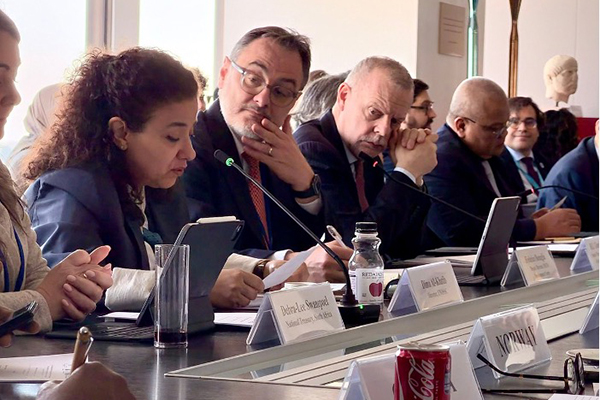
As countries across the Global South accelerate their transition to greener and more resilient economies, ensuring that women are not left behind has emerged as both a development imperative and an opportunity for transformative change. South-South cooperation is increasingly playing a catalytic role in this effort, enabling countries to exchange practical solutions, scale proven approaches, and place women at the centre of green economic growth.
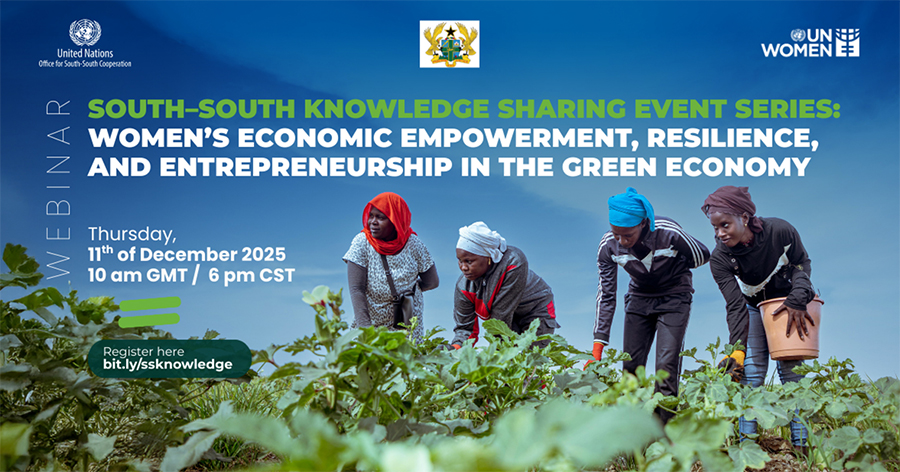
Against this backdrop, the United Nations Office for South-South Cooperation (UNOSSC) and UN Women convened a South-South Knowledge Sharing Event on 11 December 2025, bringing together diverse stakeholders to explore how knowledge exchange, innovation, and partnerships can advance women’s economic empowerment in the green economy. The virtual dialogue showcased concrete experiences from across the Global South, highlighting how cross-regional learning can translate policy commitments into inclusive, women-led economic opportunities.
Taking place as part of the webinar series
“Women’s Economic Empowerment, Resilience, and Entrepreneurship in the Green Economy,” the event brought together over 45 participants from more than 20 organizations, including government institutions, UN agencies, civil society, and private sector actors, demonstrating strong collective commitment to advancing gender-responsive green economies.
The webinar formed part of a pilot initiative supported through the Global South-South Development Center (GSSDC), funded by the Government of China via the
United Nations Fund for South-South Cooperation, and implemented by UN Women in partnership with Ghana’s Ministry of Gender, Children and Social Protection. The initiative aims to strengthen women’s access to green and digital value chains, skills, and markets, while fostering cross-regional learning among countries of the Global South.
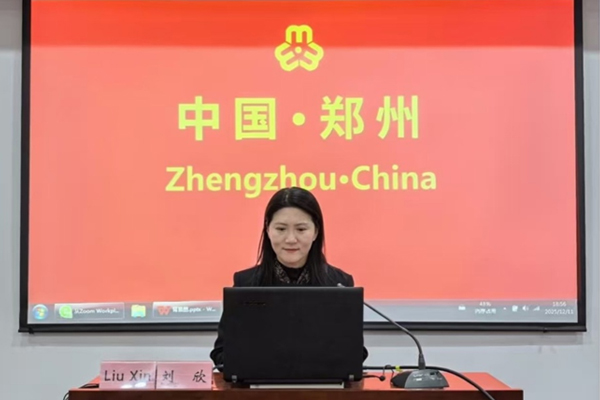
A key highlight of the event was the South-South knowledge exchange between Ghana and China, featuring Ms. Liu Xin, Vice Chairwoman of the Women’s Federation of Zhengzhou. Drawing on Zhengzhou’s experience, Ms. Liu shared practical approaches to women’s economic empowerment through green industries, digital entrepreneurship, skills development, and community-based support systems. Her contribution generated dynamic discussion and offered concrete examples of how local institutions can support women’s participation in sustainable economic transformation.
The exchange also reflected the growing city-to-city and community-level cooperation facilitated through UNOSSC, including earlier engagement between Zhengzhou and Kumasi, Ghana, which has helped lay the foundation for continued mutual learning under South-South cooperation frameworks.
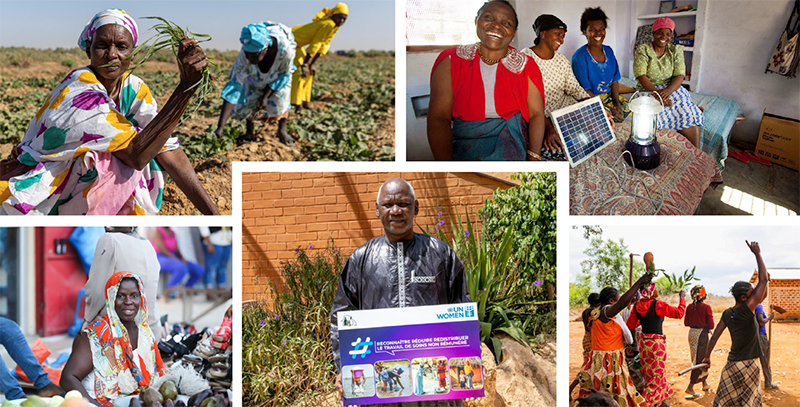
The session further benefited from UN Women’s good practices from West Africa, with UN Women Liberia sharing innovative approaches that integrate digital inclusion, renewable energy solutions, and women-led entrepreneurship to strengthen resilience in rural communities.
These experiences complemented the Ghana and Zhengzhou perspectives, reinforcing the value of regional and interregional learning.
This webinar marked the first milestone in a broader Gender and Green Economy South-South knowledge-sharing series. UNOSSC and UN Women look forward to continuing this collaboration – deepening partnerships, exchanging practical solutions, and translating shared knowledge into action to support women’s economic empowerment across the Global South.