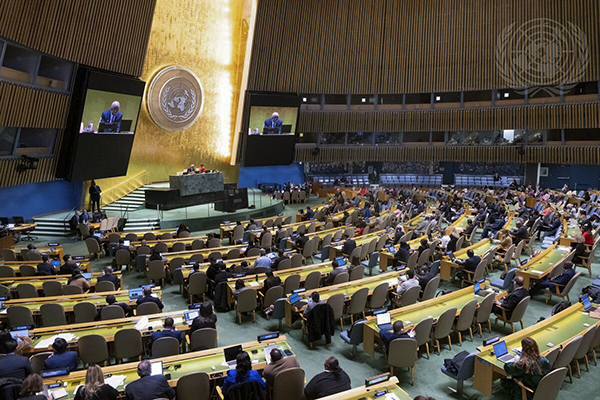
Against the backdrop of multiple, intersecting global crises and mounting pressure on the international development system, the 80th General Assembly voted to adopt resolution A/RES/80/156 on South-South cooperation reaffirming the growing strategic importance of South-South and triangular cooperation as indispensable complements to traditional development cooperation modalities. The resolution situates these forms of cooperation as practical, solidarity-based approaches that respond to contemporary development challenges while reinforcing national ownership, mutual benefit, and equality among partners.
At the core of the resolution lies a strong recommitment to the Buenos Aires outcome document of the second High-level United Nations Conference on South-South Cooperation (BAPA+40). Member States reaffirm the outcome document as the principal normative framework guiding South-South and triangular cooperation within the United Nations system. Significantly, the resolution initiates a formal intergovernmental process on the review of the impact and implementation of the BAPA+40 outcome document, taking note of the recommendation of the Administrator of the United Nations Development Programme and requesting the President of the General Assembly to appoint two co-facilitators to facilitate discussions on the modalities of the review. This step marks an important milestone to reflect on the new development contexts, emerging trends and assess achievements, identify gaps, and build consensus on future priorities to reinforce institutional frameworks, partnerships, and system-wide coherence for South-South and triangular cooperation within the UN system and among Member States.
The resolution further underscores the central role of the High-level Committee on South-South Cooperation as the main intergovernmental body responsible for reviewing system-wide progress and providing policy guidance. By recalling the outcomes of the Committee’s twenty-second session and looking ahead to its twenty-third session in 2027, the resolution reinforces continuity in intergovernmental oversight and affirms the Committee’s relevance in shaping the future direction of South-South cooperation.
South-South and triangular cooperation are explicitly positioned as important means of implementation of the 2030 Agenda for Sustainable Development. The resolution highlights their contribution to poverty eradication, food security, the reduction of inequalities, the promotion of decent work, and the acceleration of digital transformation. Particular emphasis is placed on science, technology, and innovation, including the transfer of digital technologies on mutually agreed terms, as critical enablers for closing development gaps and advancing inclusive and sustainable growth.
A prominent focus of the resolution is the need to address the specific development challenges of countries in special situations, including African countries, least developed countries, landlocked developing countries, and small island developing States, as well as countries affected by conflict and post-conflict conditions. At the same time, the resolution reflects a growing recognition of the distinct and multidimensional challenges facing middle-income countries. In this regard, it calls for coherent and tailored support and looks forward to the elaboration of a system-wide response plan to better address their diverse development needs through South-South and triangular cooperation.
The resolution places strong emphasis on financing and resource mobilization as prerequisites for scaling up South-South and triangular cooperation. It encourages increased and diversified contributions to the United Nations Fund for South-South Cooperation, Triangular Cooperation Window and the Pérez-Guerrero Trust Fund, while also recognizing innovative financing approaches, third-party cost-sharing, parallel financing, in-kind contributions and special funding arrangements such as those of the India-United Nations Development Partnership Fund, and the India, Brazil and South Africa Facility for Poverty and Hunger Alleviation (IBSA Fund). This also includes partnerships with the private sector, civil society, academia, and development banks. These efforts are framed as essential to enhancing the sustainability, scale, and impact of cooperation initiatives.
Strengthening the evidence base for South-South cooperation constitutes another key area of work. The resolution welcomes progress in the development of an initial voluntary conceptual framework for the measurement of South-South cooperation by the United Nations Conference on Trade and Development (UNCTAD), in collaboration with the United Nations Office for South-South Cooperation (UNOSSC) and regional commissions. By calling for continued capacity-building, pilot testing, and periodic briefings to Member States, the resolution underscores the importance of country-led data, transparency, and accountability in demonstrating the contribution of South-South cooperation to sustainable development outcomes.
Finally, the resolution reaffirms the mandate and central coordinating role of UNOSSC as the focal point for promoting and facilitating South-South and triangular cooperation across the United Nations system. It calls for deeper mainstreaming of these modalities into United Nations strategic frameworks, planning instruments, and country-level cooperation, including through the work of resident coordinators and United Nations country teams (UNCTs). In this context, the resolution also takes note of the development by UNOSSC, in collaboration with other United Nations entities, of guidance materials and training modules, including e-learning tools, to strengthen institutional capacities and support the systematic integration of South-South and triangular cooperation into policy instruments and cooperation frameworks.
Taken together, these efforts position South-South cooperation as an integral component of system-wide action to accelerate the implementation of the 2030 Agenda and to ensure that no one is left behind.