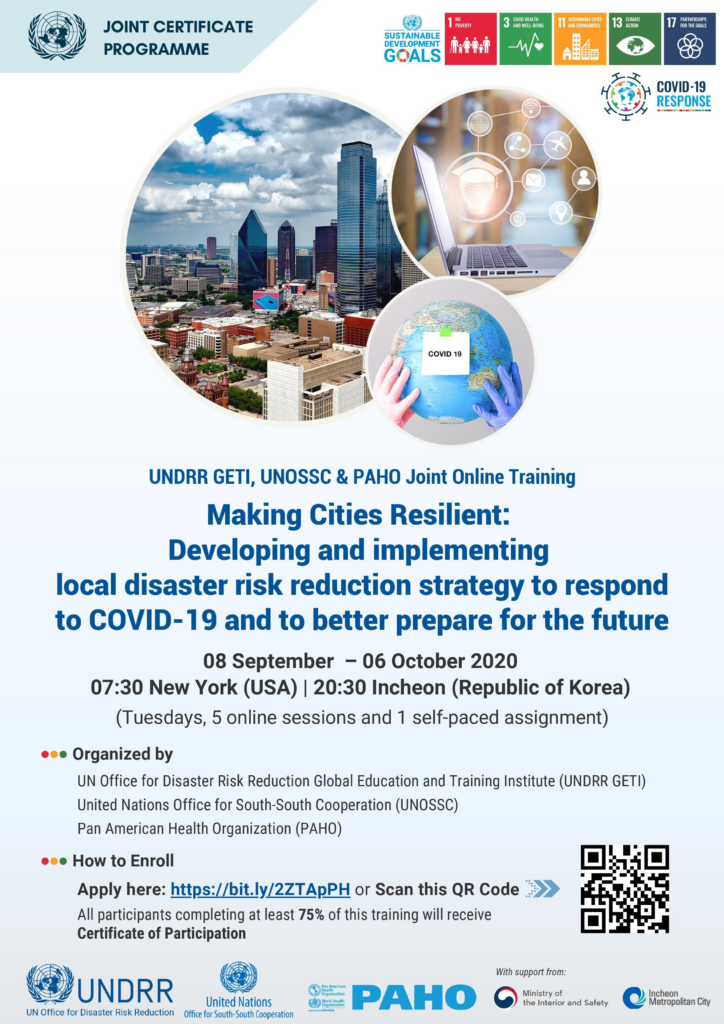
UNDRR GETI, UNOSSC & PAHO Joint Online Training on Making Cities Resilient: 8 September – 6 October


UNDRR GETI, UNOSSC & PAHO Joint Online Training: Making Cities Resilient: Developing & Implementing Local Disaster Risk Reduction Strategies to Respond to COVID-19 & Better Prepare for the Future
Background

Over the past 20 years disasters have affected 4.4 billion people, caused USD 2 trillion of damage and killed 1.3 million people. Disasters affected people living in developing countries and the most vulnerable communities within those countries. Over 95 percent of people killed by disasters are from developing countries.

Current and future challenges of mainstreaming Climate Change Adaptation (CCA) and Disaster Risk Reduction (DRR) in development planning demand new approaches, mechanisms, sets of skills and competencies that need to be identified and strengthened in order to form the basis of increasing public demand and political commitment to local actions and budget allocations. Lack of appropriate knowledge on the subject, lack of government commitment and the absence of mainstreaming in current organizational and government strategy are key existing challenges.

Urban risk is continually increasing. It has been estimated that, more than 50 per cent of the world’s population is living in urban areas. Urbanization is taking place at an unprecedented rate. In the next 20 years, the world’s population is predicted to increase by an additional two billion. By 2030 more than 60% of the world’s population is expected to live in cities, with record concentrations in large urban conglomerations and megacities in the developing world. Vulnerability of cities to disasters is on the rise especially as poor people settle in high-risk urban areas. Unfortunately, planning and development of cities has given little consideration to the consequences of hazards such as earthquakes, hydro-meteorological risks and others. The implication of this reality is the need for countries to focus their collective energies to create a safer world for urban dwellers and develop a series of innovative approaches to meet this challenge.

In this regard, building resilience and adapting to climate change is crucial for cities. Efforts to build resilience in cities can benefit from integrating disaster risk reduction and climate change adaptation with existing efforts in disaster risk management, sustainable development and other similar planning processes.

The Buenos Aires outcome document of the second High-level United Nations Conference on South- South Cooperation (BAPA+40) in 2019, recognized that South-South and Triangular cooperation, takes different forms, such as knowledge sharing, training and capacity building and technology exchange on mutually agreed terms in different important areas for sustainable development, such as disaster risk mitigation and climate change among developing countries.

Disaster risk reduction is an important component for achieving sustainable development of cities, in particular when the world is steadily becoming more urban. Fast-growing cities and urban areas of the world, mostly located in the global South, increase disaster risk due to economic growth and fast population expansion. The knowledge sharing between cities, especially government authorities at the forefront of disaster risk mitigation, by reporting practices that have been already tested and implemented by one city and that can be successfully adapted by another is highly desired.

Young people are very crucial stakeholders when mitigating disasters and for climate action. The Youth4South: Advanced Youth Leadership Programme launched by the United Nations Office for South-South Cooperation in 2017, aims at facilitating capacity development of young government officials, experts, and local authorities from developing countries to learn and adapt South-South and Triangular cooperation knowledge and tools for scaling up Southern development solutions, in their country context.

Course Objectives

The aim of this training is to strengthen an understanding on making cities resilient and to provide suite of tools to develop an evidence based local disaster risk reduction planning with multi- stakeholder engagement and in alignment with the national DRR strategies and Sendai Framework. The course also aims to introduce and familiarize local experts and government officials to South- South and Triangular Cooperation and its importance in disaster risk reduction, public health, and climate change adaptation agenda. Specifically, the course aims to:
  1. Increase political commitment and social demand for disaster resilient development, adapted for climate change, aiming for sustainable development.
  2. Increase engagement of local government actors in the field of local development, especially young government officials and planning with disaster risk reduction and climate change adaptation agenda as well as to enhance city planners and decision makers’ ability and commitment to promote disaster risk reduction and climate change adaptation through relevant systems, policies, and processes.
  3. Learn about the Making Cities Resilient Campaign and how its tools, materials and approaches may be used to build local resilience to disasters.
  4. Provide an opportunity for local experts and young officials to enhance capacities with a focus on DRR action plan development and implementation based on the Making Cities Resilient Campaign 10 Essentials for making cities resilient
  5. Introduce and familiarize the local young experts and government officials, to South-South and Triangular Cooperation, and its’ importance in disaster risk reduction and climate change adaptation agenda.
  6. Serve as a platform to share good practices and exchange in-depth learning among participants, especially for exchange of knowledge and solutions between these young representatives from developing countries with regards to relevant policies, technologies and technical knowledge and know-how.
  7. Expected Outcomes

Trained cadres of national and local young government officials, equipped with knowledge and tools in making cities resilient with a focus on the development and implementation of local DRR strategies and action plans in alignment with the national DRR strategies and Sendai Framework.

Targeted Audience

Local and national government officials in charge of disaster risk reduction and management, urban development and planning; national associations of municipalities; urban resilience practitioners as well as civil society, private sector, and academia. The course is open to all applicants from both developed and developing countries, especially young experts and officials. Participants from Least Developed Countries (LDC) and Small Island Developing countries are highly encouraged.

All participants completing 75% attendance will receive a certificate of participation

Agenda
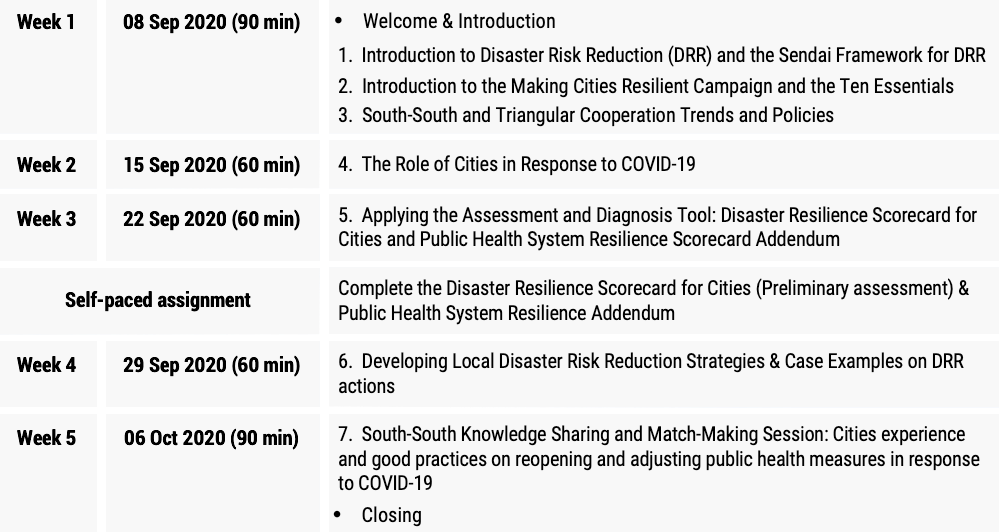
Session 1

Session 1 Agenda

Session 2

Session 2 Agenda

Session 3

Session 3 Agenda

Session 4

Session 4 Agenda

Session 5

Session 5 Agenda

Download the Training Report

Related Post


  • All Post
  • ATCT Featured Publications POM
  • BAPA+40
  • Blog
  • Capacity Development Initiatives
  • CICETE Featured Publications POM
  • CIKD
  • Cities Clusters - Agriculture
  • Cities Clusters - COVID-19
  • Cities Clusters - COVID-19 Knowledge Products
  • Cities Clusters - DRR
  • Cities Clusters - E-commerce
  • Cities Clusters - Tourism
  • Cities Clusters - Tourism Knowledge Products
  • Cities Clusters - Transport
  • Cities Clusters - Waste
  • Cities Project
  • Cities Project COVID-19 Newsletters
  • Cities Project COVID-19 Response
  • Cities Project Knowledge Products
  • Classic (untouched)
  • Climate Action
  • COMSATS Featured Publications POM
  • COMSATS Featured Solutions POM
  • Converted from Divi
  • Converted from Mixed
  • Converted from WPBakery
  • COVID-19
  • COVID-19 Page Featured Solutions
  • DRR Knowledge Products
  • DRR News
  • Empty Post
  • Events
  • Featured Event UN-Habitat POM
  • Financing for Development
  • Financing Mechanisms
  • g7+
  • Gender Events
  • Gender News
  • Good Practices in SSTrC Series
  • Good Practices Publications
  • Good Practices Thematic Series & Special Editions
  • Good Practices Vol. 2
  • Good Practices Vol. 3
  • GSSDC
  • Highlighted
  • Highlighted Publications
  • IAEA Featured Solutions POM
  • IBRAF Featured Publications POM
  • IBSA Fund
  • IBSA Fund Annual Reports
  • IBSA Fund News and Stories
  • IBSA Fund Publication
  • IBSA Fund Story
  • ICGEB Featured Events POM
  • ICGEB Featured Publications POM
  • ICGEB Featured Solutions POM
  • ILO Featured Events POM
  • ILO Featured Publications POM
  • ILO Featured Solutions POM
  • India-UN Development Partnership Fund
  • India-UN Fund Publication
  • India-UN Fund Story
  • IsDB
  • IsDB Featured Publications POM
  • IsDB SCC
  • News
  • Norec Featured Publications POM
  • Norec Featured Solutions POM
  • Peace and Development
  • PGTF Publications
  • PGTF Story
  • PICA Featured News POM
  • PICA Featured Publications POM
  • PICA Featured Solutions POM
  • PIDF Featured Publications POM
  • Publications
  • Regional Updates
  • Research
  • ROK-UNOSSC Facility
  • SGP Featured Publication POM
  • SGP Featured Solutions POM
  • Solution
  • South South in Action
  • South-South Global Thinkers
  • South-South Ideas
  • South-South Ideas Series
  • South-South in Action Series
  • Southern Response to COVID-19
  • SSN4PSI Featured Publications POM
  • SSN4PSI Featured Solutions POM
  • Training
  • UN Day for SSC 2020
  • UN Fund for SSC
  • UN SSC Day Publications
  • UN-Habitat Featured Publications POM
  • UN-HABITAT Featured Solutions POM
  • UNCCT
  • UNEP Featured Publications POM
  • UNFPA
  • UNFSSC Publication
  • UNFSSC Story
  • UNIDO Featured Publications POM
  • UNIDO Featured Solutions POM
  • UNIDO POM Events
  • UNOCT Featured Publications POM
  • UNV
  • UNV Featured Publications POM
  • WB Featured Publications POM
  • WB Featured Solutions POM
  • Webinars
  • WFP Featured Events POM
  • WFP Featured Publication POM
  • WFP Featured Solutions POM
  • WIPO
  • Workshops and Seminars
  • Youth4South
  • z Across the Globe 1
  • z Across the Globe 2
  • z Across the Globe 4
  • z Across the Globe 5
  • z Across the Globe 6
  • z Across the Globe 7
  • z Across the Globe 8
  • z ES BAPA+40
  • z ES Eventos
  • z ES Noticias
  • z ES Noticias Destacadas
  • z ES Publicaciones
  • z ES Publicaciones Destacadas
  • z ES Serie Buenas Prácticas en la CSSyT
  • z ES Serie El Sur-Sur en Acción
  • z FR Actualités
  • z FR BAPA+40
  • z FR Événements
  • z FR Publications
  • z FR Publications en vedette
  • z FR Série Bonnes pratiques en CSST
  • z FR Série Sud-Sud en action
  • z Highlighted News
  • z Photos
  • z Videos
  • z ZH BAPA+40
  • z ZH Events
  • z ZH News

ABOUT

Terms of Service

Privacy Policy

Disclosures

RESOURCES

Terms of Service

Privacy Policy

Disclosures

ENGAGE

Terms of Service

Privacy Policy

Disclosures

Copyright © UNOSSC/UNDP

wpChatIcon
wpChatIcon

Alliance Application Form

Submit an Expression of Interest and/or Demand Signal. UNOSSC reviews submissions on a rolling basis.

1. Official name of organization / institution / government entity (exclusions to apply) *
2. Country *
3. Region *
4. SDG *
Secondary SDG *
5. Partner category *
6. Website *
7. Brief description of your institution (max. 150 words) *
Name for the Lead *
Title for the Lead *
Email address for the Lead *
Name for the co-lead
Title for the co-lead
Email address for the co-lead
Section 3. Expression of Interest in the Alliance *
Additional information on proposed areas of engagement may be requested through the platform following initial review by the Alliance Secretariat.
Section 4. Due Diligence and Integrity Declaration *

Submission Note:

  • Submission of this Expression of Interest form does not automatically confer participation in the Alliance.
  • All submissions will be reviewed by the Alliance Secretariat, including basic eligibility screening and proportionate due diligence, as appropriate.
  • Participation in Alliance activities is determined based on relevance to articulated cooperation needs, alignment with Alliance principles, and integrity considerations.
  • Engagement under the Alliance is voluntary, non-binding, and facilitative in nature, and does not constitute funding approval, contractual commitment, or institutional membership.
  • The Alliance Secretariat may contact submitting entities for additional information or clarification during the review process.

Submission of Demand Form

Description of Demand

Indicate the type of support or cooperation requested through the Alliance.
Please briefly describe the challenge, gap, or priority. (Max. 300 words)

Thematic and Geographic Focus

Please indicate the main focus areas of your demand:

A. Thematic Areas (select up to three)
B. Geographic Focus (select all that apply)

Proposed Engagement Modalities

Please indicate how you would like to engage through the Alliance (select all that apply):

Expected Outcomes

Please indicate the main results you seek to achieve through this engagement. (Max. 200 words)
Examples:
• Capacity strengthened
• Partnerships established
• Sectoral or regional strategies co-developed
• Solutions piloted
• Knowledge generated
• Policies informed

Timeline and Readiness (if applicable)

1. Expected timeframe for engagement:
2. Current stage:

Additional Information

Please provide any additional information, documents, or links relevant to this submission.
(Max. 200 words or upload link)

Submission of Offer Form

Description of Contribution

Indicate the type of contribution your institution can provide and describe the expertise, resources, or solutions you may offer.
Please briefly describe your proposed contribution. (Max. 300 words)

Thematic and Geographic Focus

Please indicate the main focus areas of your interest:

A. Thematic Areas (select up to three)
B. Geographic Focus (select all that apply)

Proposed Engagement Modalities

Please indicate how you would like to engage through the Alliance (select all that apply):

Expected Outcomes

Please indicate the main results you aim to achieve through this engagement. (Max. 200 words)
Examples:
• Capacity strengthened
• Partnerships established
• Sectoral or regional strategies co-developed
• Solutions piloted
• Knowledge generated
• Policies informed

Timeline and Readiness (if applicable)

1. Expected timeframe for engagement:
2. Current stage:

Additional Information

Please provide any additional information, documents, or links relevant to this submission.
(Max. 200 words or upload link)

Organization Registration

Authentication & Due Diligence This prototype simulates identity verification, due diligence confirmation, and an authentication step before submission. *

First Name *
Last Name *
Email address *
Password *
Confirm Password *
Name of institution / organization *
Country / Region *
Organization Type *
Organization other *
Function / role *
Organization logo *
Maximum file size: 1 GB

Login

Login / email *
Password *
Remember me

Forgot password?

Connect form

Your name *
Email *
Organization / institution *
Job title / role *
Reason for connecting:
Short message

Scroll to Top