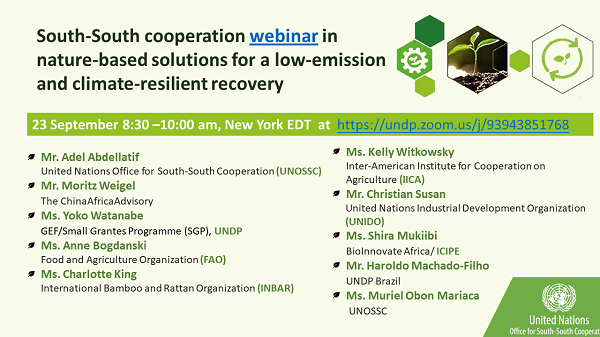
“Fostering South-South cooperation on nature-based solutions for a low-emission and climate-resilient recovery”
September 23 8:30 –10:00 am New York Time
Watch Webinar: https://youtu.be/C5W5h86fwvo
Read Summary
Biodiversity and terrestrial and marine ecosystems provide the foundation for human societies and a safety net of resources and ecosystem services for billions of people. Strengthened ecosystem management and nature-based solutions can help achieve food and water security and sustainable livelihoods and can also help governments to identify and access new financing opportunities, promote policy coherence on natural resources and help transitions to green economies. In the aftermath of crises, nature-based solutions can assist with sustainable recovery efforts protecting natural resources, biodiversity, and ecosystems.
Organized by the United Nations Office for South-South Cooperation (UNOSSC), this webinar brings together experts, scientists, and researchers from national, regional and international organizations to share their experiences in developing, using, and promoting nature-based solutions in countries of the Global South.
The development of innovative nature-based technologies around the world is leading to less fuel emissions, and to the production of nature-based materials and renewable chemicals that are replacing fossil-based products, with significant positive impacts related to climate change and to the Sustainable Development Goals (SDGs). Given that the Global South has abundant biomass and a great variety of approaches and technologies to use biomass, opportunities related to the bioeconomy have a large potential to produce low-emission energy solutions, enhance food security and generate jobs. South-South and Triangular Cooperation (SSTC) has become a dealmaker for development in the South and an enabler to achieve the global 2030 Agenda for Sustainable Development and the Sustainable Development Goals.
The discussions at this webinar will center around (1) how can South-South cooperation on nature-based solutions contribute to making economies more resilient to global pandemics like COVID-19, as well as (2) in which areas and how can South-South cooperation on nature-based solutions have the greatest impact on advancing climate change mitigation and adaptation in this context.
By highlighting the importance of knowledge-sharing on technologies, practices and experiences to foster the use of nature-based solutions in developing countries, UNOSSC fosters knowledge-sharing on practical and effective development solutions to be undertaken by Southern countries, in order to inspire, replicate and upscale SSTC on the bioeconomy.
1. Opening remarks (5 min)
Mr. Adel Abdellatif, Officer-in-Charge, United Nations Office for South-South Cooperation (UNOSSC)
2. Presentations (35 min)
moderated by Muriel Obon, Project and Event Management, UNOSSC- Presentation of the Publication on South-South and Triangular Cooperation and the on the Bioeconomy cases on nature-based solutions– by Mr. Moritz Weigel, Managing Director, The ChinaAfricaAdvisory and former Senior Research & Program Advisor, UNOSSC.
- SSTC best practices on nature-based solutions – by Ms. Yoko Watanabe, Global Manager, UNDP GEF Small Grants Programme.
- ISBWG mechanism and case study on South-South cooperation on a sustainable bioeconomy – by Ms. Anne Bogdanski, Natural Resources Officer, Food and Agriculture Organization (FAO).
- Case study on the industrial use of bamboo – by Ms. Charlotte King, International Communications Specialist, International Bamboo and Rattan Organization (INBAR).
- South-South cooperation experience on System of Rice Intensification – by Ms. Kelly Witkowsky, Manager, Climate Change and Natural Resources Program, Inter-American Institute for Cooperation on Agriculture (IICA).
- Case studies on ecosystem services and nature-based solutions – by Mr. Christian Susan, Industrial Development Officer, United Nations Industrial Development Organization (UNIDO).
- Case study on turning fruit waste into gel fuel for rural household – by Ms. Shira Mukiibi, Business Development Manager, BioInnovate Africa/ICIPE.
3. Q&A and discussion (15 min)
4. Conclusions (5 min)
Mr. Haroldo Machado-Filho, Senior Advisor on SDG and Coherence, UNDP Brazil and former Senior Programme Manager on Climate and Sustainability, UNOSSC (5 min)